
Big Battle II
For the second DBM run-out on my 8’ x 5’ mat with big 25/28mm armies, the same four players commanded invading Suevi and Late Imperial Romans, 408 AD. At this date no allies were available so each army had three commands; one of the Suevi commands was Alamannic.
The terrain dice favoured the Romans, with large areas of rough going giving them a good defensive position for their numerous Superior Auxilia with psiloi support. The plan was defend on the right and centre while a force of lancers (Fast Knights) and light horse outflanked the enemy on the left. However, facing the lancers was the Alamanni command which featured 20 Inferior Bow elements as well as warband. The Romans’ smallest command was in the centre, in open ground, facing massed warband: supported Ax(S) with legionaries cowering behind. The Roman right included more supported Ax(S) and legionaries, plus a few cataphracts, cavalry and light horse. Each flank had two Fast Artillery; they and the Alamanni bowmen would be hampered by a strong wind blowing up the table.
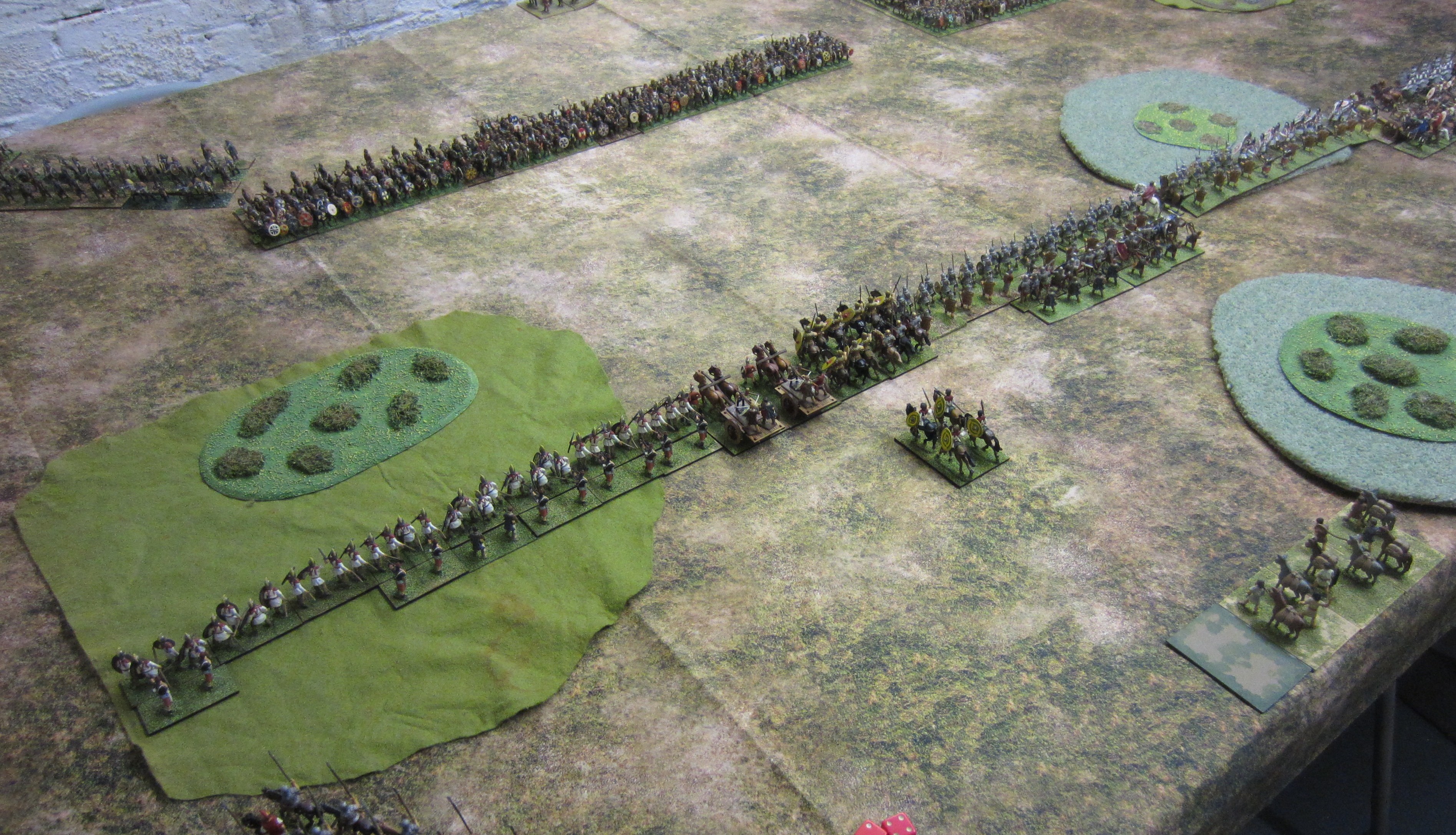
The armies at deployment
The Germans rushed forward, warband charging into rough going on each flank. The Roman C-in-C and lancers went for the Alamanni bowmen; two Kn(F) were immediately shot down and a third died in combat, but the C-in-C personally slew some bowmen. Artillery managed to kill two warband elements despite the wind. The Ax(S) v Wb(S) struggles were tough; the auxilia especially were hard to kill but they did manage to take down some warband.
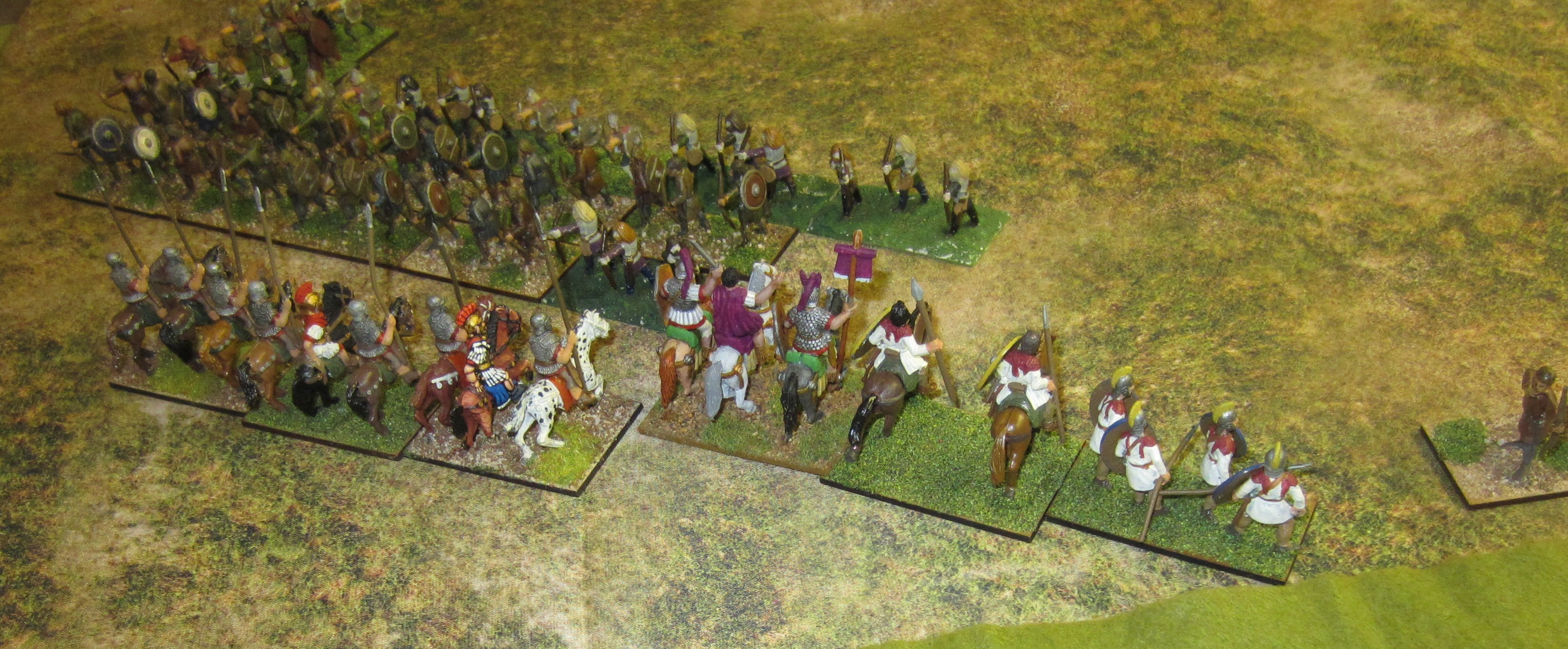
The Magister Militum against Alamannic archers
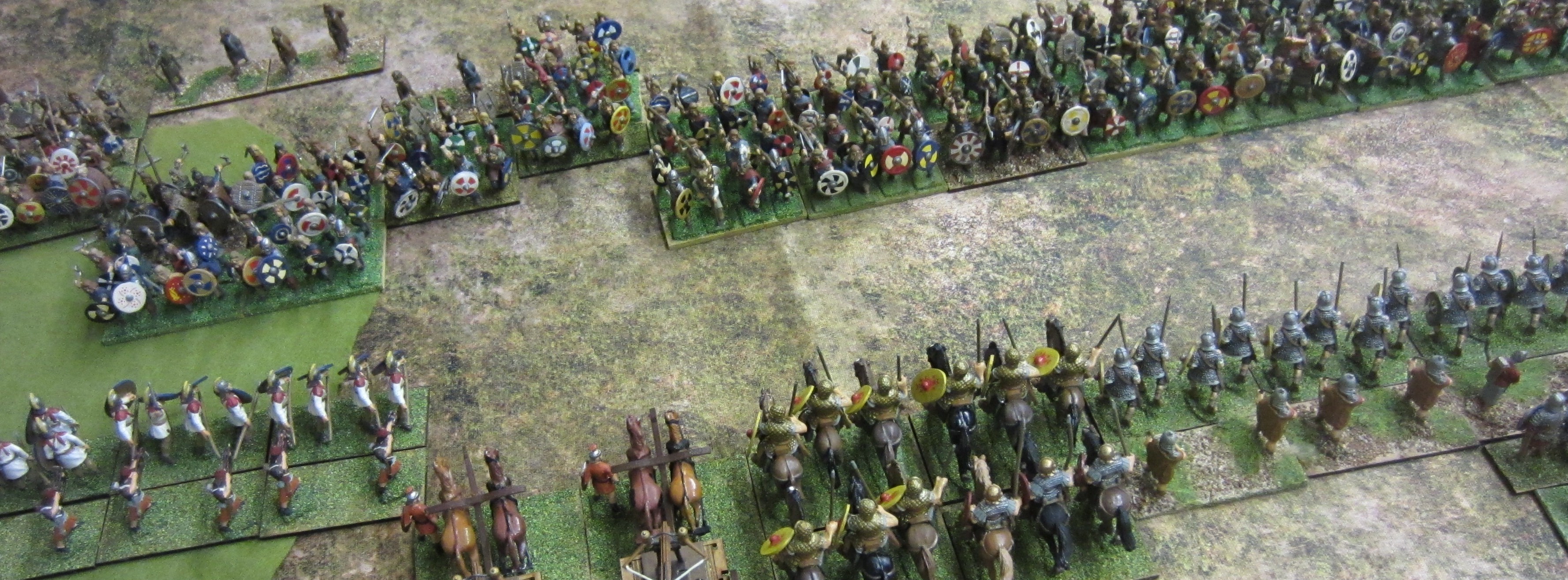
Impending carnage as the warband prepare to charge
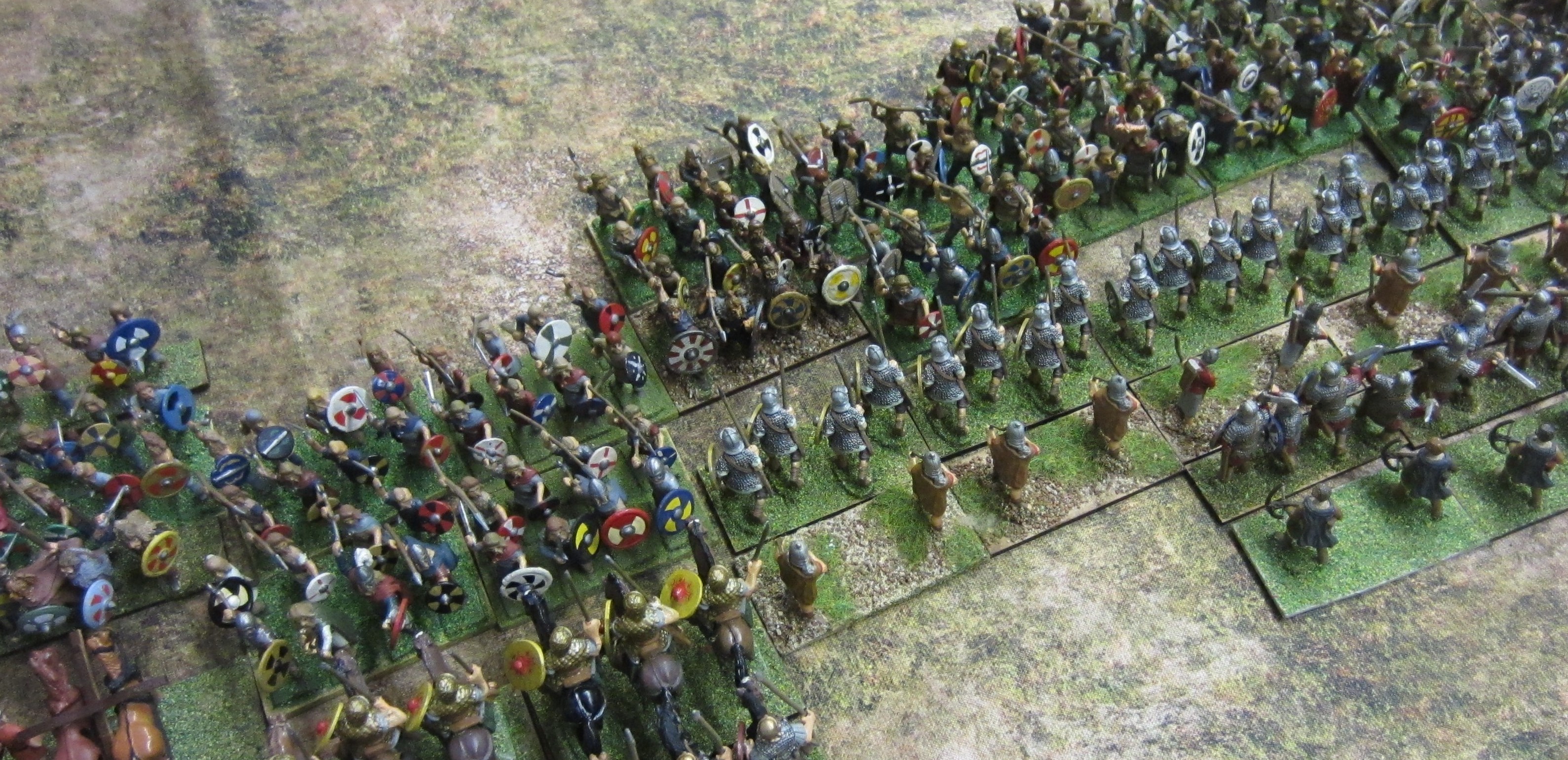
The Auxilia are holding up well
The Roman C-in-C continued against the Bw(I), slaying four more elements while the surviving lancers got some more. The general managed to survive several shots by massed bowmen. Eventually the Alamanni command reached its 15.5 break point and broke; with casualties elsewhere that made half the Suevi army. 10-0 to the Romans, and an excellent hard-fought game.
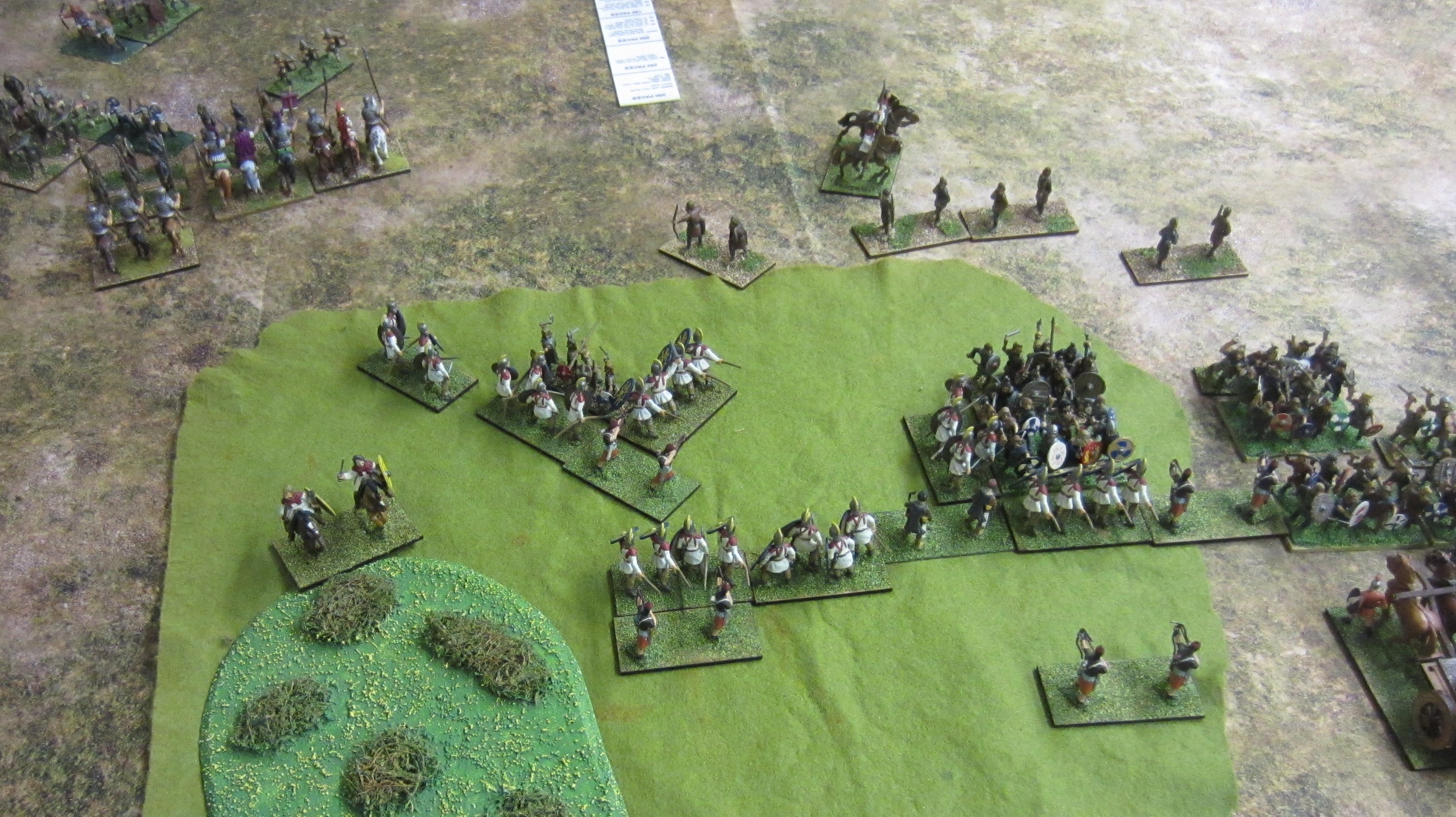
The left flank at the end – the Suevi are about to collapse
Big Battle
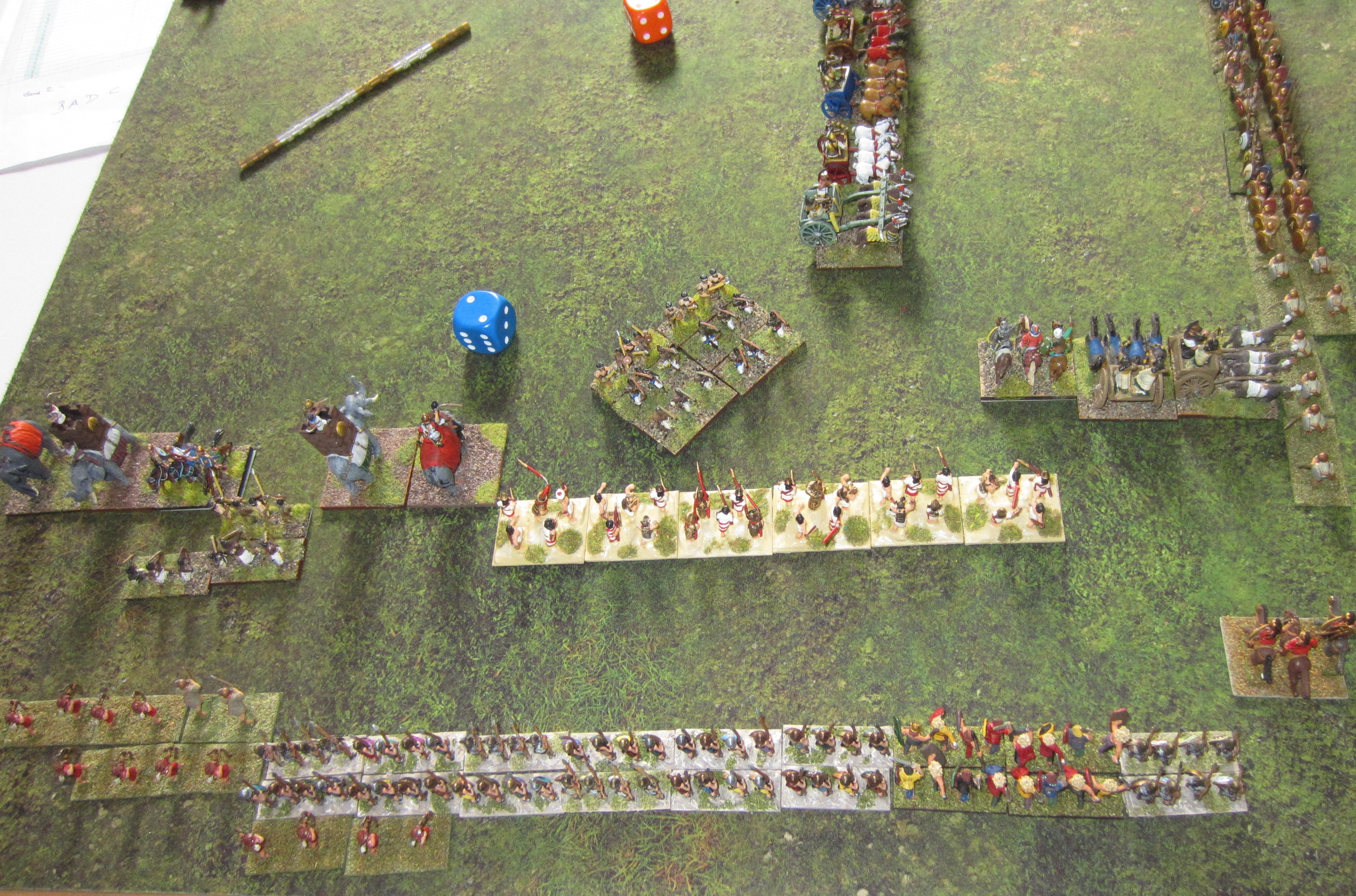
This game christened my new giant battle mat for an 8’ x 5’ table. Bought from Simon Miller’s BigRedBat store and looked great. The armies were Early Neo-Assyrian against New Kingdom Egyptian, DBM 500 points, 28mm figures, two players a side.
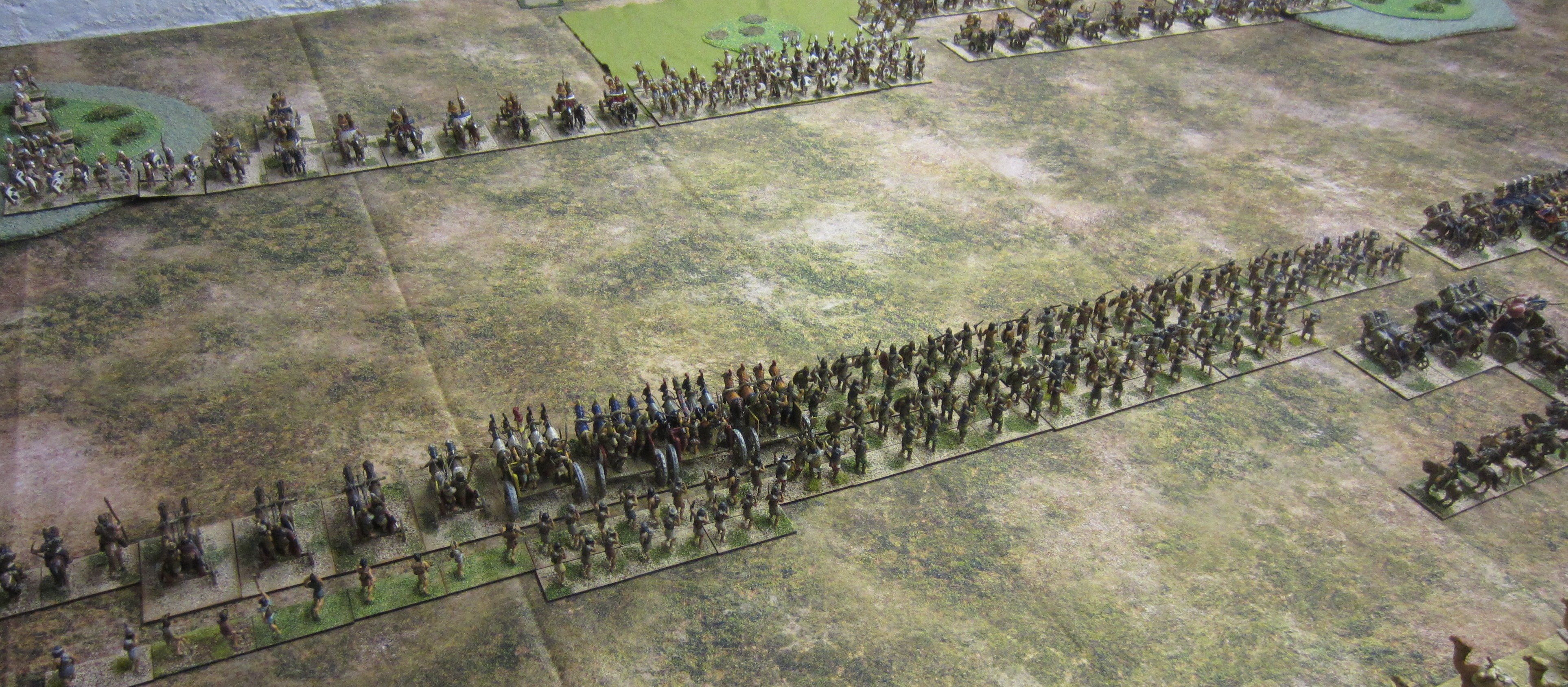
The armies line up – Egyptians at top
The Egyptians had four Regular commands, the Assyrians only three but with bigger break points – the armies were about the same size. The Assyrian advantage was that some of their chariots were heavy (Ordinary Knights); the Egyptians had a large force of Libyan warriors (Fast Warband). The Egyptians invaded despite their lower aggression, giving them an advantage in deployment.
The Egyptians refused their left flank and set up with the warband in the centre where they faced numerous light spearmen (Auxilia with psiloi support). The Assyrians attacked on both flanks with their heavy chariots (supported by the lighter chariots, Superior Cavalry like the Egyptian ones), and quickly destroyed many Egyptian chariots on the left.
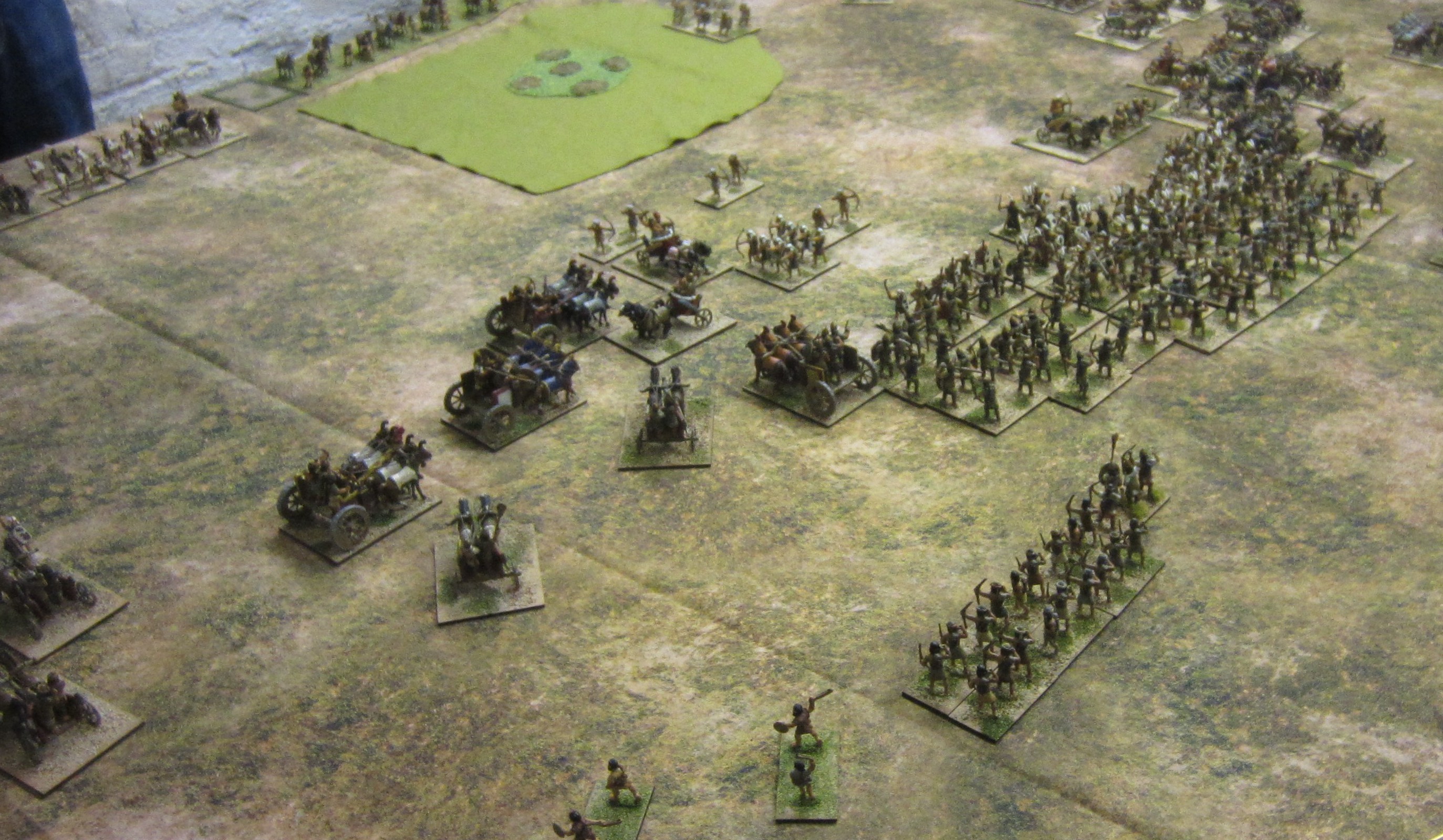
The victorious Assyrian chariots close in on the Egyptian centre
The warband crashed into the auxilia for a long indecisive slog – losses on both sides. The Assyrian archers to the right of the auxilia shot ineffectively and were destroyed by Sherden mercenaries (ordinary Blades) and chariots; the central Assyrian command eventually broke when its general fell. However, the Assyrians carried all before them on the left and the Egyptian command there broke. The heavy chariots outflanked the Egyptian centre and killed enough there to break a second Egyptian command and win the battle.
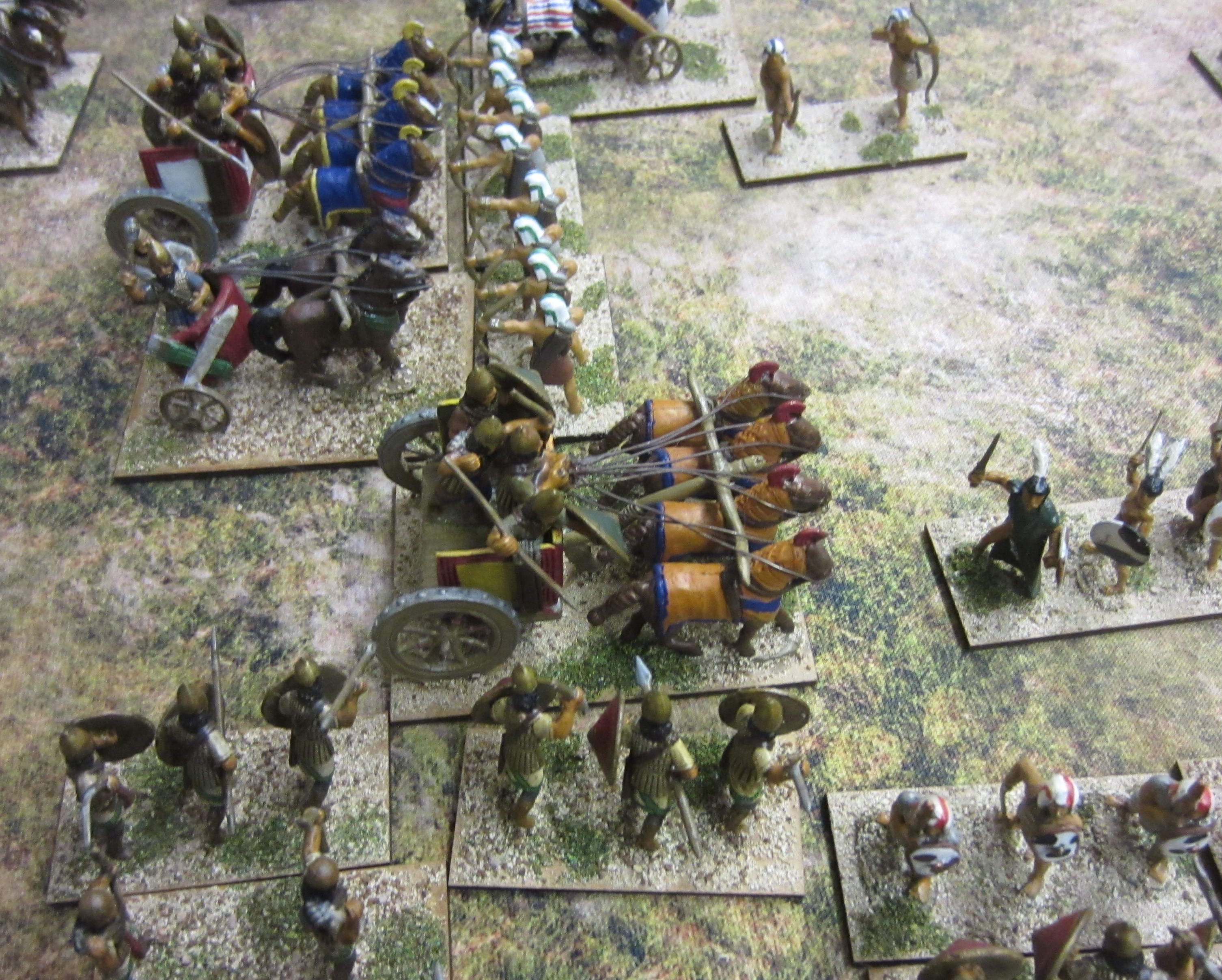
The nearest Assyrian chariot has just destroyed a Blade element for the coup de grace
A great hard-fought game, enjoyed by all.
Vexillum 2025
For the final doubles competition of the year Russ and I fielded Hundred Years War English: Richard II in Ireland, 1394. Three commands under the King, Norfolk and Salisbury, each with Bw(S) longbowmen, Kn(I) men-at-arms who could (and usually did) deploy dismounted as Bd(S) and a few psiloi. Plus an Anglo-Irish ally, the Earl of Kildare, with cavalry, auxilia, psiloi and a few longbowmen.
The Portuguese, who included an English ally, deployed evenly along the front, but we refused our right with a smallish command angled back. On the far left the Irish attacked into an area of bog, where they overwhelmed some Portuguese javelinmen and broke one command. The Portuguese sent light horse through the gap in our centre but these were driven off with loss by two Kn(O) generals and some longbowmen. Then our numerous longbowmen shot effectively and, aided by Bd(S), broke a second command for a 10-0 win. Right on time.
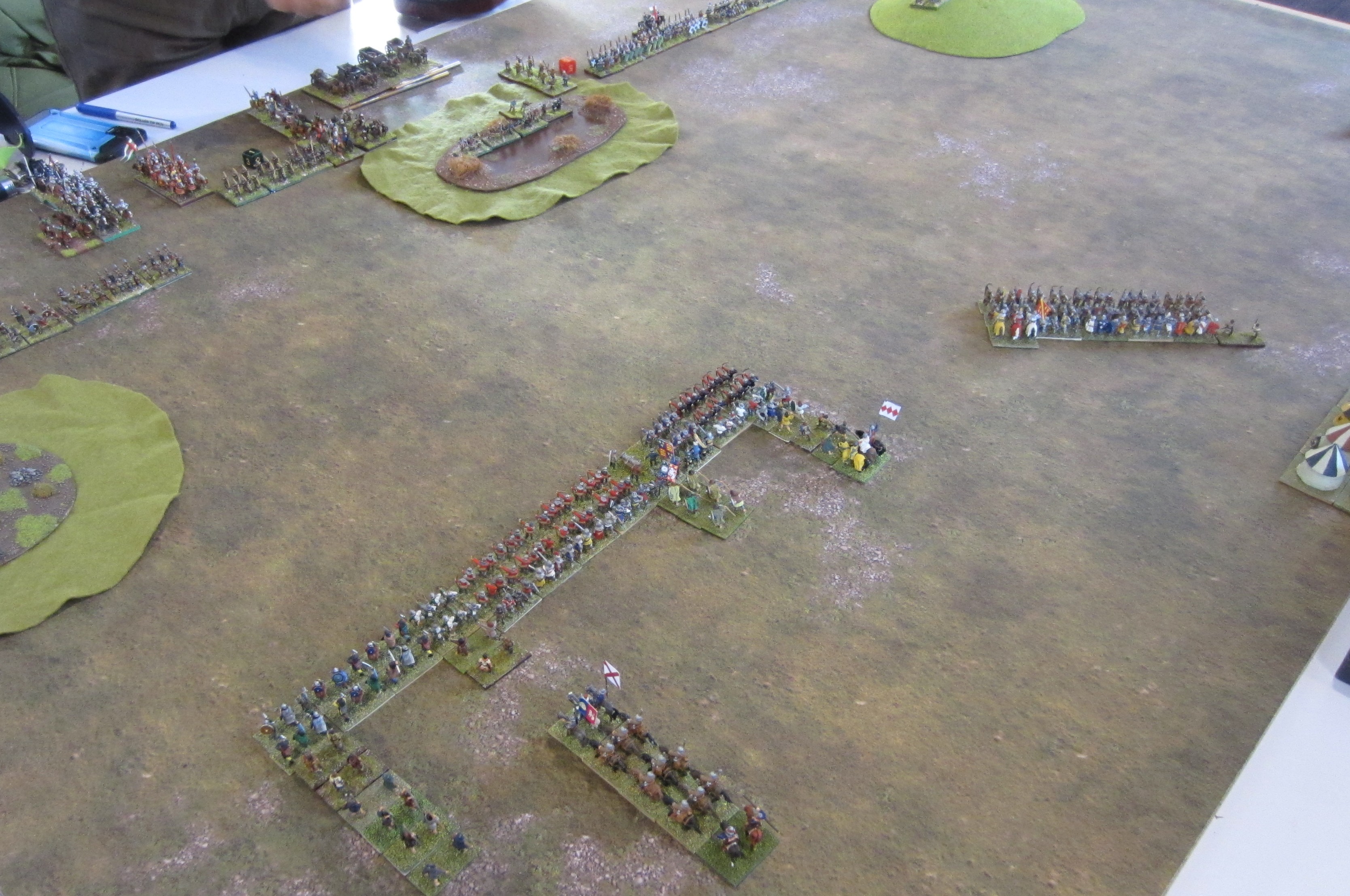
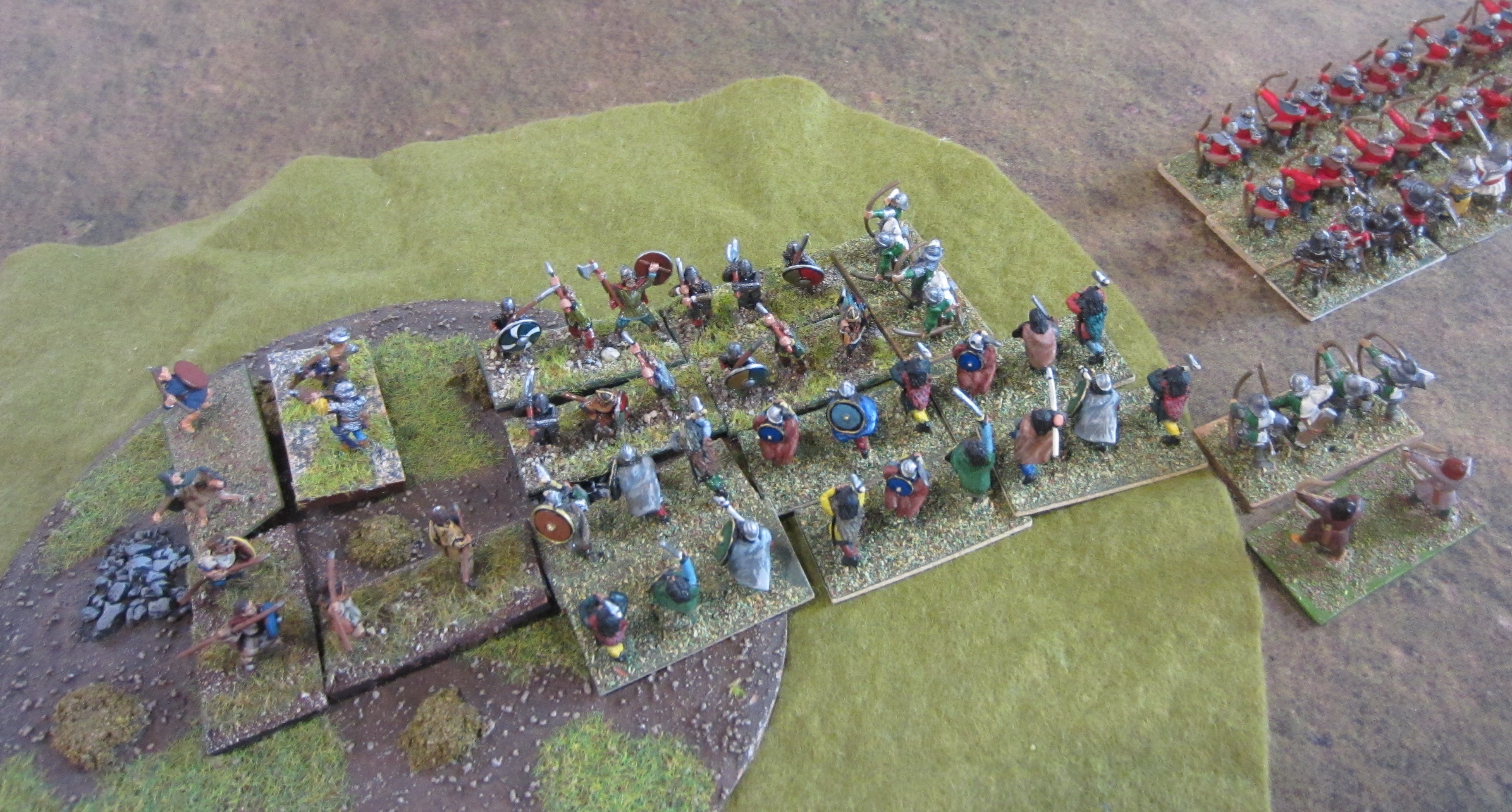
The Irish overwhelm Portuguese javelinmen
Then Jeremy Morgan and John Calvert led a later HYW English army with Burgundian allies. This time we refused the left, held by the Irish in some handy rough going; the enemy did the same, relying on Burgundian Bd(S) on a gentle hill. On the right our Kn(I) deployed mounted and charged up the hill, assisted by longbowmen shooting into the Burgundians’ flank and deterring any possible reinforcements. On the left, the Irish were attacked by two enemy commands – they fought valiantly but were overwhelmed. Our knights rode down four Burgundian Bd(S), needing five to break that command, but couldn’t manage the last one. The game timed out at 4-6.
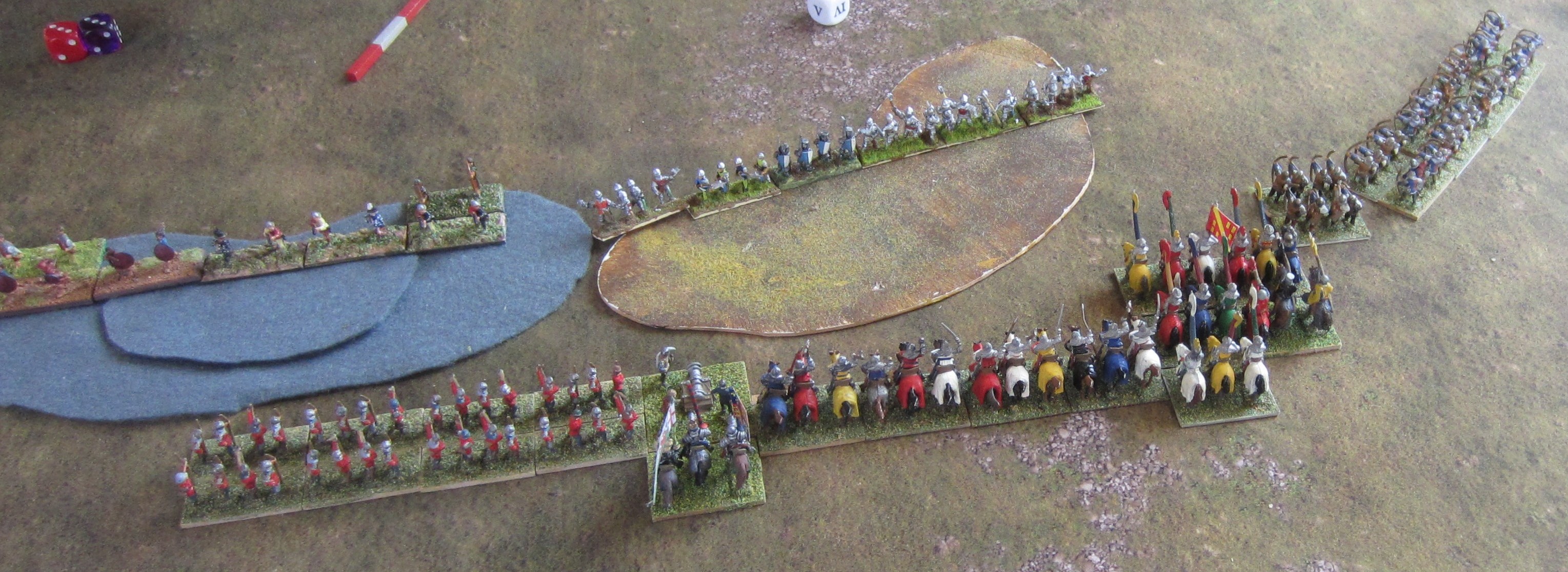
Storming the Burgundian-held hill
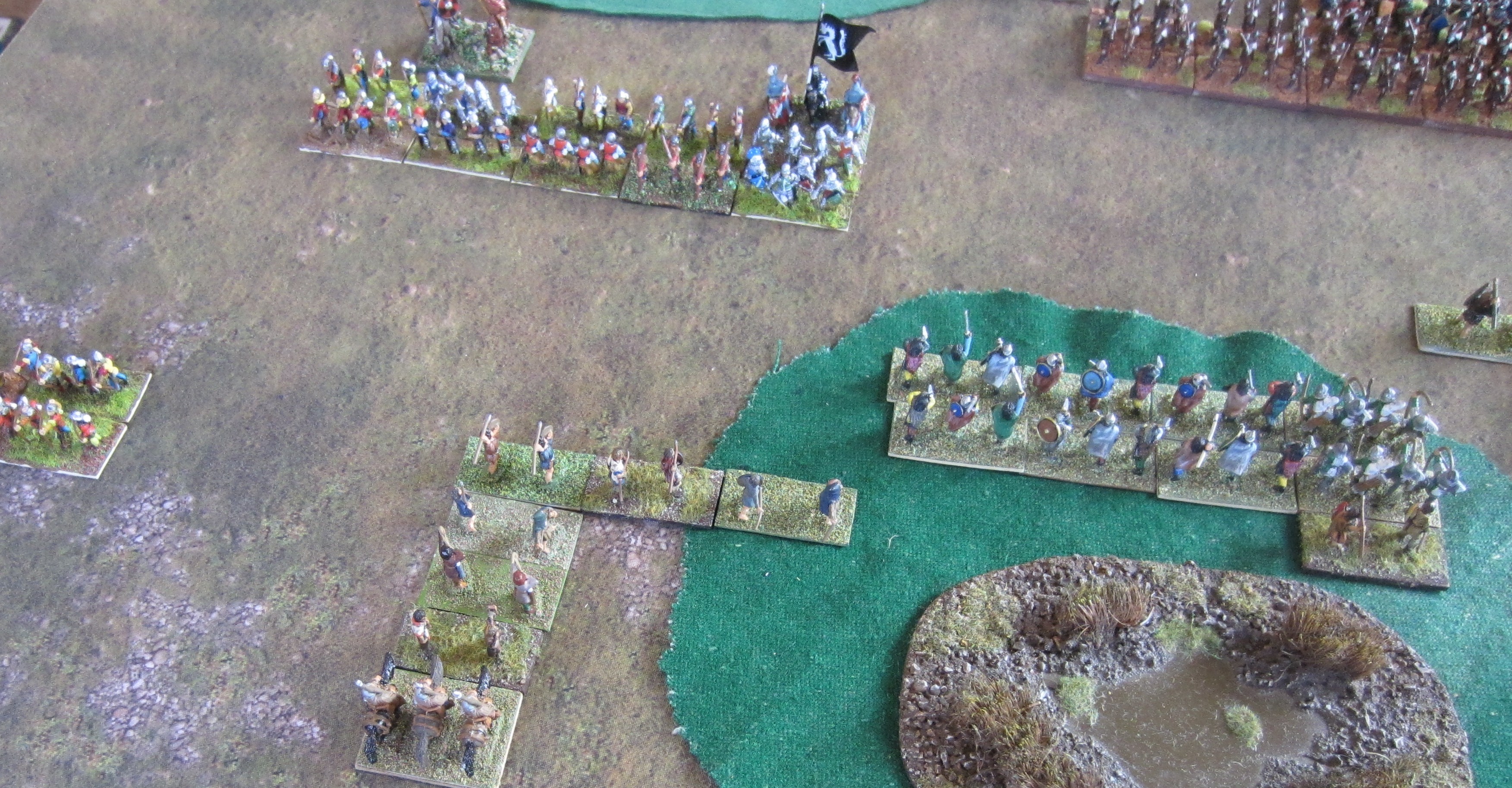
The Irish are under threat
Next we faced the redoubtable Dave Madigan and Chris Smith with Siamese. Numerous Superior Elephants escorted by Fast Blades swordsmen, and a Burmese ally with more elephants. Unfortunately there was a risk of rain, Kildare was (and stubbornly remained) unreliable, and a Siamese flank march on our left was declared on the first turn. Ouch! So we attacked with two commands on the left while wheeling Richard’s command, which was facing nothing, to get at the enemy centre. Richard had an artillery element (Art(I)) which caused the Siamese to spend numerous PIPs on getting elephants away from it. The flank marchers made slow progress, delayed by our psiloi, and our main attack went in. Our longbowmen shot several elephants but took heavy losses, and eventually first one and then the other command broke. Less than half the army, though, and we were able to keep our remaining forces out of danger. Kildare’s men looked vulnerable, but on the last turn he decided to join in and the six PIPs were enough to move his men too to safety. The game ended at 3-7.
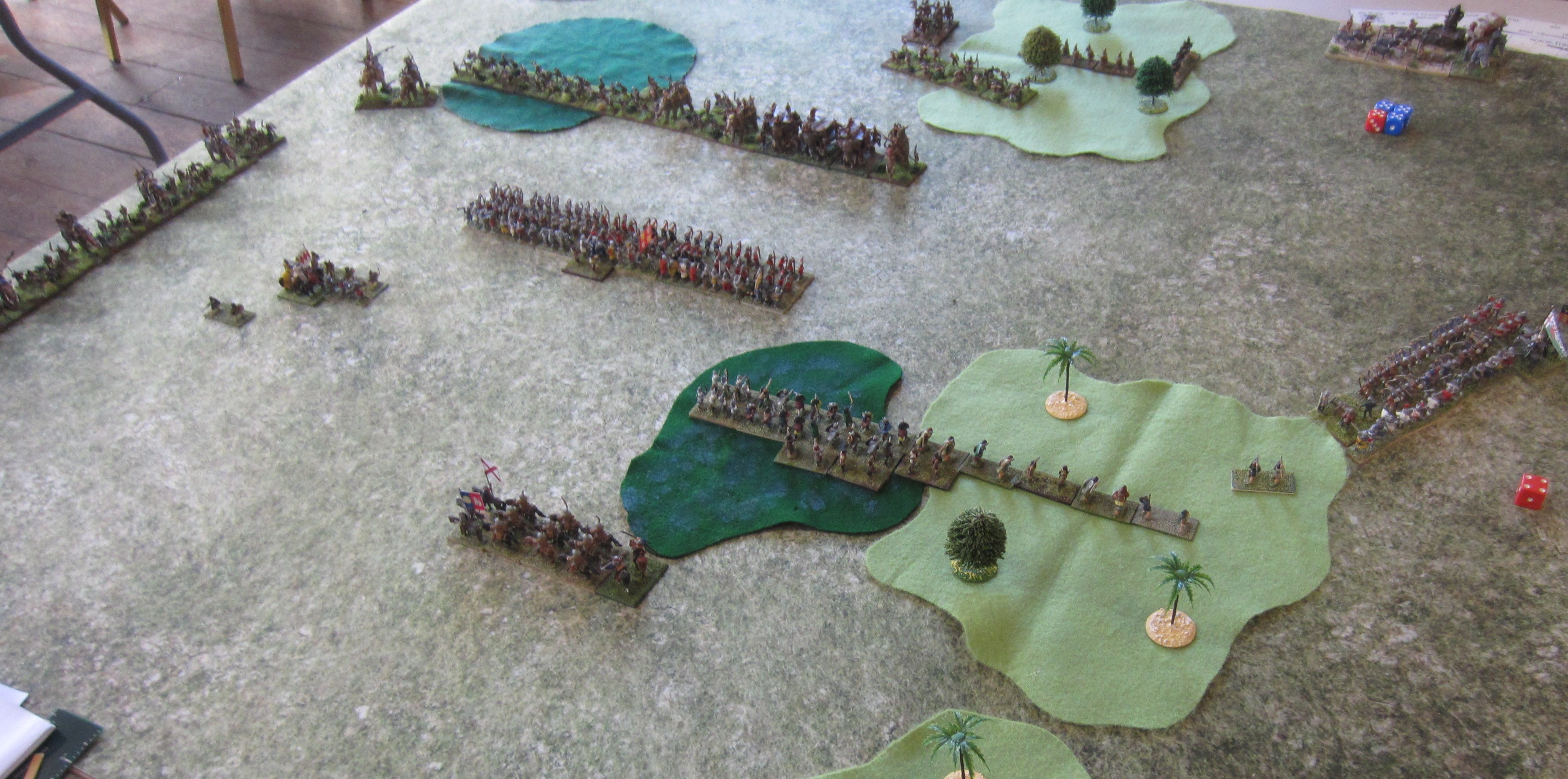
The Siamese flank march has appeared dismayingly early
The last game was the hardest-fought of the weekend. John Vaughan and Kevin Everard led Charles the Bold’s Burgundian Ordonnance with English allies. We refused the right and attacked vigorously on the left; the Irish on the far left fought doughtily against English longbowmen and even knights, but took losses. In the centre two commands attacked; our bowmen shot down several Pk(I) elements and some crossbowmen, then our men-at-arms attacked the pikemen. Disastrously – a string of 6-1 and 5-1 results destroyed a row of Bd(S) and broke our C-in-C’s command. On the right, our Bw(S) were outshot by Burgundian Bw(X) and the resultant gaps were exploited to break a second command there. 0-10 defeat, but a close and exciting game. John and Kevin overtook the top table players to win the competition.
Holigost 2025
For the 25mm singles competition on the Solent I took a newly-painted Assyrian army – that of Ashurnasirpal II, classed as Early Neo-Assyrian. The C-in-C’s element was Ordinary Bows; he led a command with light chariots (Superior Cavalry), a large force of guardsmen (Fast Blades) with supporting archers (Psiloi) and some massed archers (Inferior Bows). One sub-general had the heavy chariots (Ordinary Knights) plus light spearmen (Ordinary Auxilia) with supporting psiloi, and the other had light chariots, auxilia, psiloi, archers and Inferior Light Horse. One annoying aspect of this list is that the supporting psiloi must be deployed in contact with their Blades or Auxilia – something which is not required for identical troops in other lists such as Babylonians or Mitanni.
Last year Gavin Pearson won this competition and I was second. This year we faced each other in the first game. Gavin had his Trojan War Mycenean army, which I’d faced several times before with mixed results. Four commands, two of them with Cv(O) chariots and Sp(I) spearmen, one under Nestor with Kn(F) chariots and Pk(X) pikemen, and one under Achilles with Cv(O) and the formidable Myrmidons (Superior Warband). This was a rip-roaring game in which both sides attacked all out. My troops inflicted heavy losses on the more numerous enemy, notably slaying some of the Myrmidons and Nestor’s pikemen, but also took losses which were more significant as my commands were smaller. Eventually the heavy chariot command in the centre, which had been fighting both Achilles and Nestor, lost one chariot too many and broke. This left a large hole in my centre which Gavin was able to exploit, and soon my army broke on accumulated losses for a 0-10 defeat. All the Mycenean commands were badly damaged but none had broken.
Next I played Duncan Thompson who had Early Imperial Romans – the standard fare of legionaries, cavalry, light horse, Superior Auxilia and a pair of Fast Knight lancers. The main action was on the right flank, where my heavy chariots demolished a cavalry and light horse command. Meanwhile a fierce melee in the centre saw light chariots gradually defeating legionaries while Inferior Bows successfully defended a steep hill against more legionaries. The struggle here was decided when the Roman sub-general, on foot as a Blade, was ridden down. Then the enemy C-in-C, also on foot but as Superior Auxilia, was also ridden down. I lost a general on the left flank – so four of the six generals on the table were killed. The Roman army broke for a 10-0 win.
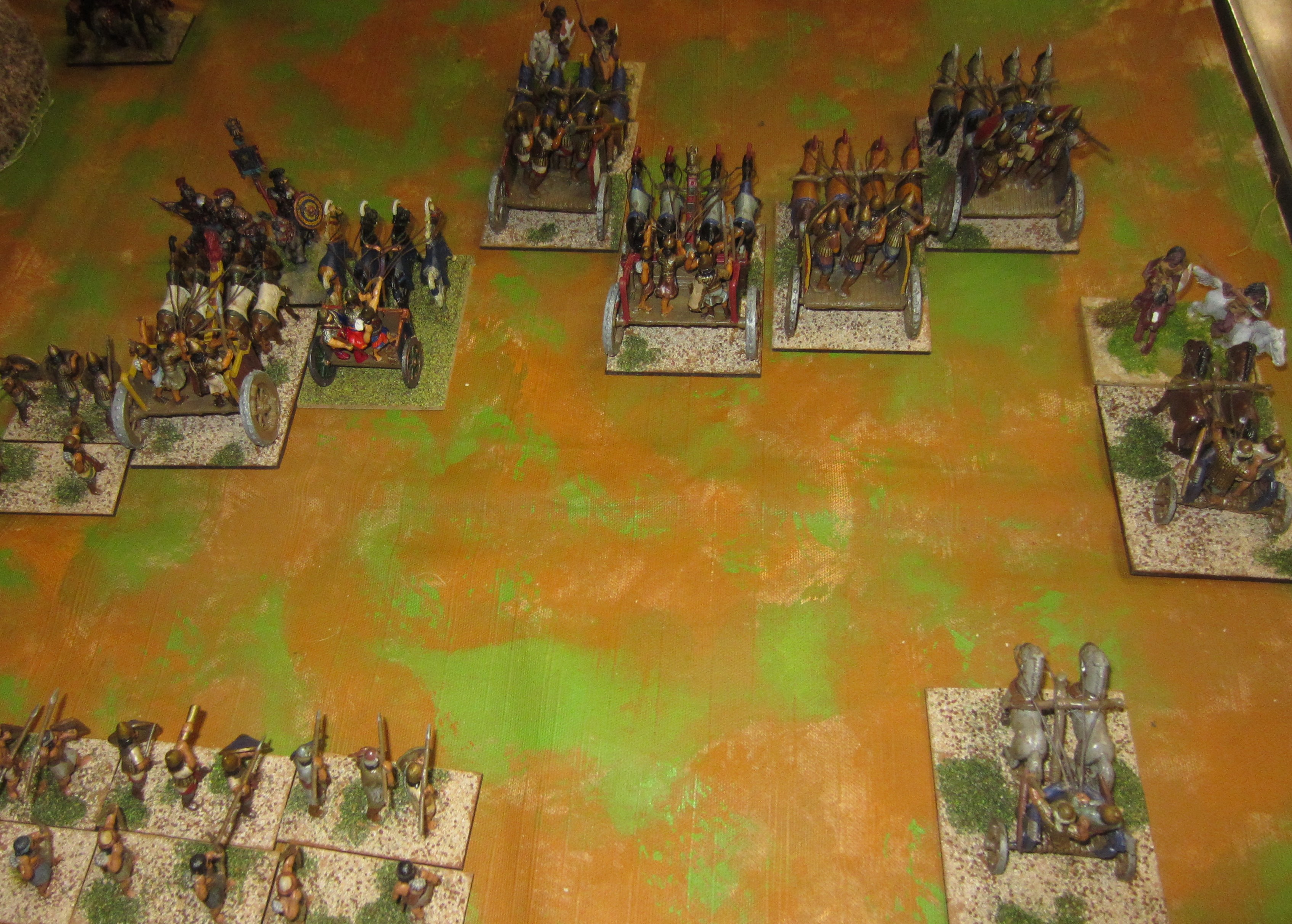
Chariots finishing off the Roman cavalry wing
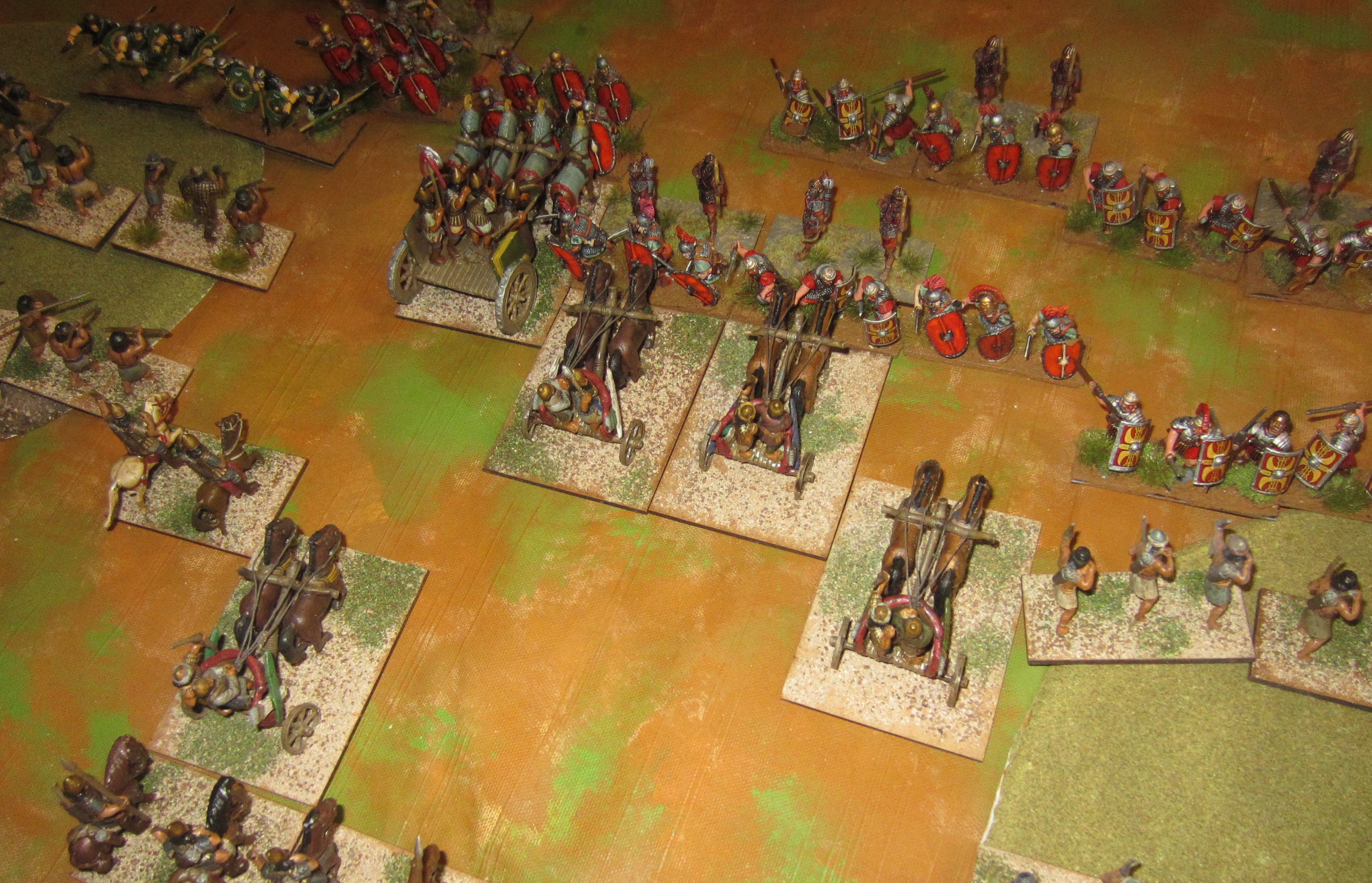
The central struggle between light chariots and legionaries
The third game was against Venetian Condotta led by John Calvert. A stand-off on the right as neither side ventured to advance beyond its protective terrain, but I attacked strongly on the left with my guards (Blades) against Venetian militia (double based Bw(X/O)). All six Venetian elements were destroyed and my archers shot a psiloi which made enough to break that command. Its subsequent loss of its general and low PIP dice meant that the command effectively vanished, leaving nothing between my victorious troops and the baggage. John conceded the game: 10-0 to me.
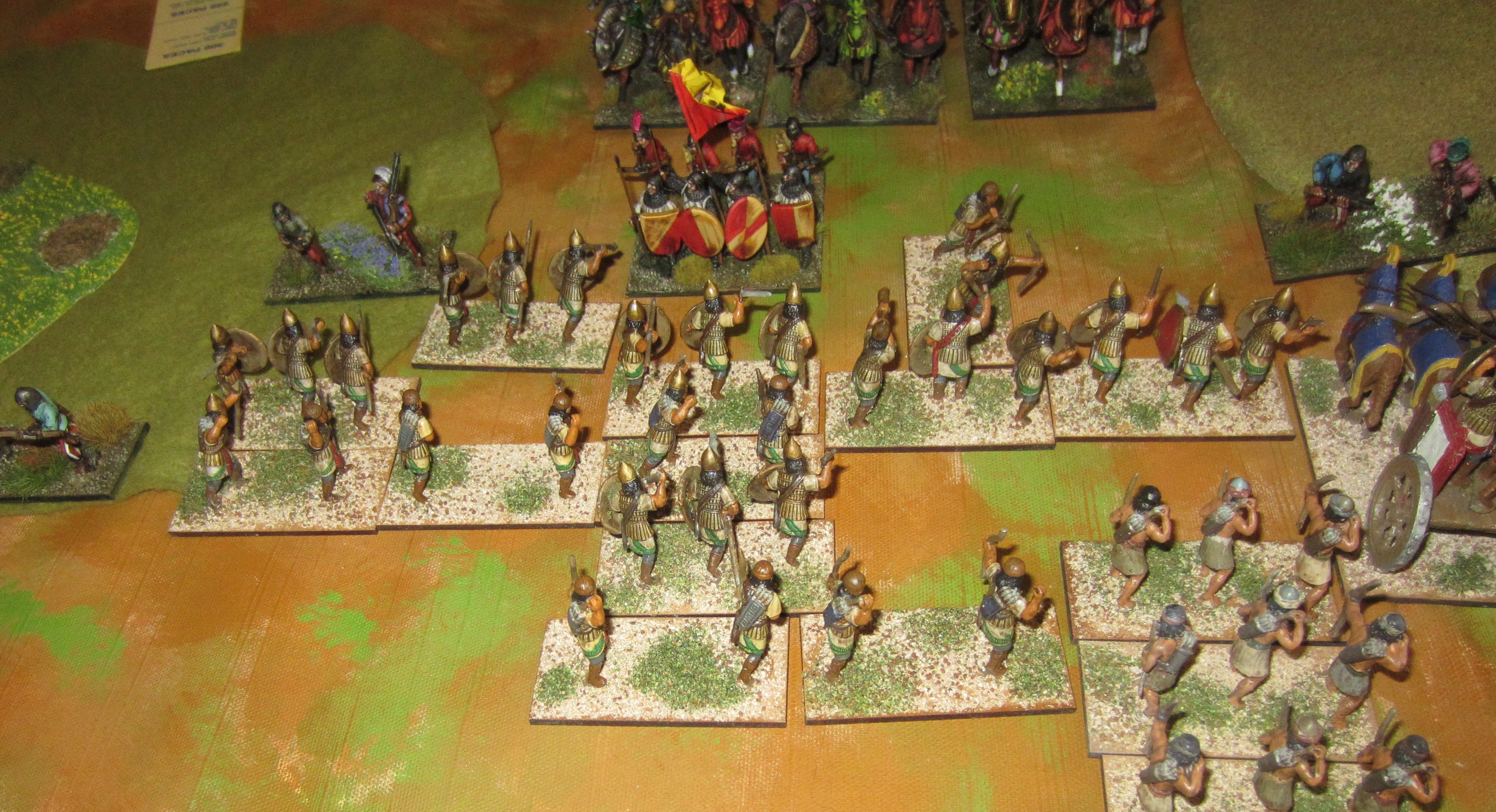
The surviving Venetian militia are in peril
My final opponent was Andy Leeser with Malays – lots of Superior Warband and elephant, a block of Bw(I) and a Tamil ally with more elephants and Fast Blades. Intimidating troop types. I feared a flank march but all the enemy were on the table and both sides rushed forward; my PIPs were excellent, enabling me to reorganise and optimise the matchups. On the right my archers destroyed an elephant with their first shot but were then outshot by enemy archers; I looked to be in trouble on that flank. My heavy chariots defeated the central Malay command, slaying many warband, but then broke itself – demoralised warband destroyed a chariot element, taking two other elements behind it. Then an elephant-mounted general on the left was attacked by Blades while a Bows element turned his flank; the general died and the command failed its panic roll (needed 4 or more, scored 1). 9-1 win.
For the second year running Gavin won the competition and I was second. A great weekend’s gaming.
Iceni 2025
We’d used Middle Assyrians, Early Neo-Assyrians and Later Sargonid Assyrians in doubles competitions, but not Neo-Assyrian Empire. So Russ King and I took Sennacherib’s lads to the Iceni competition in Norfolk. Sennacherib himself constituted a single-element command; the three main commands each had some heavy chariots (Superior Knights), auxilia and psiloi, while two of them had cavalry and light horse as well and one had the four elements of guardsmen (Superior Spears). The main strength of the army was its sixteen elements of Kn(S) chariots. We invaded in all four games, having the maximum Aggression 4, and generally placed a road and steep hills to make the most of our very numerous psiloi and auxilia. Our army was relatively narrow so we usually had a refused flank anchored on difficult terrain.
Our first game was against Paul Apreda and Jimmy Walton with Akkadians – mainly spearmen classed as Pk(I) or Pk(X), plus auxilia, bowmen and psiloi with Hordes to stand at the back. The only mounted troops were a few straddle-cars (Inferior Cavalry) and battle-carts (Inferior Knights). All the spearmen counted as inferior against our chariots, but were still dangerous opponents. The enemy were reluctant to advance but we went forward and were able to push our guardsmen through the centre. An initial charge of chariots against spearmen failed but without serious loss, then came the crucial moment. The guards were attacked by a Kn(I) battle-car and pushed it back with the enemy C-in-C behind it, then destroyed it taking out the general too. At the same time Sennacherib, following up, attacked some spearmen and, with help from light horse, destroyed them. Four elements gone from the Akkadian C-in-Cs very large central command, and it failed its morale test and broke. Then our chariots on the left flank were attacked by another big command of spearmen. With a series of brilliant die-rolls from Russ ten elements were destroyed in five combats. Meanwhile our auxilia had attacked up a steep hill and cleared away enemy psiloi. The Akkadian casualties reached half their army to give us a 10-0 win.
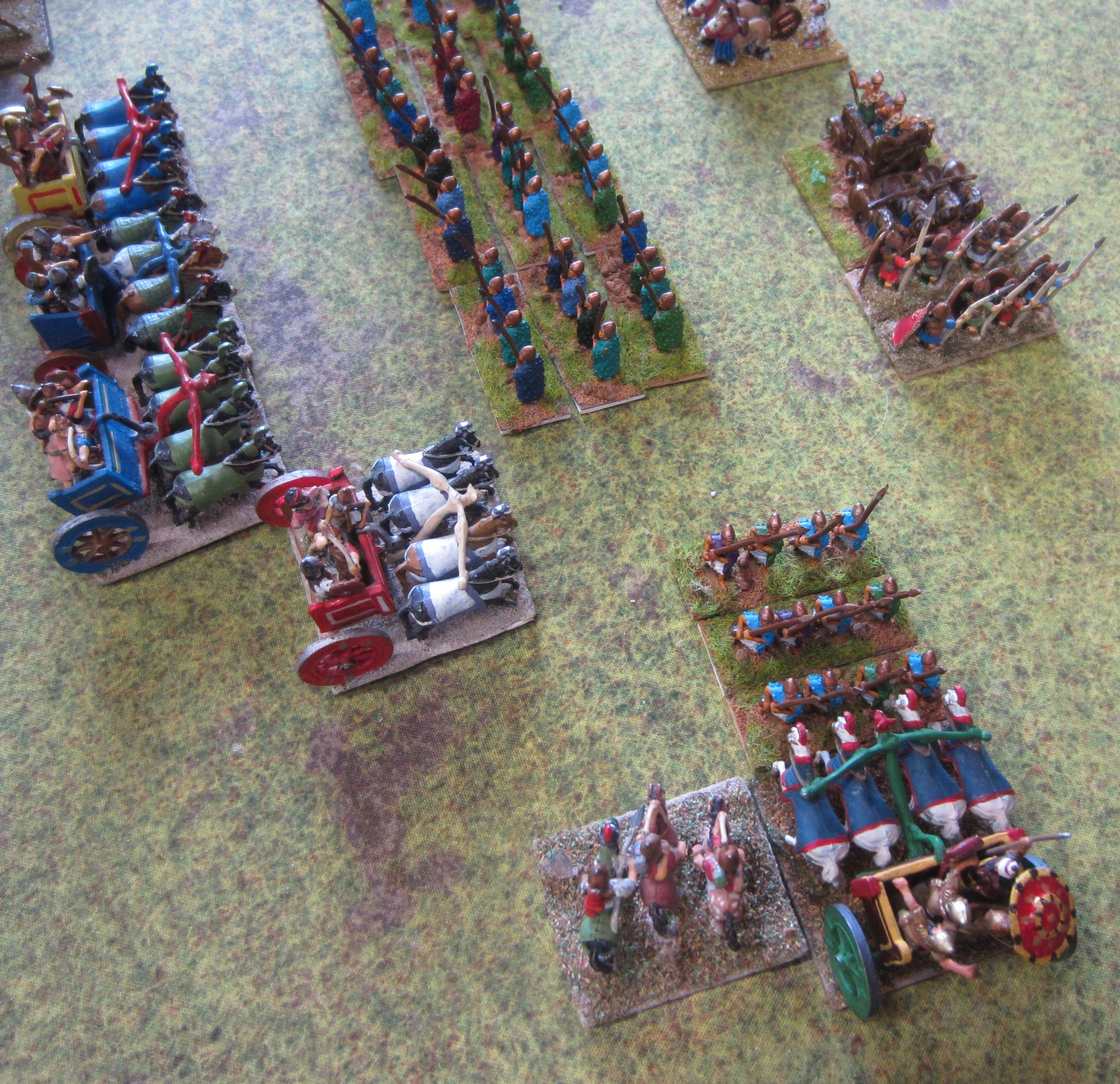
The vital moment… Sennacherib is at bottom right, the Guards at right centre
Next we faced Jeremy Morgan and John Calvert who had Ottomans. We anticipated that their powerful Serbian allied command would attack supported by the dangerous Bw(S) Janissaries, but instead they hung back, not wanting to fight on our preferred line where they could be outflanked by auxilia on a steep hill. They merely bombarded with their artillery, killing a few auxilia. With neither side committing to attack, Jeremy offered a draw and we accepted. 5-5.
Sunday morning brought more Assyrians – Later Sargonids commanded by Dave Madigan and Chris Smith. We refused our right flank and advanced with two commands’ mounted troops on the left where they were faced with Superior Cavalry and light horse. Unfortunately our PIPs were poor and the enemy’s were excellent, allowing them to concentrate against our weaker cavalry and light horse while avoiding the chariots. Our mounted troops died in heaps and one command broke while the other was in trouble. Little chance of our hanging on for an hour and a half so we conceded for a 0-10 defeat.
Finally a very exciting game against Pete Connew and Richard Newland with Carthaginians – Hannibal’s Zama army with eight untrained elephants counting as Expendables. As usual we invaded and placed steep hills which allowed us to refuse the right flank and face the expendables on the left with two commands. The expendables caused havoc, slaying five psiloi elements and one of chariots, but eventually they were all destroyed. This allowed our chariots and cavalry to attack the enemy cavalry with great success, slaying a Carthaginian general whose command broke. As this command contained 25 elements of Gallic warband it was close to half the army. Meanwhile the Carthaginian spearmen, including veteran Sp(S), had marched from the far right (where they had nothing to attack) to the centre. We needed only two more elements to break the enemy army and launched a series of attacks on the spearmen but failed to get lucky; our right-flank general destroyed one auxilia element but that was all. The game timed out at 6-4.
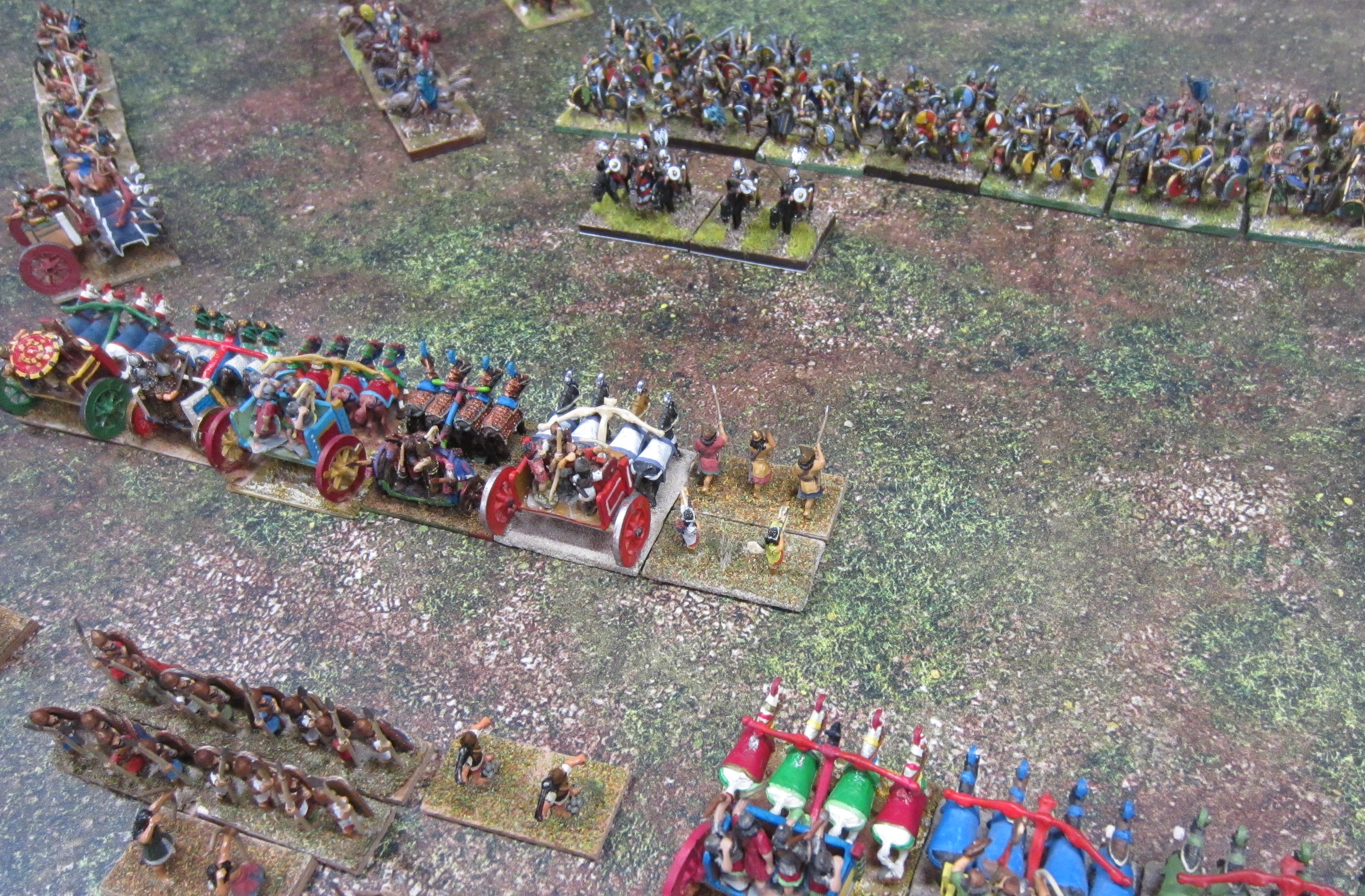
Our cavalry and chariots about to charge the enemy cavalry
An excellent Norfolk weekend as usual.
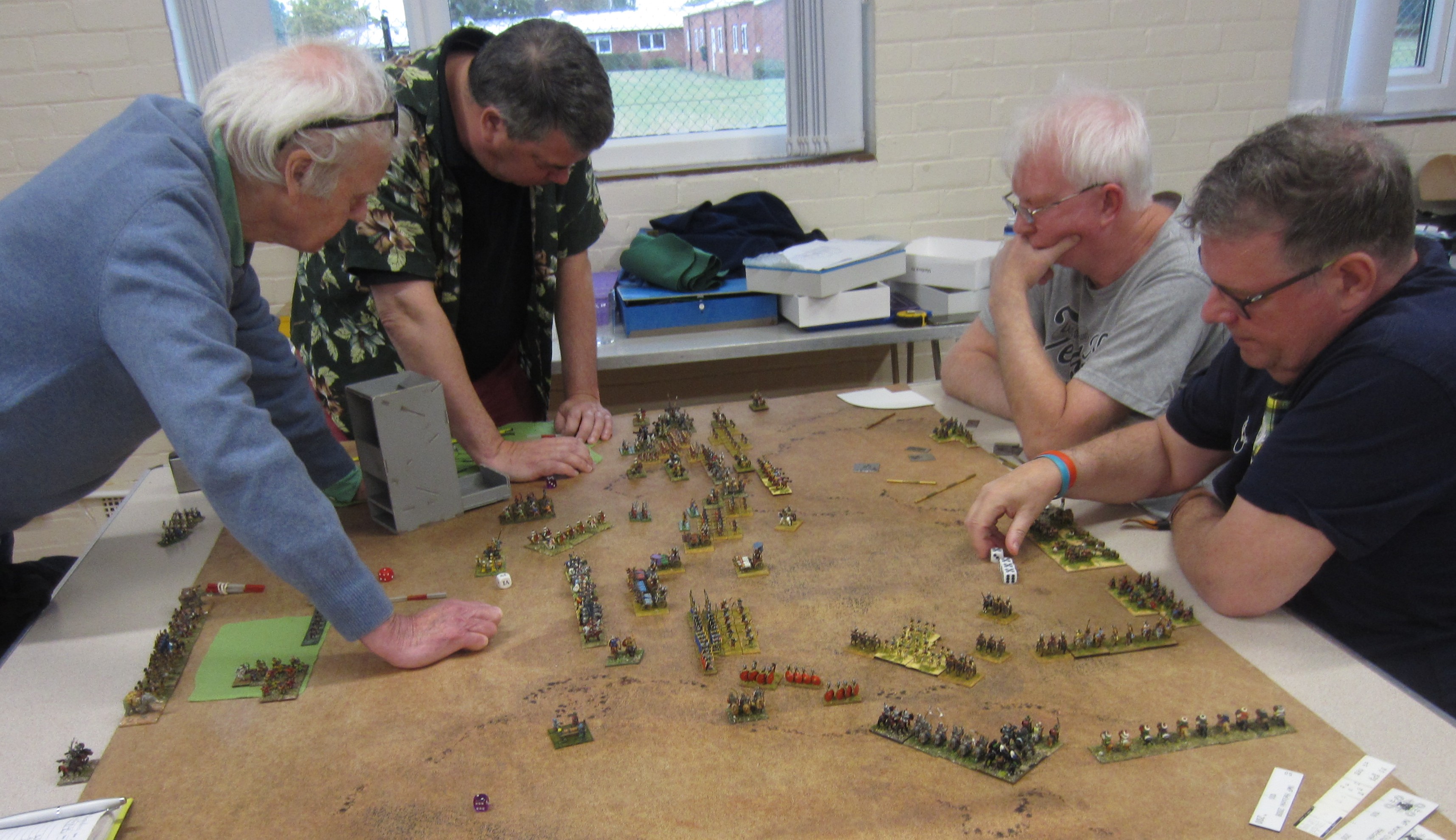
Heavy concentration in the title-decider as Jeremy Morgan and John Calvert face Dave Madigan and Chris Smith
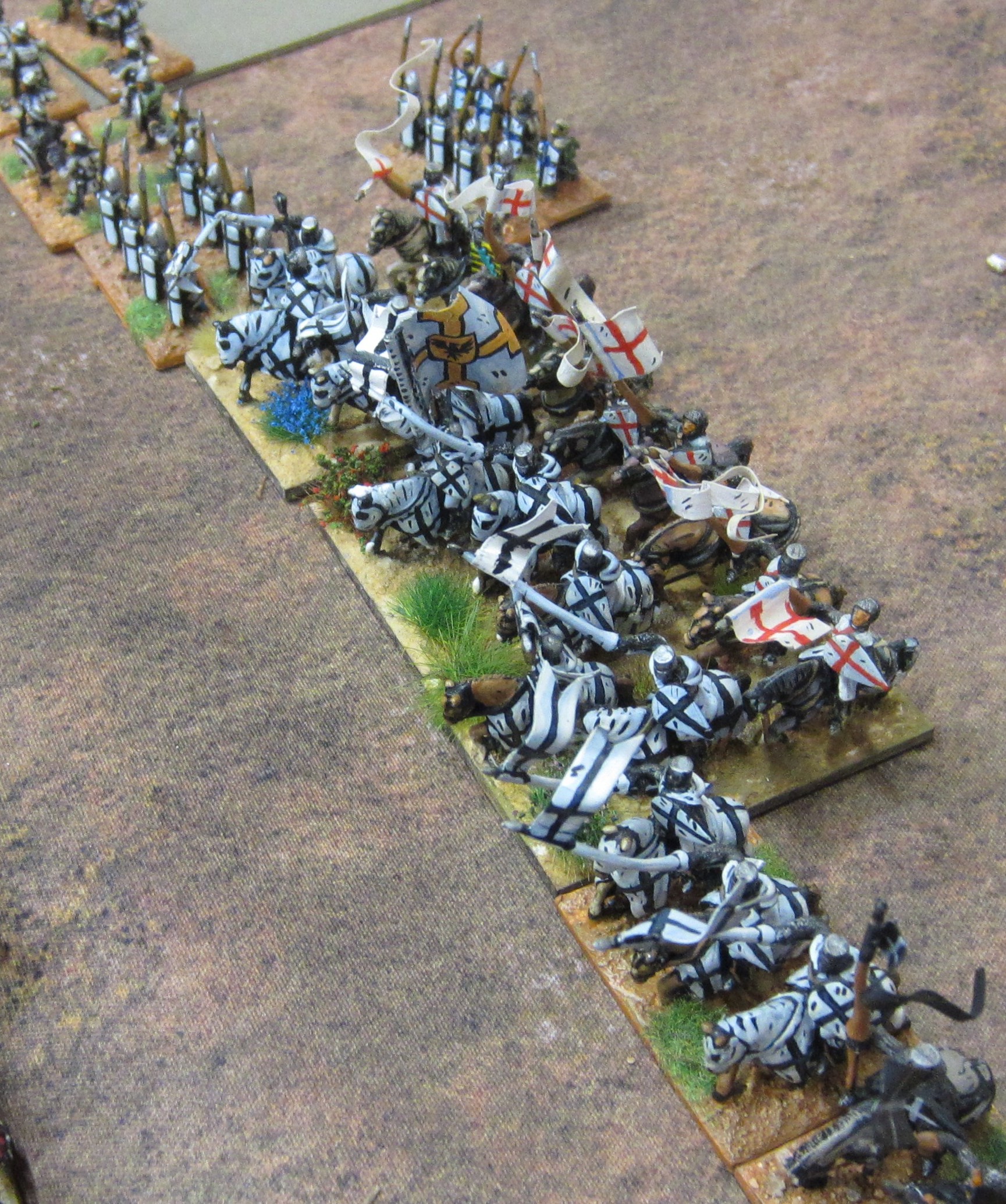
Some of Brian Ash’s impressive Teutonic Knights
Climb British Camp 2025
The 12th annual 25mm DBM competition organised by Gavin Pearson in Colwall, Herefordshire attracted twelve players with armies ranging from 2310 BC to 1440 AD. I took one of the earlier ones, Later Hebrew. This represented King Hezekiah of Judah’s army, assisted by a Libyan Egyptian contingent. Two Hebrew commands, one with heavy chariots (Ordinary Knights), the Gibborim spearmen(Superior Auxilia), archers, light horse and psiloi and the other with numerous lesser spearmen (Ordinary Auxilia plus a few Ordinary Spears) and psiloi. The Egyptian ally had small numbers of regular troops plus a substantial force of Libyan tribesmen (the “Invincible Meshwesh”, Superior Warband).
As the first round meetings were in date order I faced an invasion by Duncan Thompson’s Nubians. An enormous army, with huge numbers of archers and psiloi, a block of Fast Warband and an Early Egyptian ally with Fast Blade swordsmen. I was able to reorganise my front line so that the Nubian warband were faced by heavy chariots and the Meshwesh, a combination which soon broke them. My light spearmen (auxilia) suffered casualties from the numerous Nubian bowmen, but when they got into combat they slew many. The Nubians’ Egyptian ally arrived too late to help as the main Nubian army collapsed. 10-0 win.
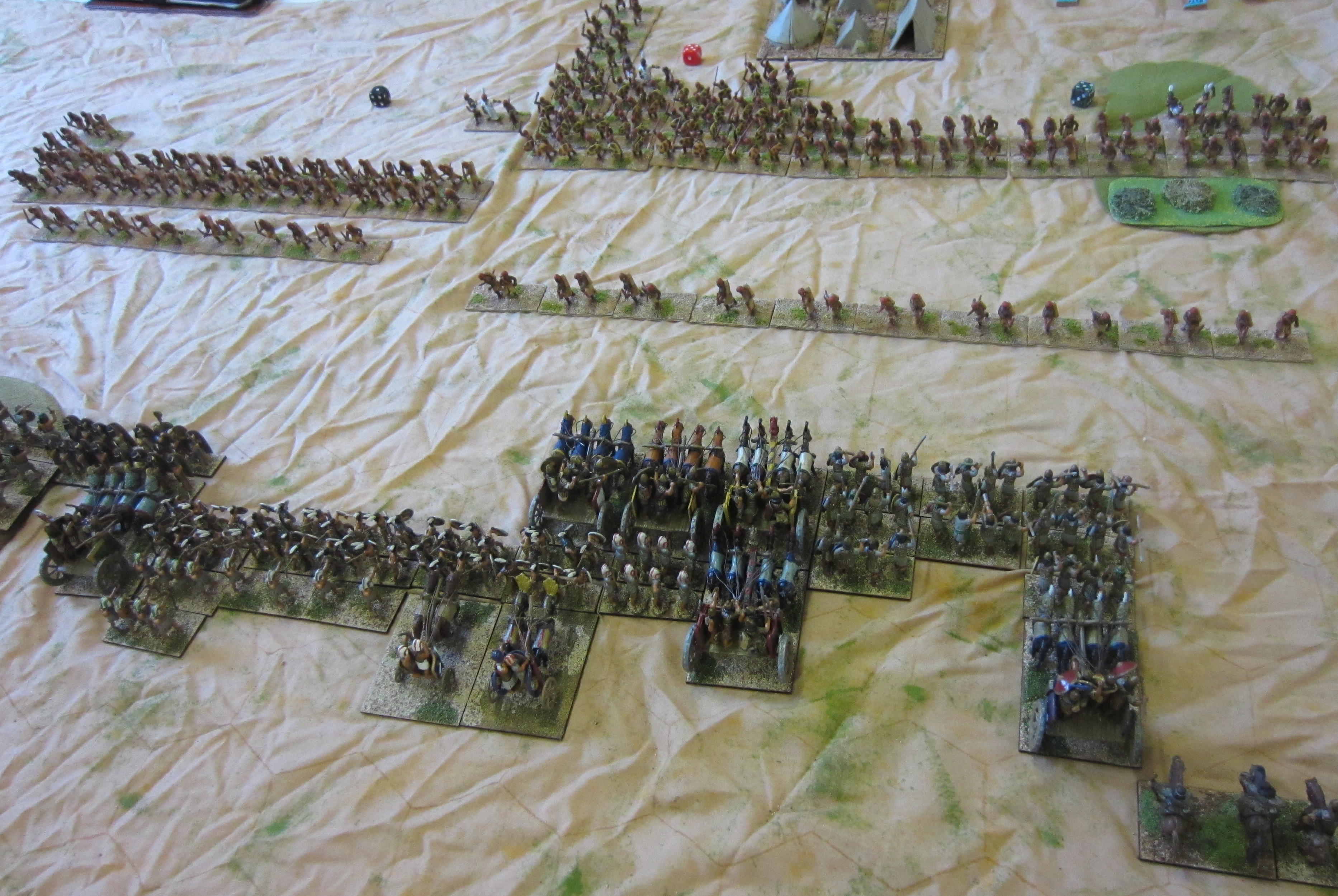
The Nubian skirmishers were soon swept away by chariots and Gibborim
Next I invaded Greece against Paul Holmes’s Phokians – four commands mainly of hoplites with some psiloi and batteries of heavy stone-throwers. One Greek command flank-marched; I attacked rapidly with the Meshwesh leading the way. The Meshwesh lost a couple of elements but slaughtered the hoplites of two Greek commands, while the Gibborim held their own against another command. The flank-marchers arrived but, as in the first game, too late to have any effect. Another 10-0 win.
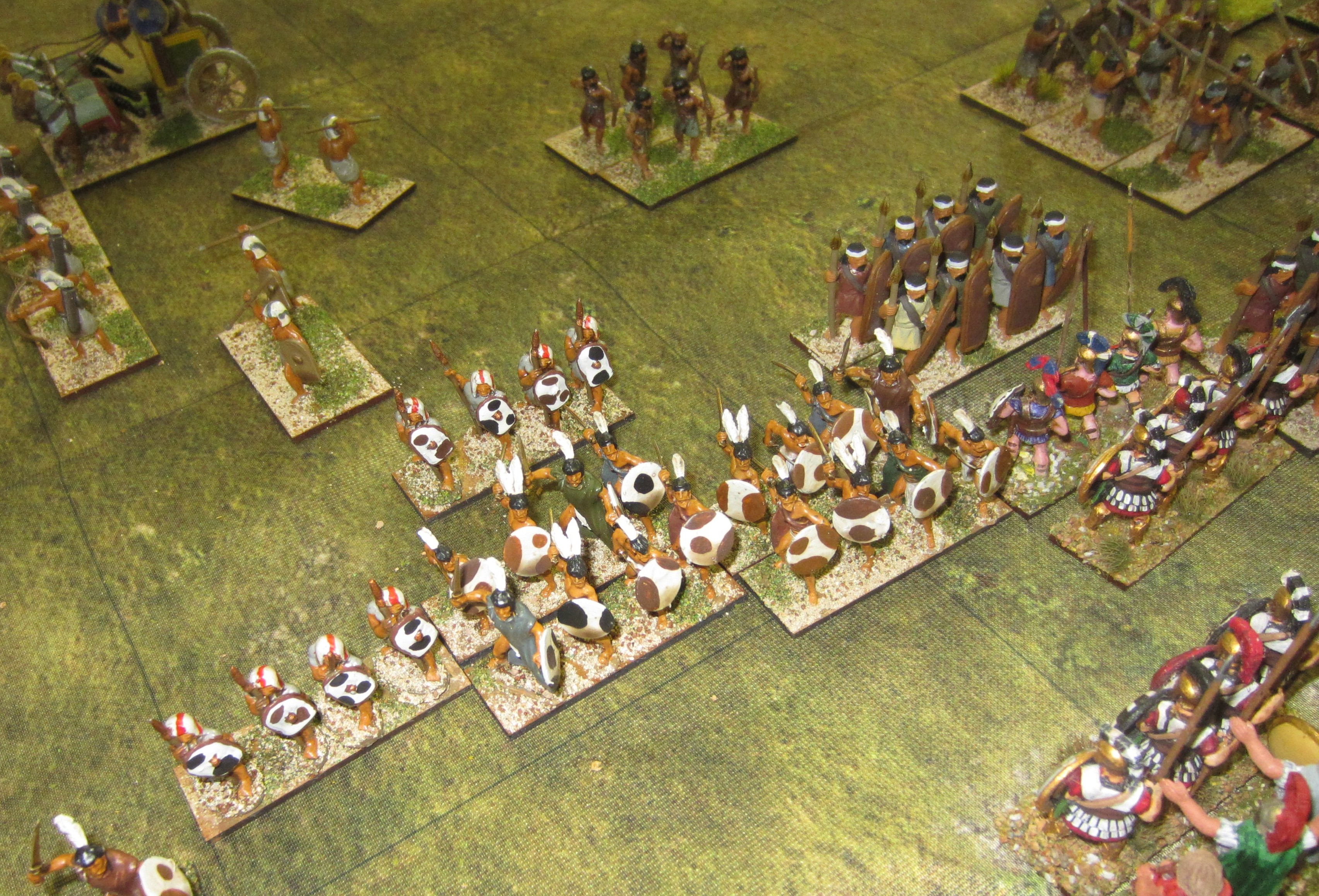
The Meshwesh demolishing a hoplite phalanx
Sunday morning saw Jeremy Morgan’s Early Burgundians invading Judah. Knowing that Jeremy had many knights, who could dismount as Superior Blades, and a block of pikemen, I placed as much rough terrain as I could but most landed on the enemy side of the table. One patch, occupied by auxilia, anchored my right flank, and on the other flank the main force of auxilia rushed forward to contest a large rough area against a substantial force of enemy bowmen. The bowmen shot down several but the auxilia eventually managed to destroy a couple of crossbow elements. Meanwhile, in the centre the Meshwesh were attacked by three enemy generals (two Kn(O) and one Kn(S)) in a line. Several Meshwesh elements were destroyed but then a 6-1 dice split slew the Duke of Burgundy whose command had now lost three elements. Its next PIP roll was two, so the command broke. On the right Jeremy lost control of Burgundian knights who charged impetuously into rough going and were despatched by the Gibborim. However, the Meshwesh were still suffering at the hands of the two surviving enemy generals and my Egyptian command broke. My left-flank command was also badly damaged, and when a pair of spearmen were destroyed (by being backed into another enemy general who also died) it broke. 2-8 defeat, and one of the most exciting games I can remember.
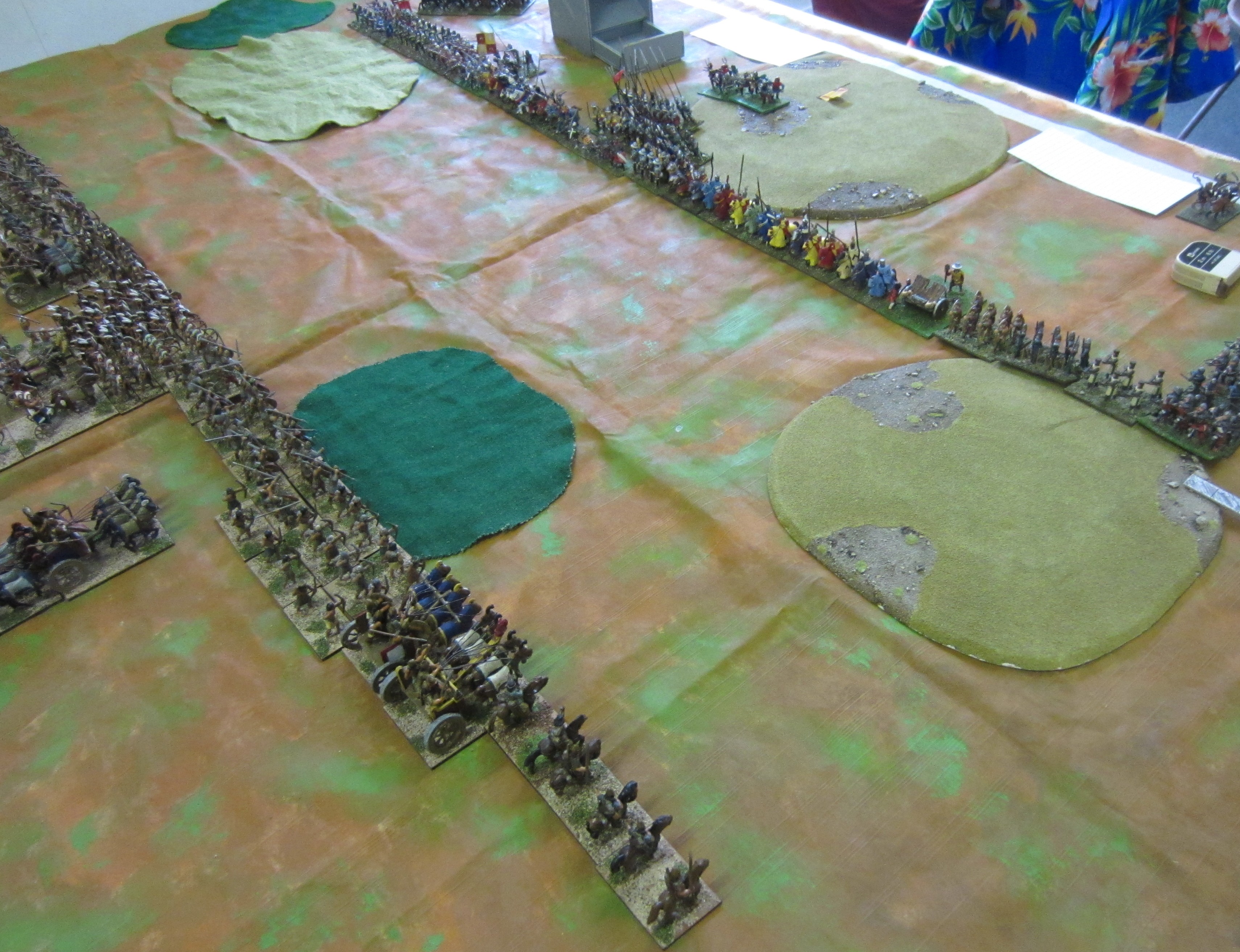
The battle lines are drawn
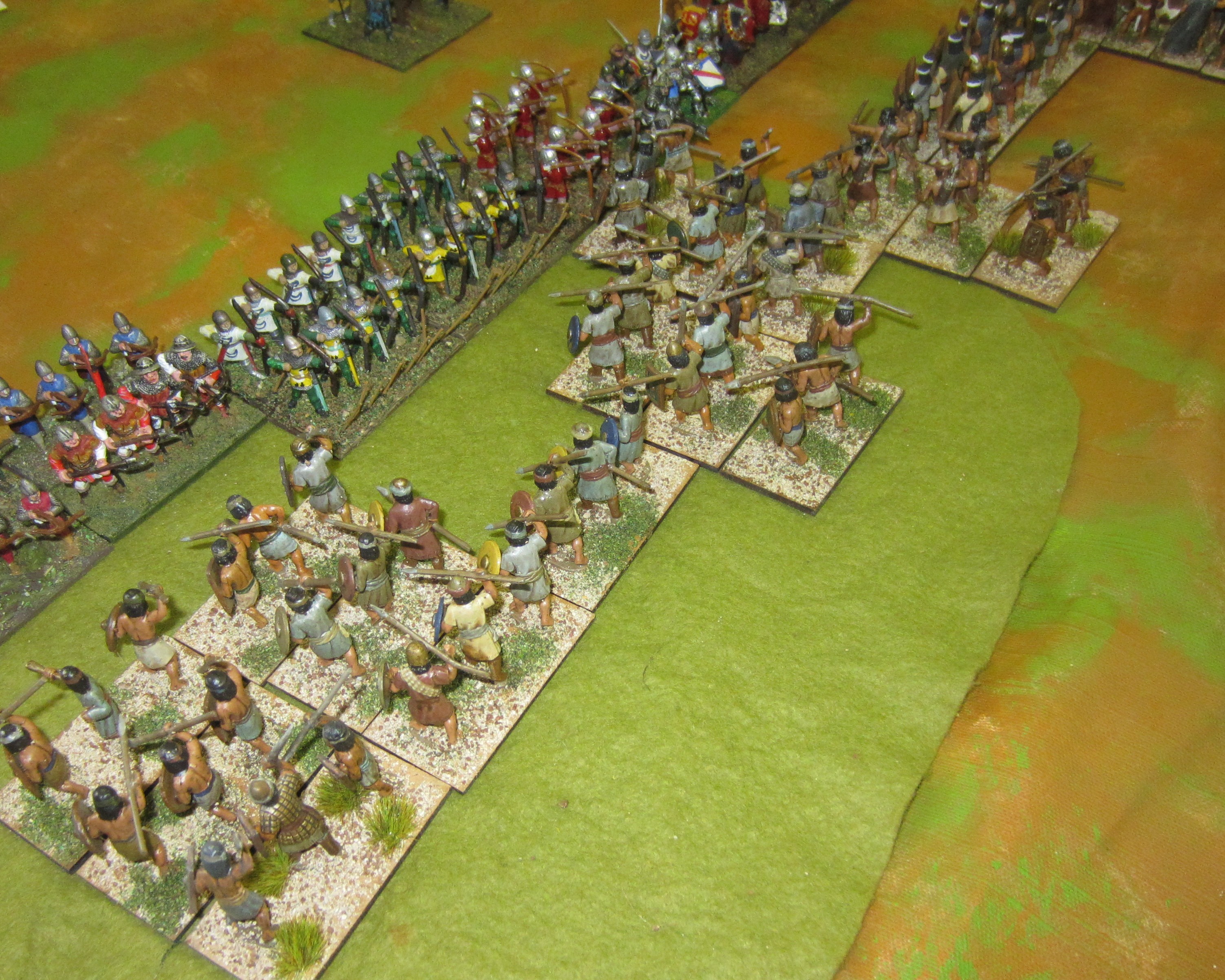
Light spearmen (Auxilia) against massed bowmen
Complete contrast on Sunday afternoon. Paul Apreda’s Later Swiss invaded Judah. Paul placed a road and steep hills which all landed on his side of the table, greatly restricting his deployment options. I added rough going which all landed on my side of the table, including useful protection for both flanks. Paul deployed one pike block in the only clear area available, on his far right, and a command of halberdiers and psiloi spread across the front on the steep hills. If these attacked they would face the fearsome Meshwesh. His third command (mainly pikes) was evidently flank-marching and the terrain enabled me to deploy so that any arriving pikemen would face difficult opposition – auxilia in rough going. As attacking by either army would be near-suicidal, we agreed a 5-5 draw.
My 27 points got me second place, behind Jeremy. Despite the non-game in the last round, an excellent weekend.
Attack! 2025
Russ and I took a Low Countries army to the doubles competition at Devizes. The turnout (eleven players in eight “teams”) was poor, but the show was excellent and we both spent substantial cash at the trade stands. Our army had three commands with pikes, one of them with some handgunners (Superior Psiloi) and a second with crossbowmen and halberdiers, plus an allied command of ten elements of Irregular Ordinary knights. A narrow army, so we expected to defend and place woods to guard our flanks.
The first game was against Pete Connew and Richard Newland with Mapuche – a massive army mainly of Ax(X) spearmen and Bw(O) archers. Our pikemen could expect to beat any of those in combat but would probably suffer severely from archery on the way in. The game turned out to be a thriller: terrain played little part, and the battle consisted mainly of our pikemen struggling through storms of arrows and eventually wearing down the enemy. Our knightly command was unfortunate, despite riding down numerous archers, and was broken by the Mapuche spearmen, but the pikemen carried the day for us by breaking two huge commands. 9-1 win.
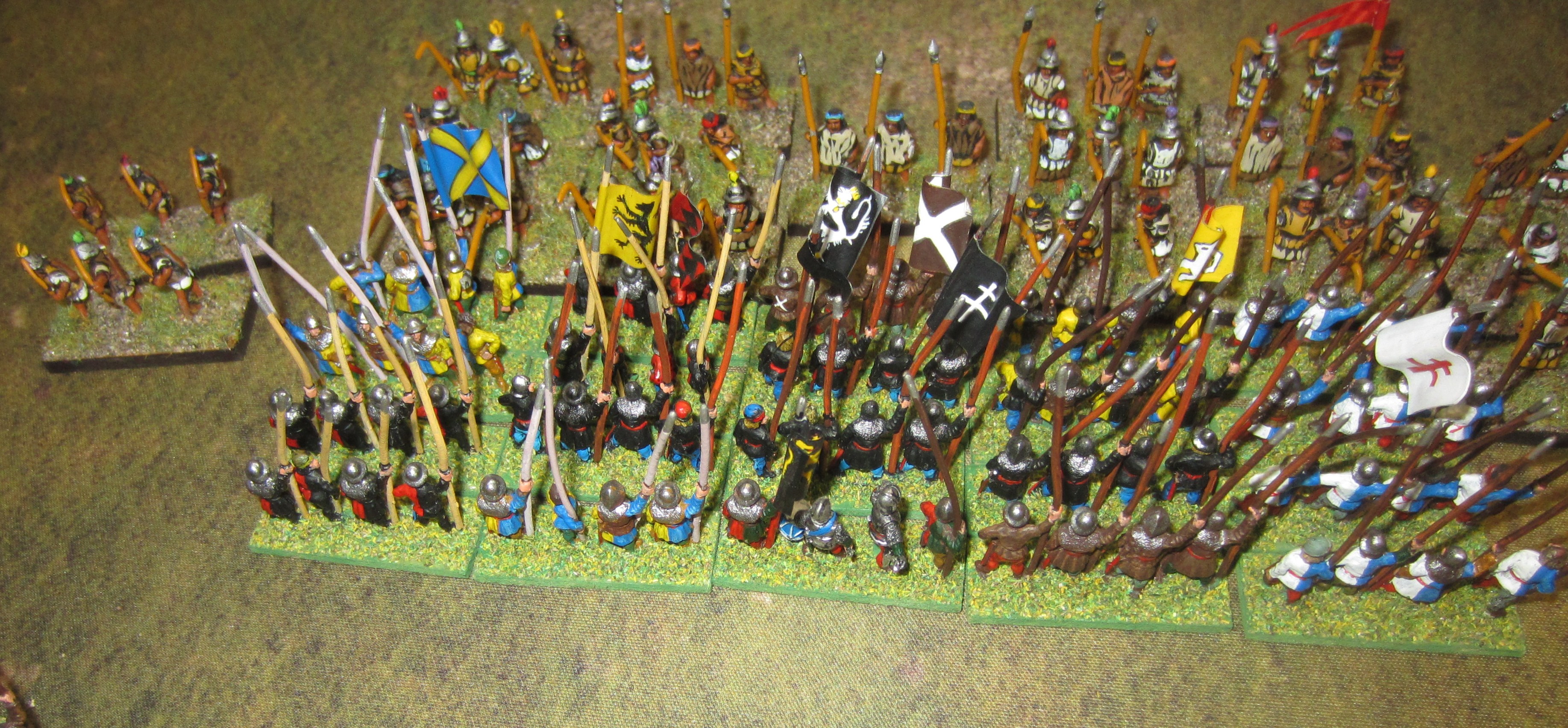
The Flemish pikemen get to grips with Mapuche spearmen
Next we faced the current top DBM player, Dave Madigan, who had a well-practised New Kingdom Egyptian army. The important terrain was a waterway on our left and an area of rough going in the centre, which we occupied with our crossbowmen and handgunners. The deployment favoured us as our knights faced Cv(S) chariots by the waterway; Dave spent many PIPs falling back with the chariots while forced-marching bowmen from the centre. In the centre more bowmen plus a few auxilia and Fast Blades swordsmen attacked into the rough going; our crossbowmen decisively outshot their opponents and the handgunners managed to flank and destroy the auxilia. Although our knights were eventually beaten by the chariots, the Egyptian C-in-C’s command in the centre was also broken. The game timed out at 6-4 to us.
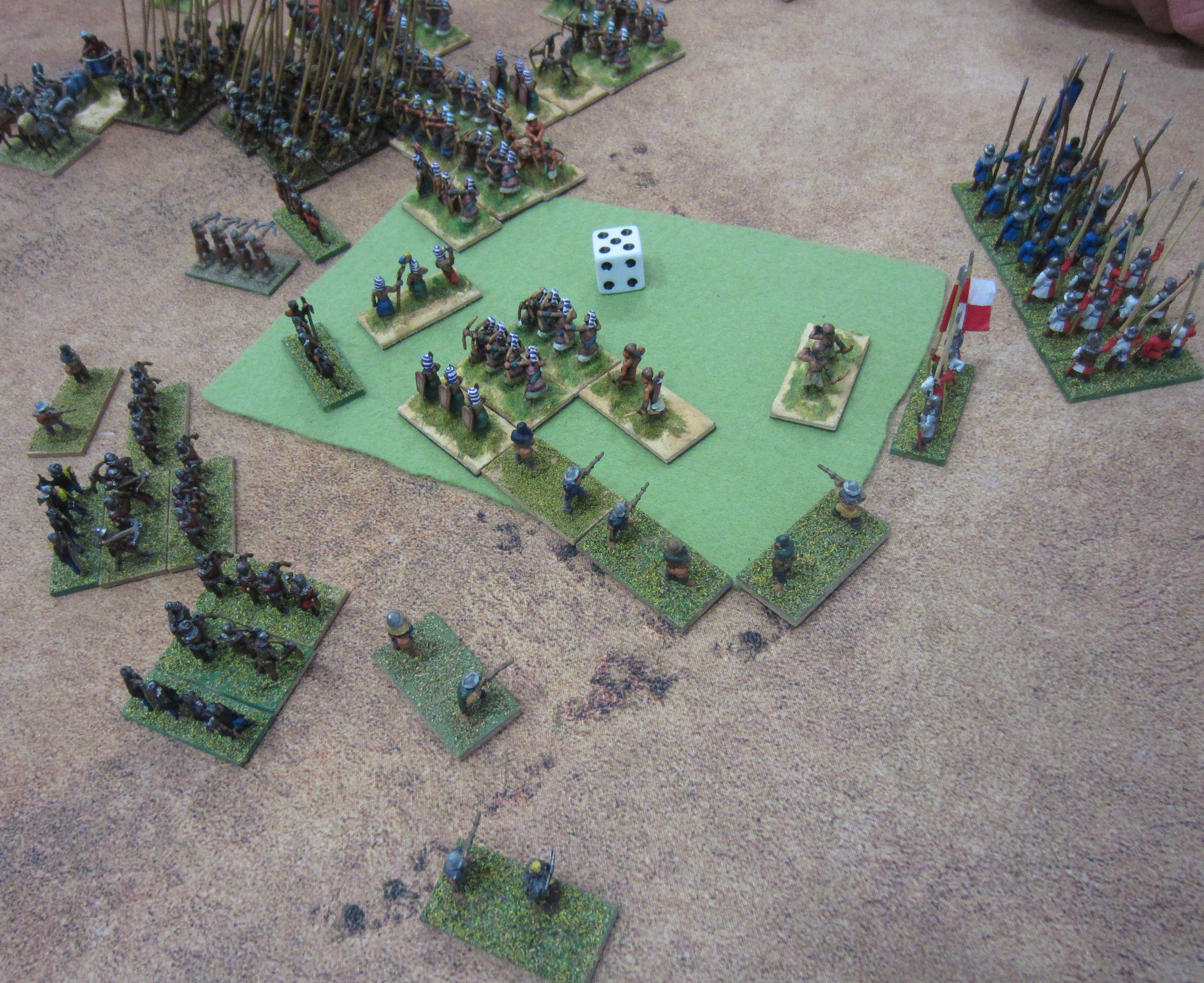
The struggle in the central rough going
On Sunday morning our opponent was Chris Smith who led White Sheep Turkomans with Georgian allies. Most of his troops, cavalry and light horse, were impervious to our pikes while their manoeuvrability meant that any attack by us would be extremely risky. Psiloi-occupied woods anchored our left flank and the right was held by pikemen angled back with the knights in support; these measures thwarted the Turks’ outflanking attempts. Chris brought forward lots of foot archers to shoot it out with our crossbowmen in the centre but we had the better of the shooting. The game ended at 5-5.
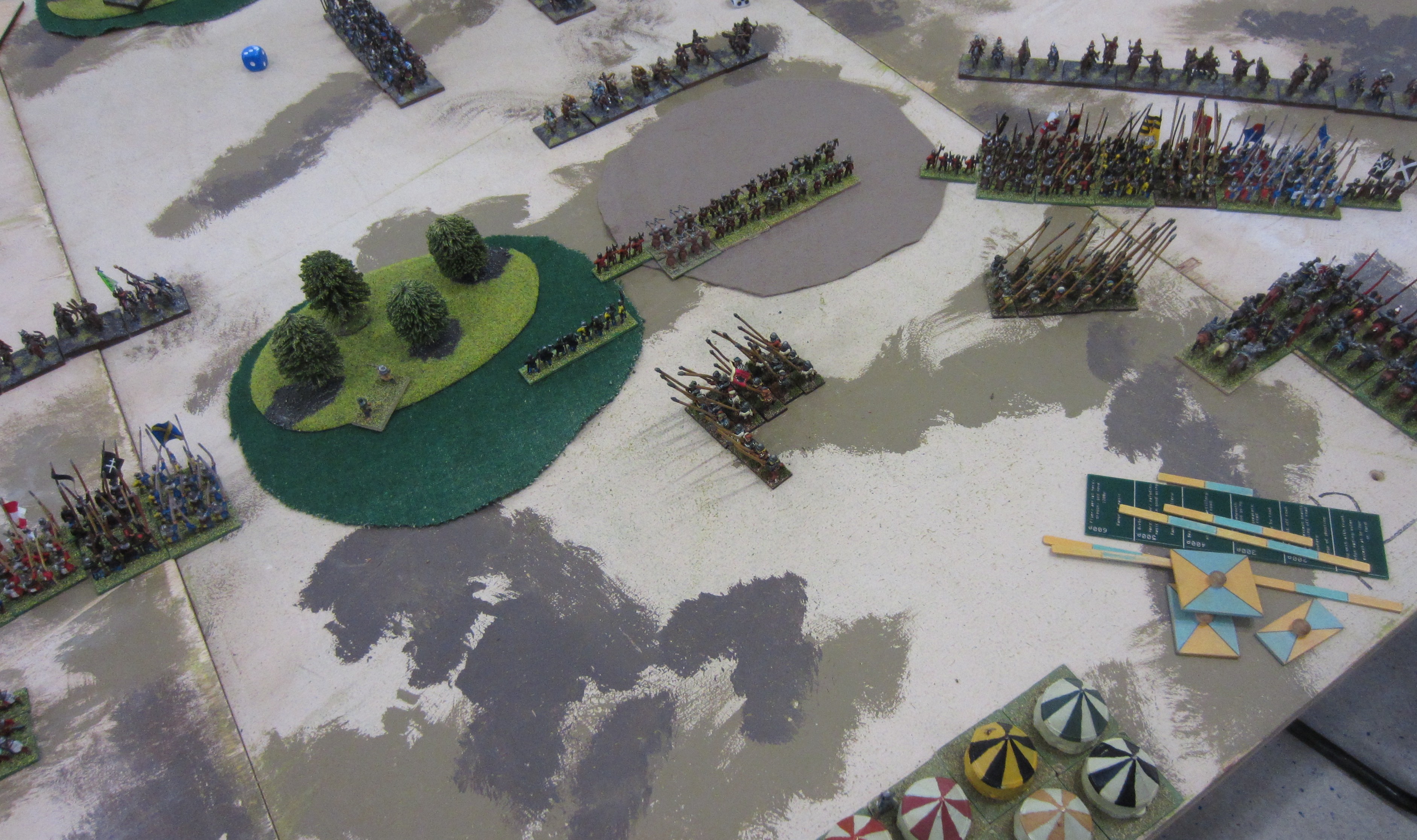
The Turkomans are unable to outflank the Flemings
The final game was against Duncan Thompson and Paul Holmes with Late Imperial Romans. We knew that they had two blocks of warband, one in an allied command, as well as lots of mounted troops and the usual legionaries, auxilia and artillery. The terrain of woods and rough going gave them a defensive position which was impossible for us to attack with pikes. Their allied command was off-table and turned out to be unreliable; if it arrived on the open flank it would be greeted by our knights. The flank march failed to appear and this game too ended at 5-5.
25 points earned us second place, behind Dave Madigan who recovered from losing to us by winning both Sunday games.
Corinium 2025
The doubles competition in Cirencester had a “Northern Wars” theme, all armies chosen from the armies and enemies of the Vikings and of medieval Germany. In Russ’s absence on holiday I teamed up with Jeremy Morgan and persuaded him to use my Teutonic Orders army. The main striking force was made up of Superior Knights, two of them double-based to form the famous “wedges”, with support from cavalry, crossbowmen, spearmen and skirmishers including a fair number of light horse. The line up was completed by a small fourth command of German allies.
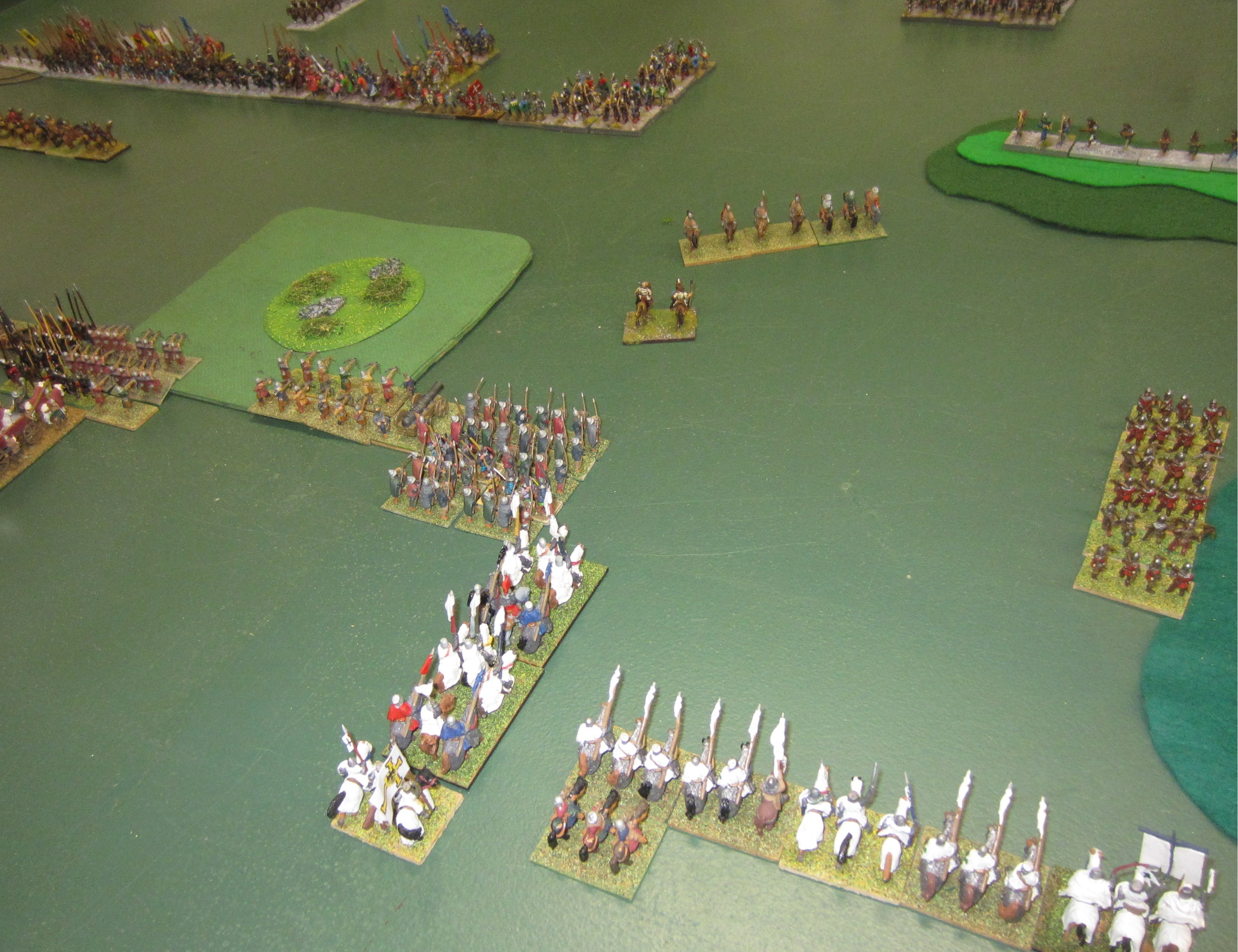
Our first opponents were Andy Cummings and Paul Nettle with Welsh: lots and lots of bowmen, a large block of Fast Warband warriors and some Fast Knight cavalry. At the start the knights were not on the table – evidently a flank march which I thought would be on our right, so I formed up the allied command to face that flank. One Welsh allied command was initially unreliable, and so was our ally. Our best plan was obvious: concentrate on the Welsh C-in-C’s command in the centre, formed of a line of bowmen in front of all the warband. Our knights thundered forward through showers of arrows and defeated the bowmen after a tough struggle. Meanwhile the Welsh ally became reliable and inflicted losses on our spearmen with shooting, then the flank march appeared on our left and, practically unopposed, reached and looted our baggage. This meant that if one of our commands broke so would our army, and losses mounted so that two commands were each two elements from their break point. However, the main force of knights finished off the central bowmen and then easily rode down the warband. With some losses elsewhere this made half the Welsh army so we won 10-0.
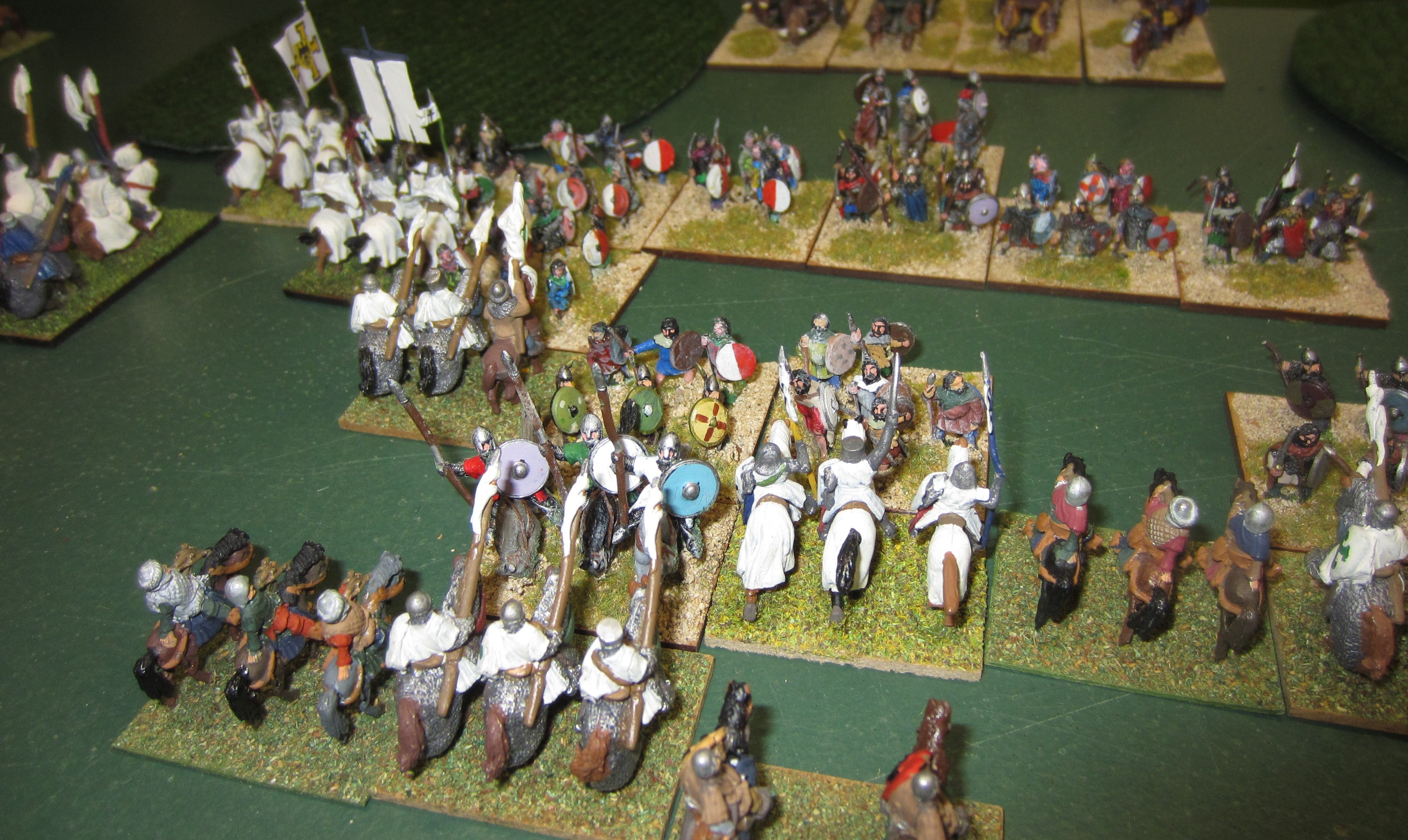
The knights ride down the Welsh warband
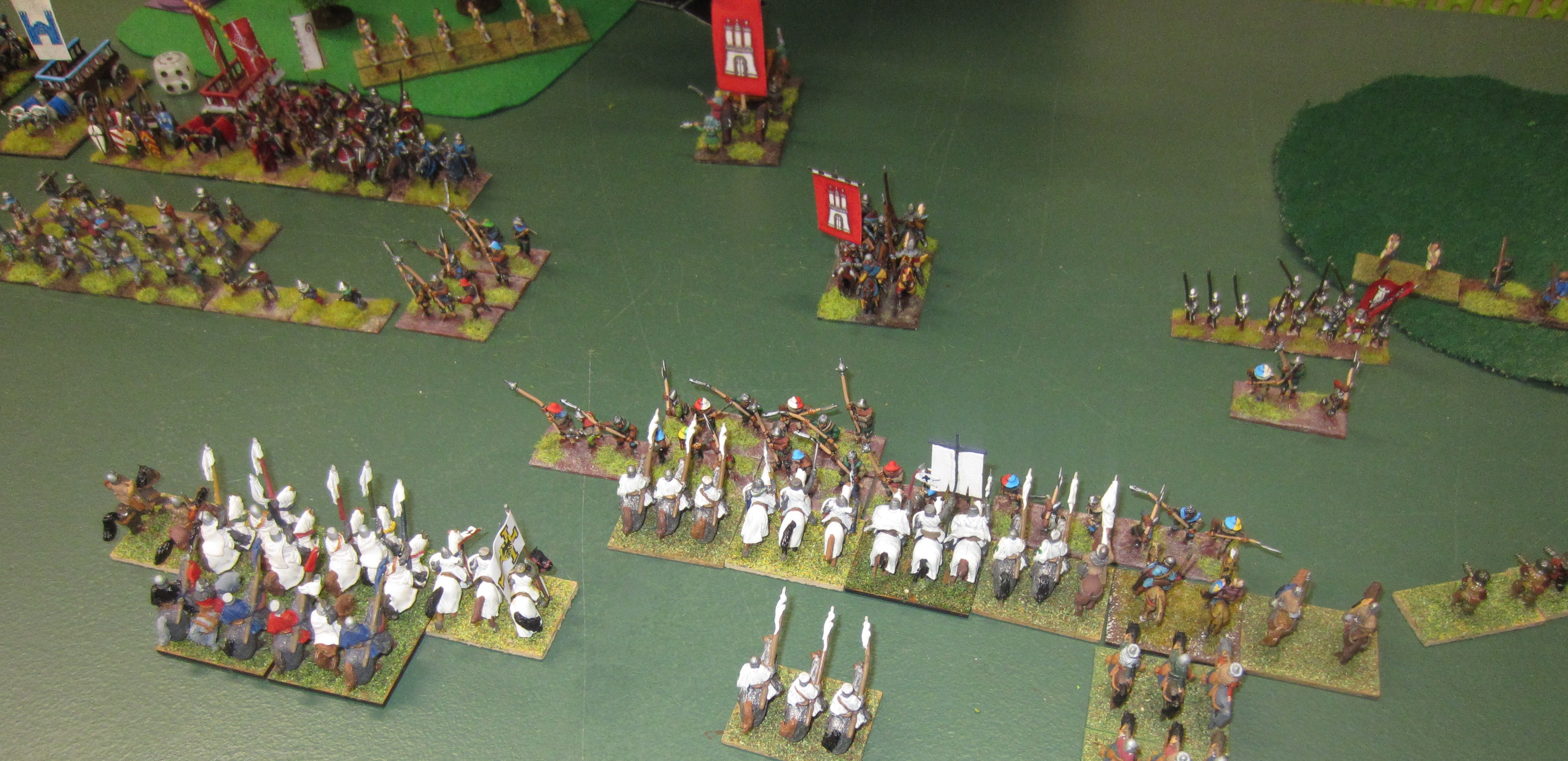
Then we faced the formidable Dave Madigan and Chris Smith with an equally formidable French Ordonnance army – two blocks of pikes, gendarmes and an English ally with Superior Blades and Superior Bows. Very difficult opponents for our knights. We held the knights back while pikemen eagerly advanced to get at them. The small English command advanced into an area of rough going in the centre, took some missile casualties and attacked our crossbowmen – disastrously, as their general was caught double-overlapped and died. The English command broke, and this enabled our crossbowmen to pepper the flank of a block of Inferior Pikes. We came close to breaking a second command, but the French held on until time. 6-4 to us.
The English (top centre) are heading for the central rough going
On Sunday morning Ed Gilhead’s Medieval Germans also looked a difficult opponent: the army was built to resist knights, with lots of Exception Blade halberdiers, some of them in a Swiss allied command. The Swiss were hidden in a wood opposite our left and were initially unreliable, faced off by our small allied command. One of the German commands in the centre was also unreliable, so we concentrated all our knights against the one opposite our right. There was a long struggle there, some halberdiers going down but also some of our knights, resulting in one of our generals being overlapped, then flanked and finally surrounded. He fought his way out of the trap and the other knights eventually destroyed enough halberdiers to break the enemy C-in-C’s command. Meanwhile both unreliable allies joined in. The Swiss tentatively advanced out of their wood but were deterred by volleys of crossbow bolts and fell back. But the German ally led a force of double-based Inferior Knights against our Inferior Spears. The spearmen fought heroically, slaying one knight wedge and then the enemy general, whose command broke. 10-0 win.
Knights versus halberdiers – a tough struggle
The final opponents were Gavin Pearson and John Calvert with Burgundian Ordonnance. We didn’t fancy fighting Superior Bows and pikes with anything we had, so placed as much difficult terrain as possible and set up defensively. Only two Burgundian commands were on the table, the third (mostly pikes) flank-marching on our left. We anchored our line on a steep hill in the centre and delayed the enemy with light horse on the left; there was nothing facing our right and we advanced there, but the terrain meant that we couldn’t really achieve anything other than drag our bombard forward to shoot (eventually successfully). Exchanges of shooting resulted in a few enemy archers going down but rather more of our troops, including some Auxilia on the hill and an unlucky Superior Knight general. The flank march turned up too late to achieve anything, but one of our commands had suffered a quarter lost and was probably going to break in one more turn. Our other commands were all untouched so there was no prospect of any other commands going in the time; we agreed to end the game at 4-6.
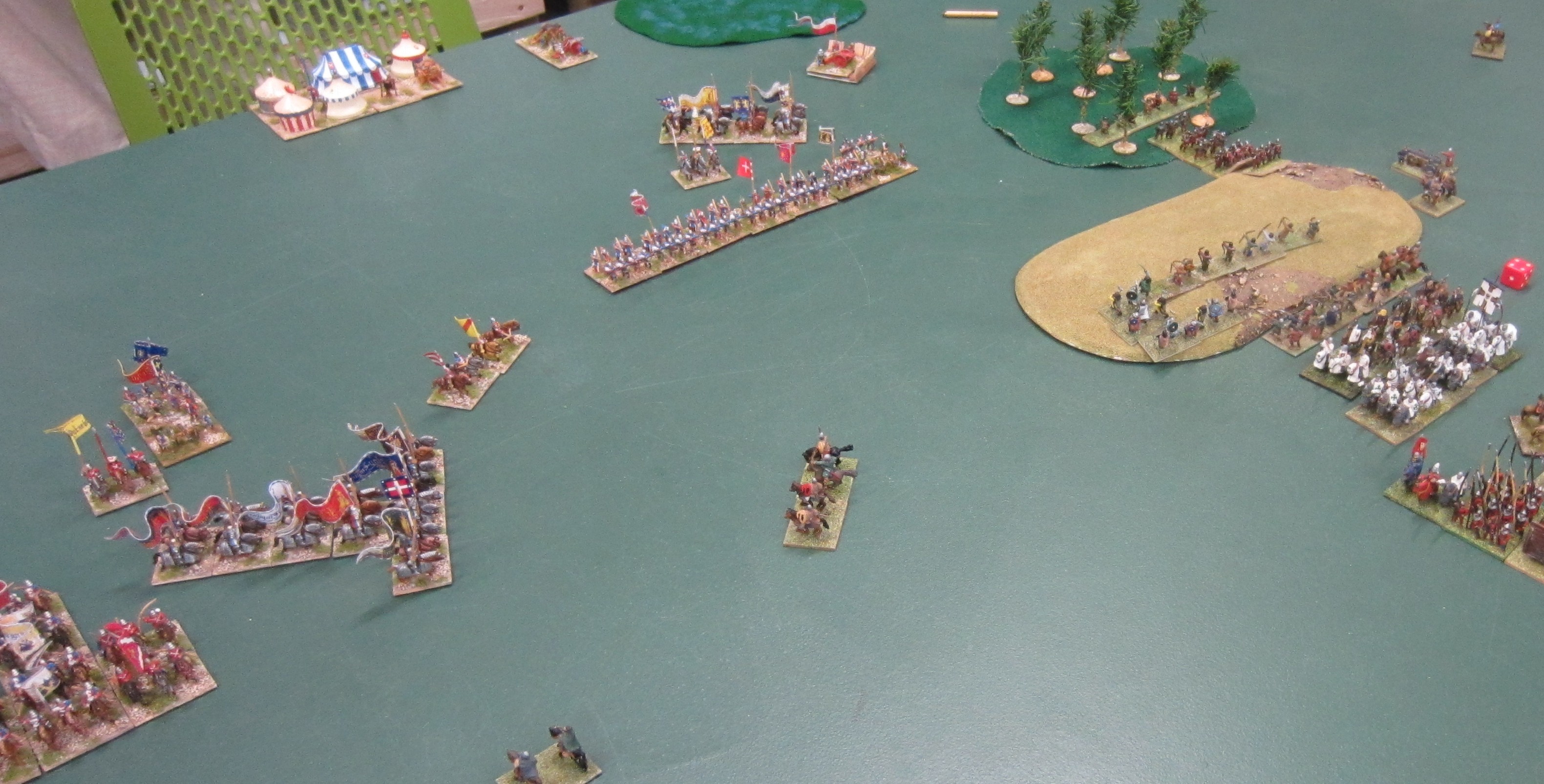
Our light horse delay the Burgundian advance
Our score of 30 points was enough to win the competition by a six-point margin. A highly enjoyable weekend in which we had more than our share of luck, especially against Ed; in that game his PIP dice were consistently better than ours and his combat dice were equally consistently worse.
Westbury Wars 2025
For the 25mm singles competition in my house, attended by a record 13 players, I used a four-command Alexandrian Macedonian army dated 322 BC, so commanded by Antipater rather than Alexander. The pike phalanx was split between two commands which also had psiloi, the C-in-C led the main mounted force of Fast Knight Companions and Superior Light Horse Prodromoi plus some peltasts, and the fourth command had more Companions and light horse. All the commands were small.
My first opponent was Paul Holmes with an early Seleucid army, generally similar to mine but with one elephant. Paul out-deployed me, leaving most of my cavalry out of position, but I was able to move cavalry to the right flank to counter his main mounted force. The principal clash came in the centre, where my pikemen, with support from the small fourth command, decisively defeated the Seleucid phalanx. 10-0 win.
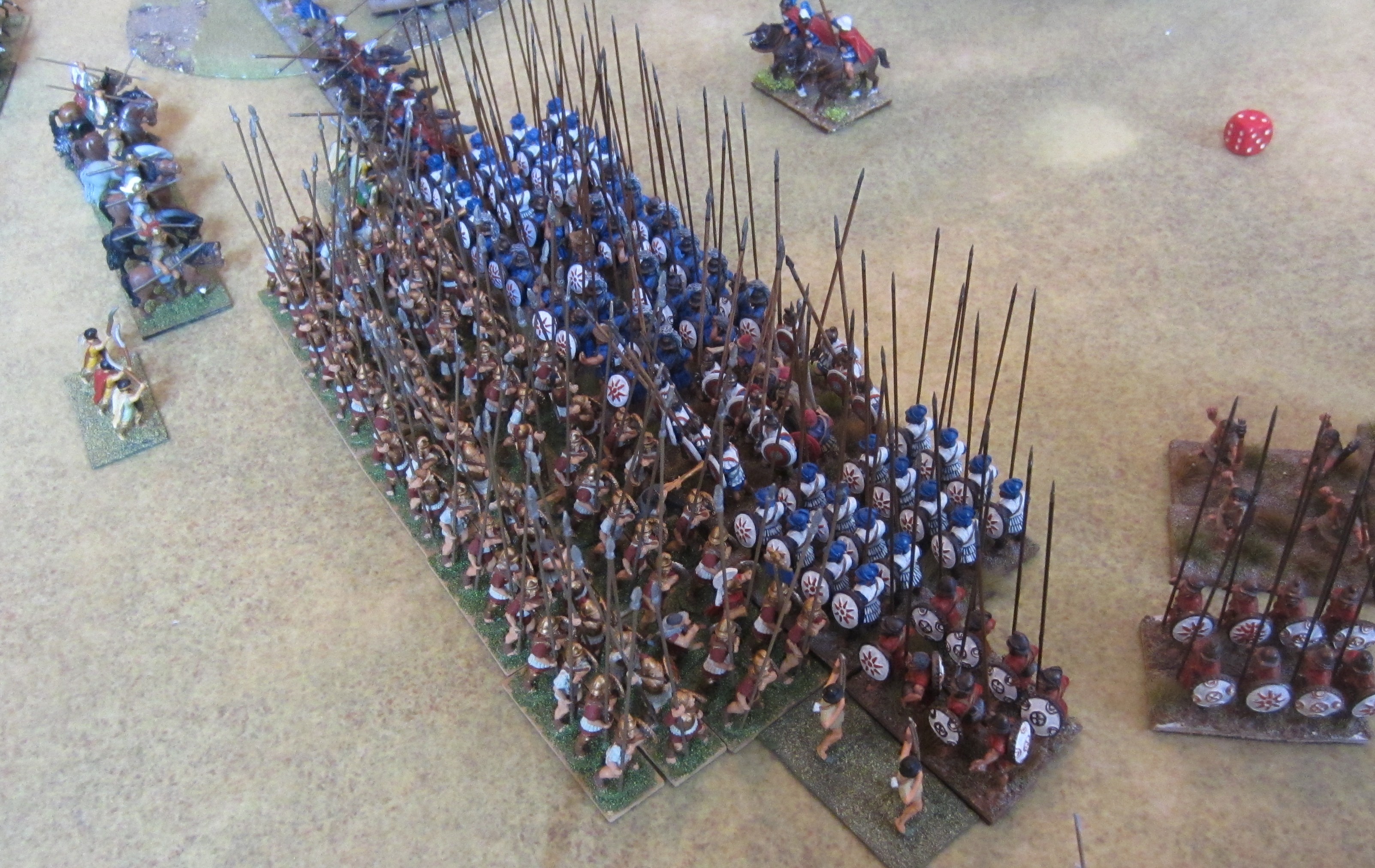
Push of pike – Macedonians on the left
Then I invaded Gaul against Jimmy Walton’s massed warband. Only two Gallic commands were visible at the start; evidently a flank march was coming with another command probably hidden in extensive woods opposite my left flank. It turned out that this was a Ligurian allied command which started the game unreliable. I sent my phalanx straight at the warband – if I could break a command the Ligurians would change sides. Unfortunately the combat dice were not with me; the pikemen failed dismally and two commands rapidly broke for a fast 0-10 defeat.
Nick Coles had another Seleucid army – no elephants but plenty of pikes and heavy cavalry. Two scythed chariots attacked my centre and were successfully countered by psiloi. A large command of Ax(S) thureophoroi was deterred from leaving rough going by my Companions, and the Seleucid phalanx and Galatian warband hesitated from attacking with an open flank. After some skirmishing with light losses we agreed a 5-5 draw.
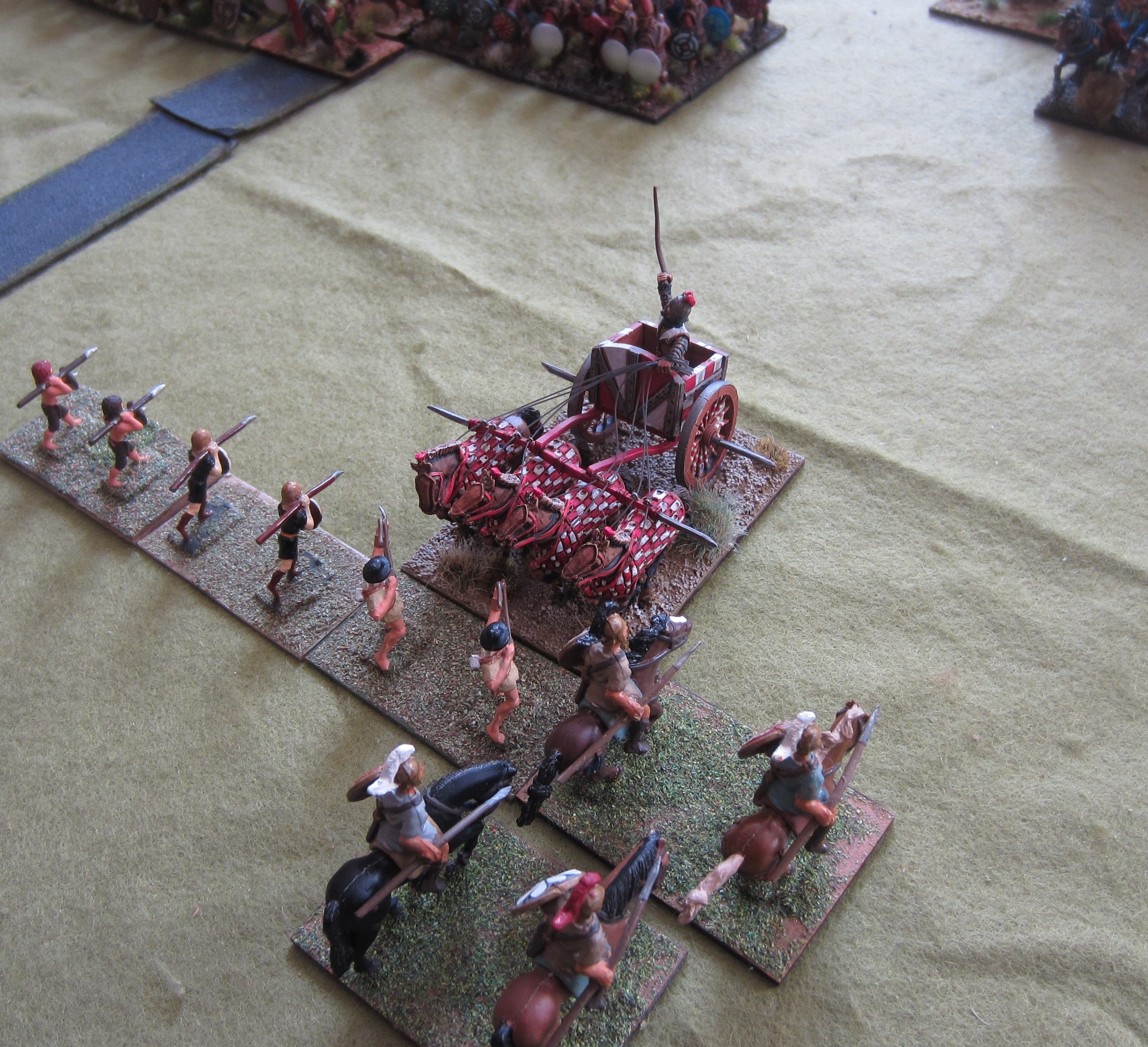
Seleucid scythed chariot – beautifully painted by Jimmy Walton
My final opponent was Russ King with Richard the Lionheart’s Later Crusaders. This was the best game of the weekend. Knowing that the Crusaders had few rough terrain troops I placed several rough hills which favoured my peltasts. The Lionheart commanded the Irregular knights of the Kingdom on one flank while the Grand Masters of the Military Orders had the Regular troops on the other. My phalanx manoeuvred against Richard on the right and eventually was able to charge; most of the knights went down. Crusader crossbowmen shot down numerous psiloi on this flank but then some pikemen attacked and destroyed some bowmen, breaking Richard’s command. On the left the Templars and Hospitallers charged with some success, destroying several elements of Companions, but it was too late – Macedonian pikemen reached the Crusader camp and looted it, breaking the army for a 10-0 win.
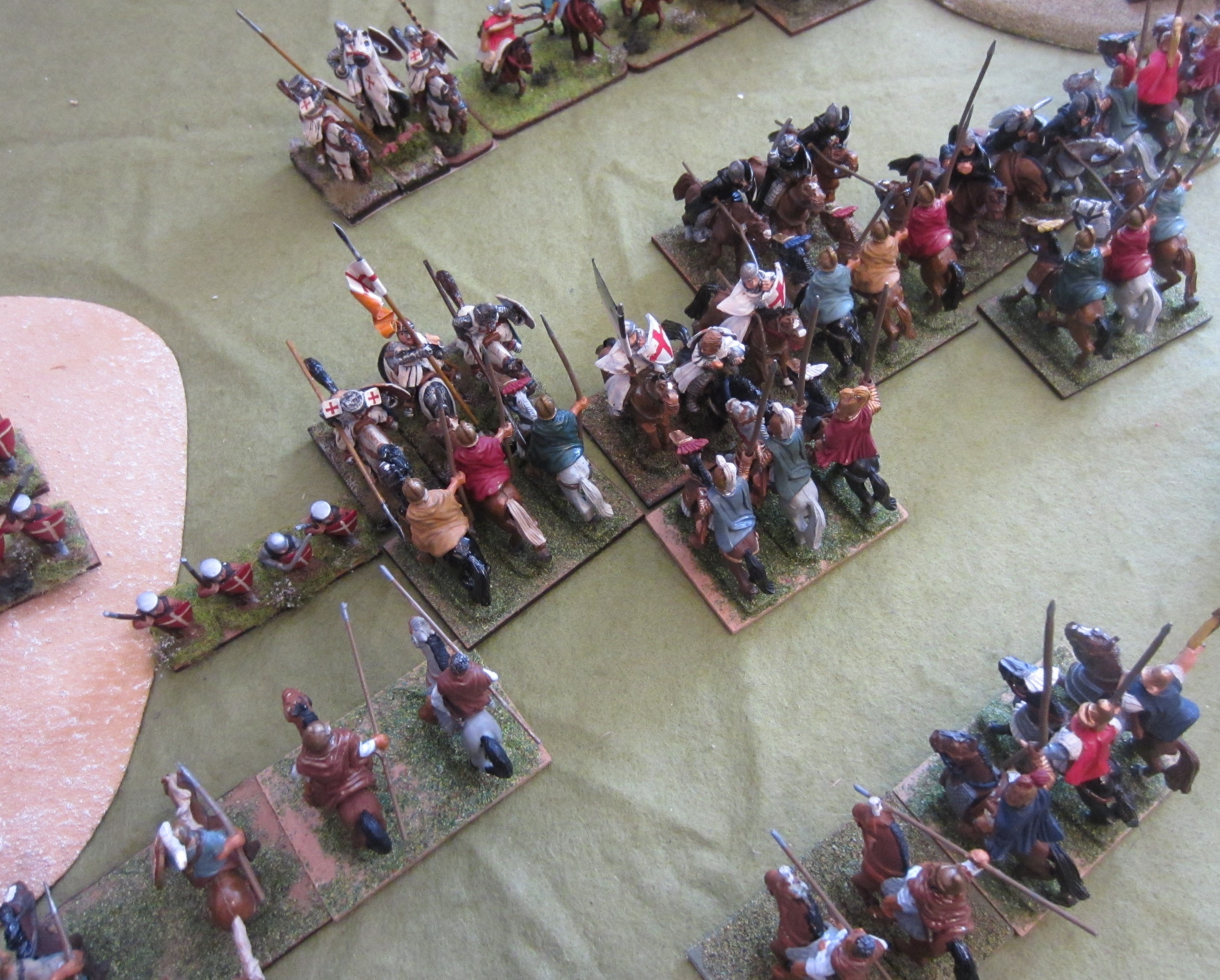
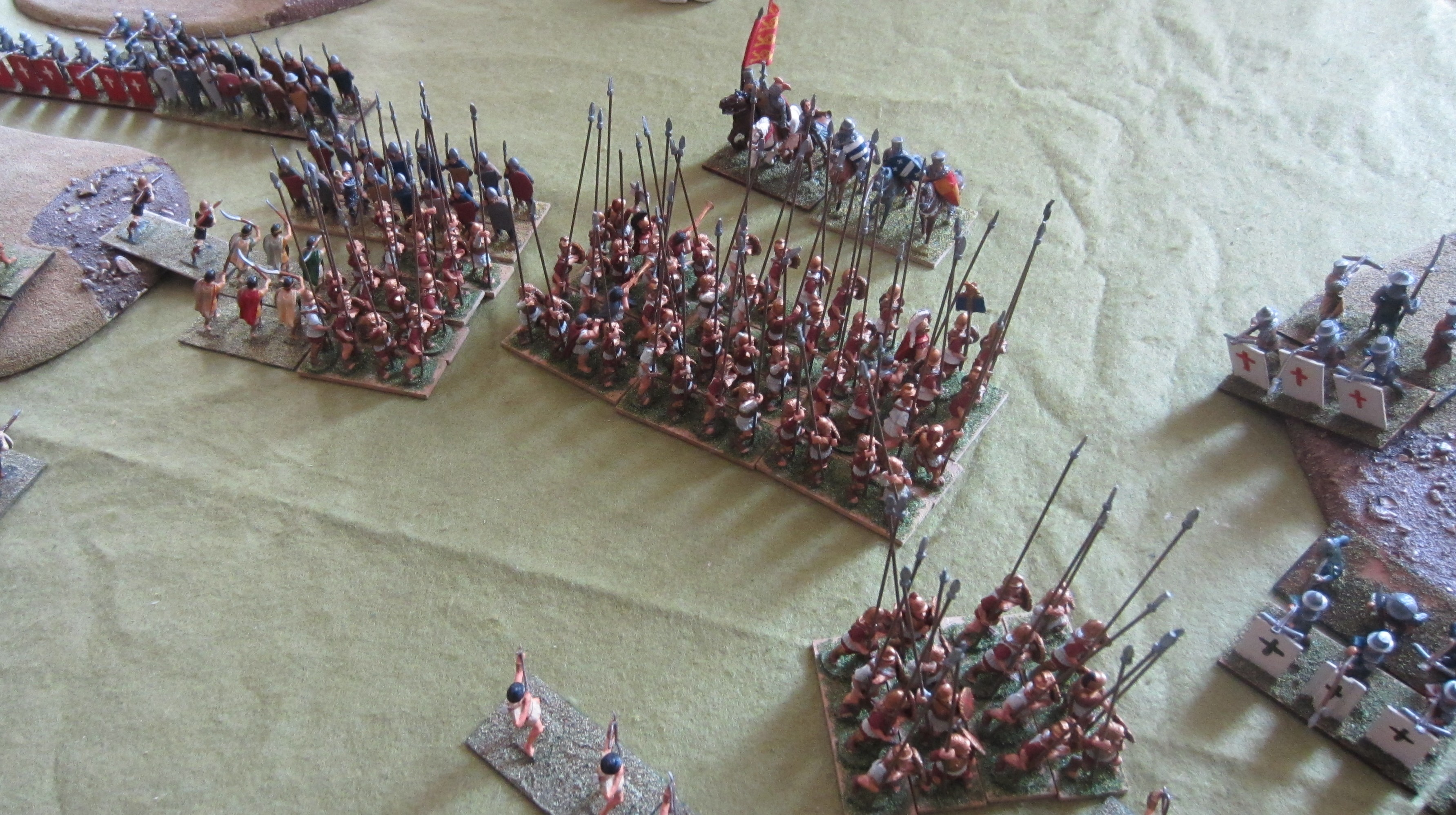
I finished in joint fourth place. There was a dramatic end at the top of the table: Jimmy Walton’s Gauls had been firmly in the lead and his final score of 31 looked to have secured the competition win. However, Jeremy Morgan was still playing and his score at the start of the last game was 22. Right at the end, in the last combat of the game, Jeremy destroyed two elements with a 5-1 dice split and broke Derek Bruce’s army for an unexpected 10-0 win, thereby winning the competition with 32 points.
Venta Silurum 2025
The first doubles competition of the year had a theme of “Armies and enemies of Achaemenid Persia” Russ King and I took Later Hoplite Greeks – Spartans. Three Spartan commands with hoplites and psiloi, a few warband, auxilia and cavalry, plus an Athenian allied command with more hoplites and psiloi.
We started by invading Macedonia where we faced Jeremy Morgan and John Calvert. The terrain featured steep hills mostly on the opposition’s side but with one large hill in our centre. This split the battlefield into distinct halves. On our right our best hoplites faced the enemy pike phalanx and there was almost no action there; neither side wanted to attack as any advance by us risked outflanking by cavalry while the Macedonians would be similarly outflanked by psiloi on the steep hill. The fighting was therefore all on the left, against our refused flank which was threatened by numerous cavalry and hoplites. We reinforced with hoplites from the centre, but eventually the enemy crushed our few cavalry and slew a general. Our left-flank command broke on the last bound, so the game ended at 4-6.
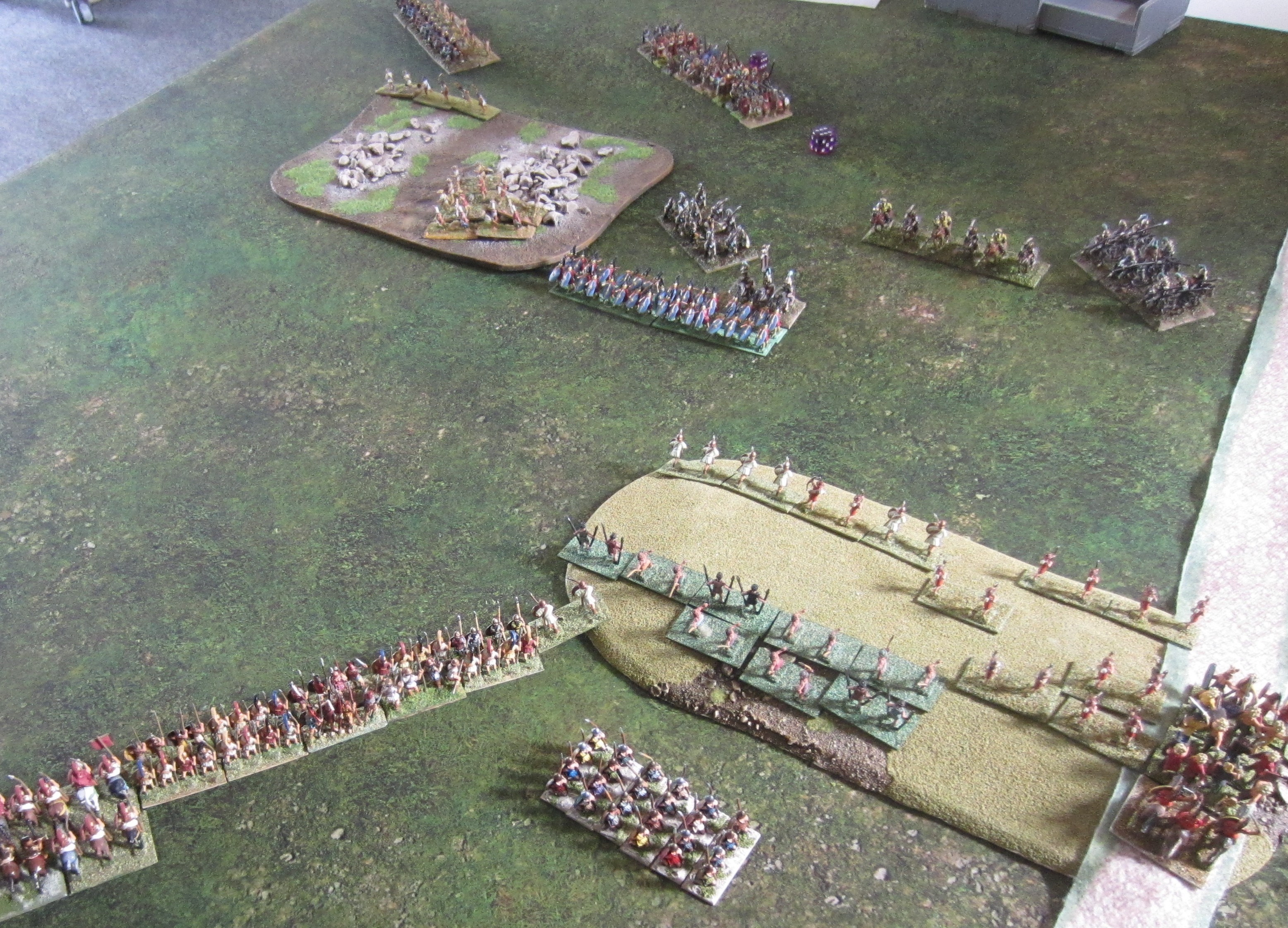
Our threatened flank is reinforced from the centre
Then we invaded India. The enemy, led by Pete Connew and Richard Newland, had numerous Superior Elephants as their main strike force, aided by Superior Cavalry chariots and large forces of indifferent infantry. This game was largely decided by two flank marches: on their first turn the Indians declared a flank march on our left but it was chased on by our larger force. So we had the pleasure of attacking Hordes with hoplites and warband, quickly breaking the small Indian command. This exposed the flank of the next Indian command and we broke that too. 10-0 win.
The Indian flank march is chased onto the table
Kevin Everard’s Late Achaemenid Persian army was a difficult opponent, with far more cavalry than we had and (unfortunately) wide open spaces in which to operate. A game of much manoeuvre in which we had some successes but little chance to use our hoplites effectively. When time was called one of our commands had lost a quarter of its strength (including its general) so the game ended at 4-6.
We then met the other Spartan army commanded by Nick Coles and Jimmy Walton. As in the first game, the terrain dictated that whichever side attacked would do so at a disadvantage so, after some ineffective skirmishing we agreed a 5-5 draw. Then we played on anyway and our side attacked for a thrilling encounter in which both sides’ small warband forces starred. We broke a large command on the right but then lost our centre command.
23 points secured fourth place, surprisingly only two points behind the winner, Andy Leeser’s Kyrenian Greeks. I think Andy’s 25 points is the lowest competition-winning score I’ve seen.
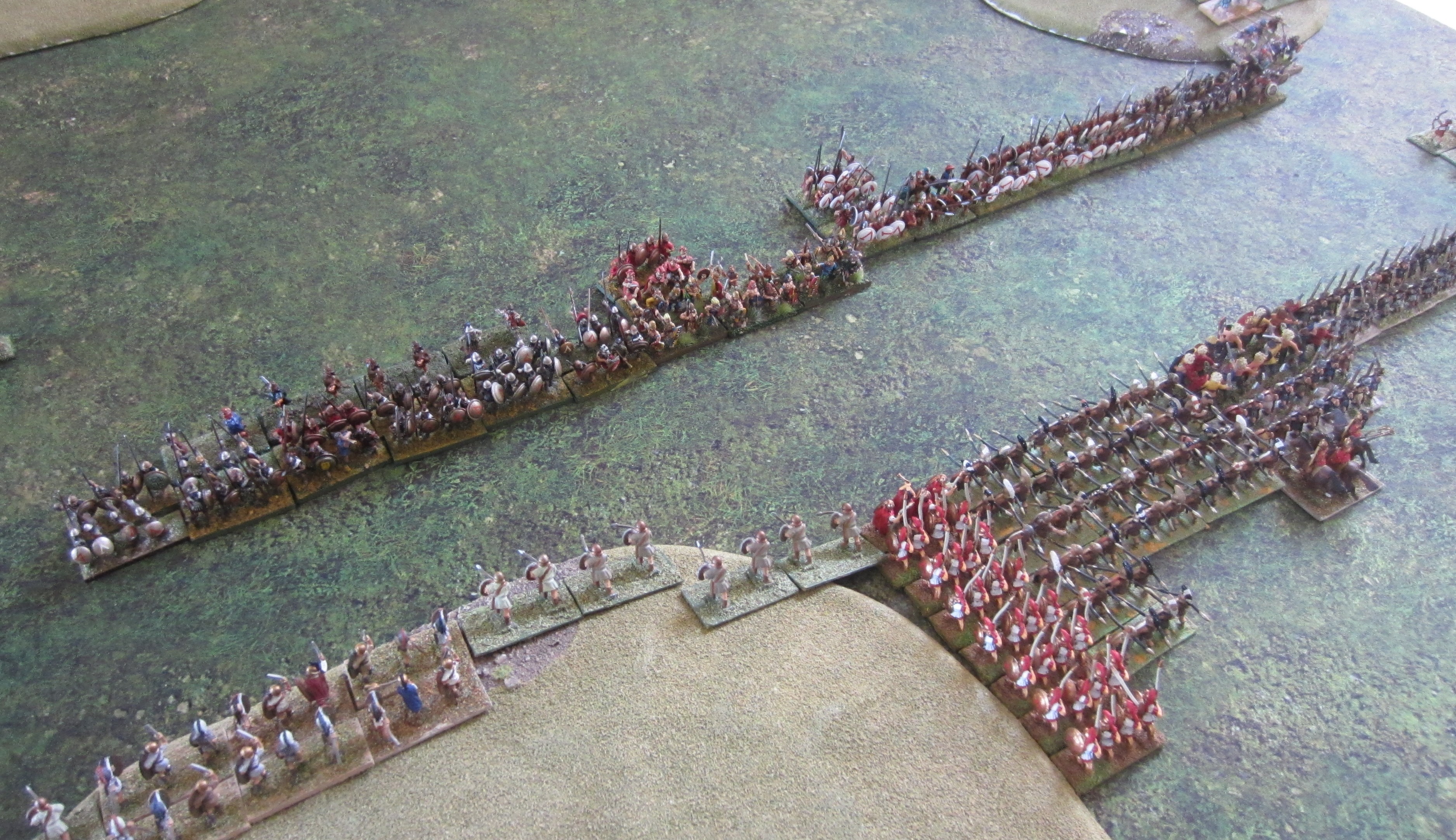
The main clash of hoplites and warbands is about to happen!
Solomon in All His Glory
The 23rd in my series of themed DBM competitions featured 18 Near Eastern armies dated 1000 to 850 BC. All went well as usual, with numerous chariots and mainly indifferent infantry clashing spectacularly. Gavin Pearson won the competition with his Mannaian army, on a tie-break from the Philistines led by Pete Connew and John Brooker. Ironically, for a competition with this title, the Later Hebrew Army of Solomon finished last! The full results are at Themed Competitions – JGL War Games

Mannaian (Kumme) against Babylonians in the first round

Top table in the last round – John Brooker faces Richard Lockwood

The trophies – a crashed chariot for the lowest scorer

Hebrews face invading Egyptians