
Holigost 2026
With my current enthusiasm for 25mm Biblical armies, I fielded Mitanni at the Holigost competition on the Solent. Three commands each with seven Superior Cavalry chariots, supplemented by various weak infantry (Ordinary Auxilia, Inferior Bows, a few psiloi), plus an Arab mini-command of four Ordinary Camels. Not much use in a straight-up fight but should be good at manoeuvring, with three Regular generals and high aggression.
The first game was against Marc Priest’s enormous Early Libyan army – mainly Fast Warband with some Inferior Bows and Ordinary Cavalry chariots, and a Sea Peoples ally with Fast Blades. Here was an enemy against whom a straight-up fight was possible, and so it proved. The Mitanni chariots comprehensively beat the warband and Sea Peoples, and though I lost the Arab command the Libyan army quickly fell apart. 9-1 win in under two hours.
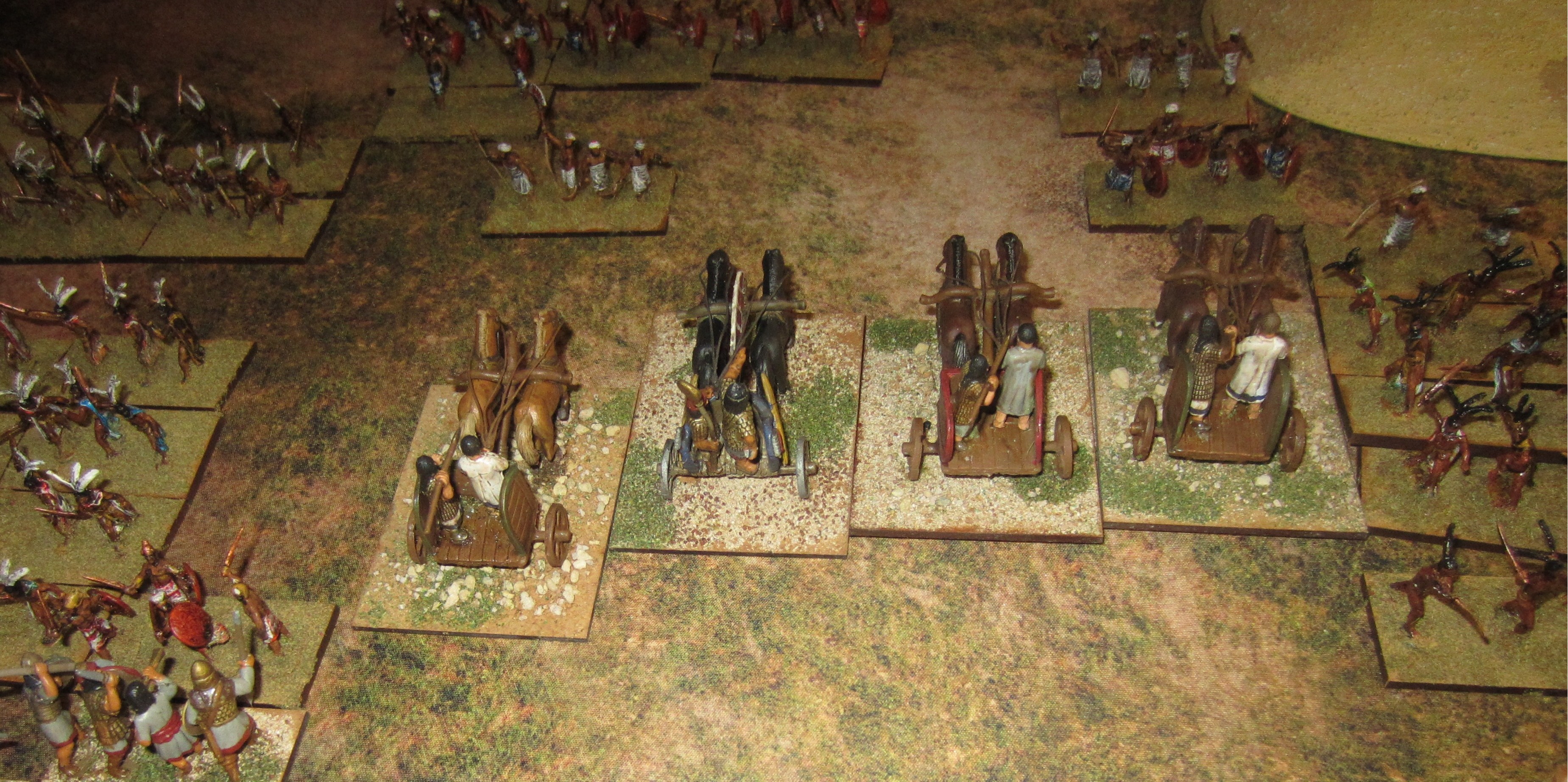
Chariots burst through the Libyan centre
John Vaughan’s Alexandrian Macedonians posed a much tougher challenge. My army had no answer but manoeuvre to pikes, and the combination of elephants and Fast Knights looked pretty deadly. In the centre most of the pikes were neutralised by skirmishing chariots, but on the right the knights and elephants made short work of chariots and infantry. On the left the Macedonian command looked much weaker and my chariots and the Arab camels went for cavalry, light horse and auxilia with great success, breaking a command, but on the right I lost two commands in quick succession, breaking my army. 1-9 defeat in an excellent hard-fought game.
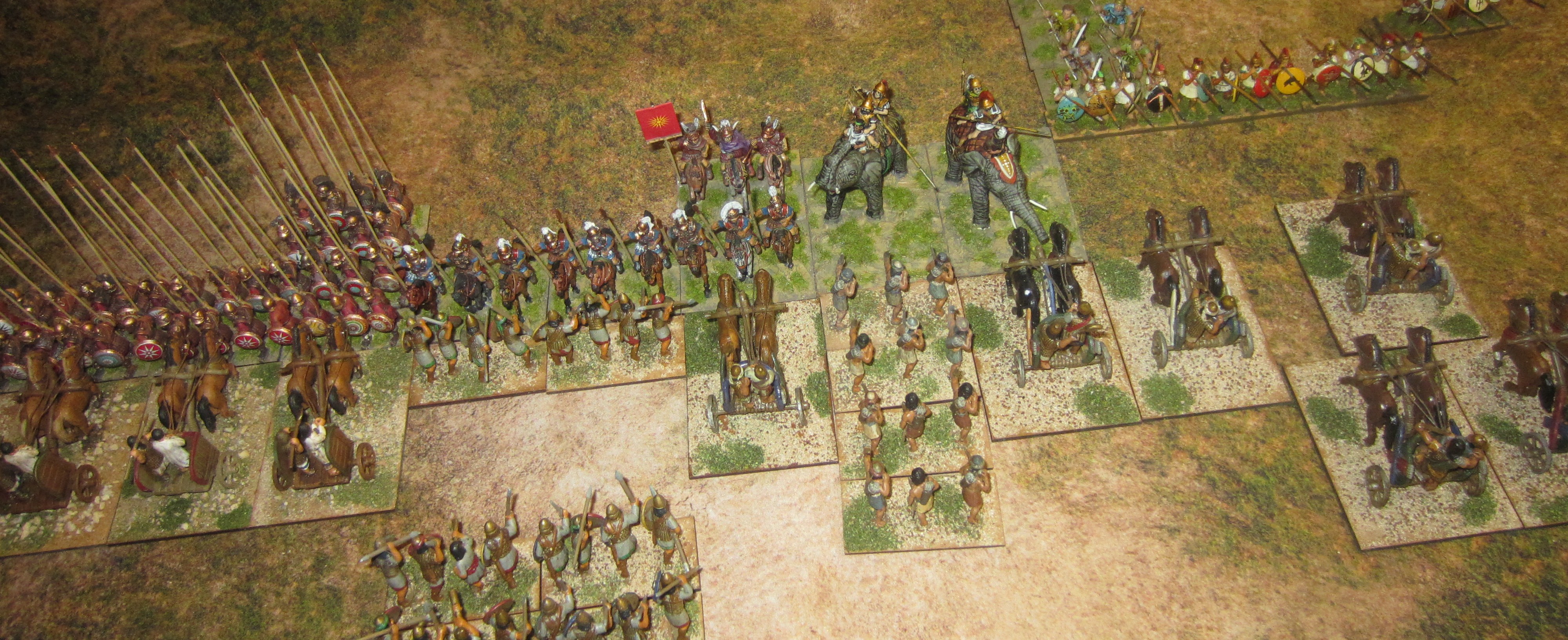
Tough going against pikes, knights and elephants
Sunday was very disappointing. Andy Leeser’s Suevi masses formed a nearly impregnable position between two steep hills and declined to advance: we quickly agreed a 5-5 draw.
Finally I faced Gavin Pearson with Palmyrans: cataphracts, bowmen, camels, many light horse and an Arab ally with more camels and light horse. Gavin is a master of manoeuvre, but I felt I could match his army as long as the PIP dice were reasonable. They weren’t. Gavin’s PIPs were excellent – three sixes for the Palmyran commands on the first turn – and mine were abysmal. This enabled the enemy to get around my left flank, stall my attack with auxilia into rough going in the centre and arrange the optimal matchups on the right. I brought up bowmen to shoot at camels there but too slowly – the camels were supported by cataphracts who shrugged off the arrows and rode down all the bowmen, breaking my command. I saw chances of counter-attacking elsewhere but the next PIP dice for the Mitanni commands were two ones and a two. I decided that it wasn’t my day and conceded the game.
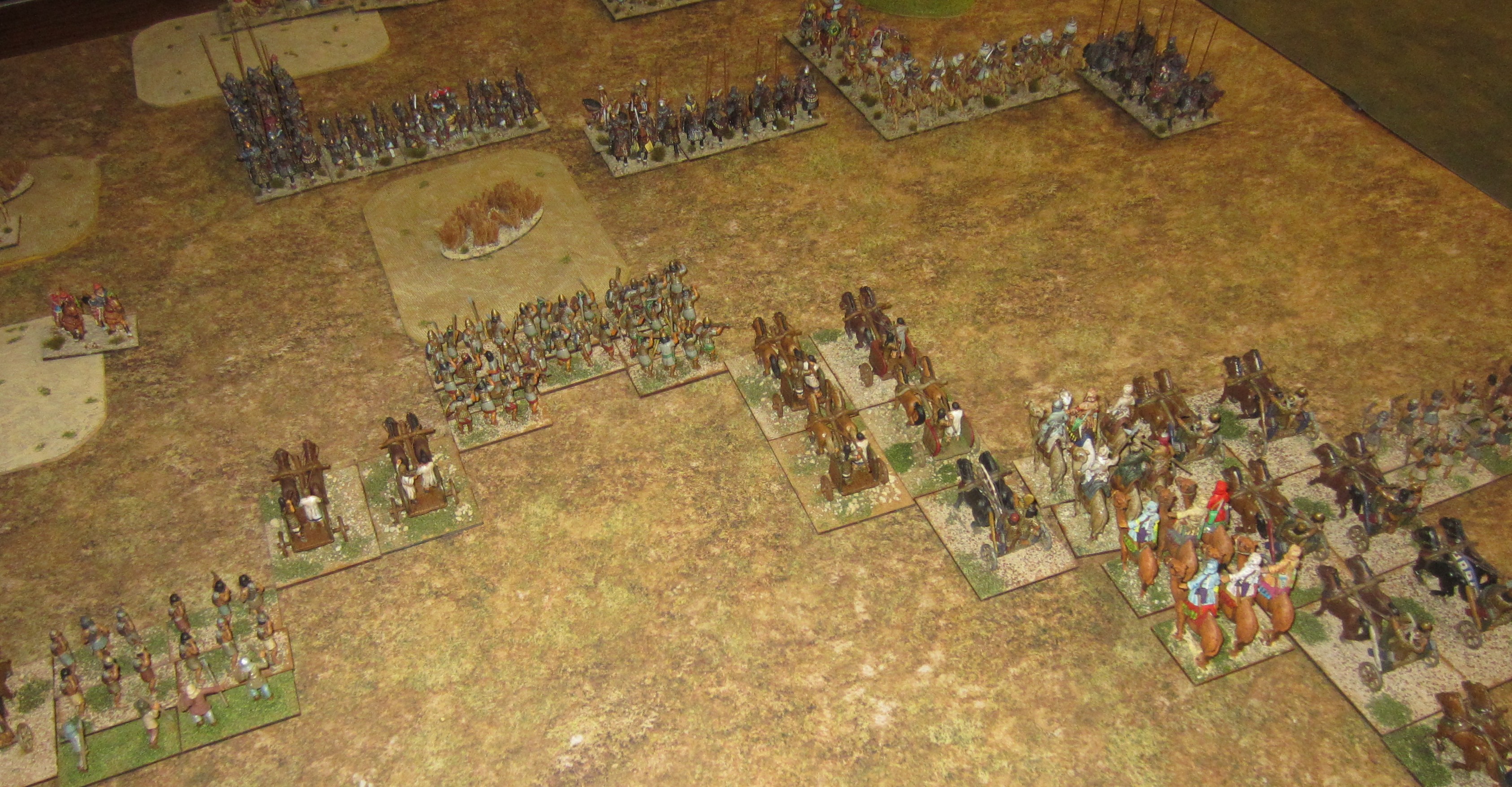
The Palmyran cataphracts on the far right struck the fatal blows
15 points made a disappointing total for the weekend but most of the games were good!
Iceni 2026
Russ and I took Hannibal’s army to the doubles competition in the Norfolk Broads. Three Carthaginian commands with spearmen, elephants (seven altogether), auxilia, psiloi, a few cavalry and some light horse, plus a Spanish ally with more light infantry and a few more cavalry. With all those light infantry we needed plenty of rough terrain.
First we played John Mee who had an early Seleucid army. The terrain wasn’t helpful, but deploying second we lined up elephants opposite Seleucid lancers (Fast Knights), while more elephants faced the pike phalanx. Unfortunately our spearmen and some Ax(S) were against a strong force of Galatian warband. Our plan was to hold back on that flank and attack strongly against the lancers with elephants and more spearmen. Unfortunately the opening PIP dice decided otherwise: we could advance only very slowly, while the lancers were able to gallop away and threaten to envelop our left flank. We did eventually force the lancers to fight and broke that command, but meanwhile the Galatians got to our line and quickly destroyed six Spear elements for the loss of only two warband. When “last bound” was called we were still a command up but a couple of bad combat throws lost two Ax(S) against warband and that broke our C-in-C’s command. 4-6 loss.
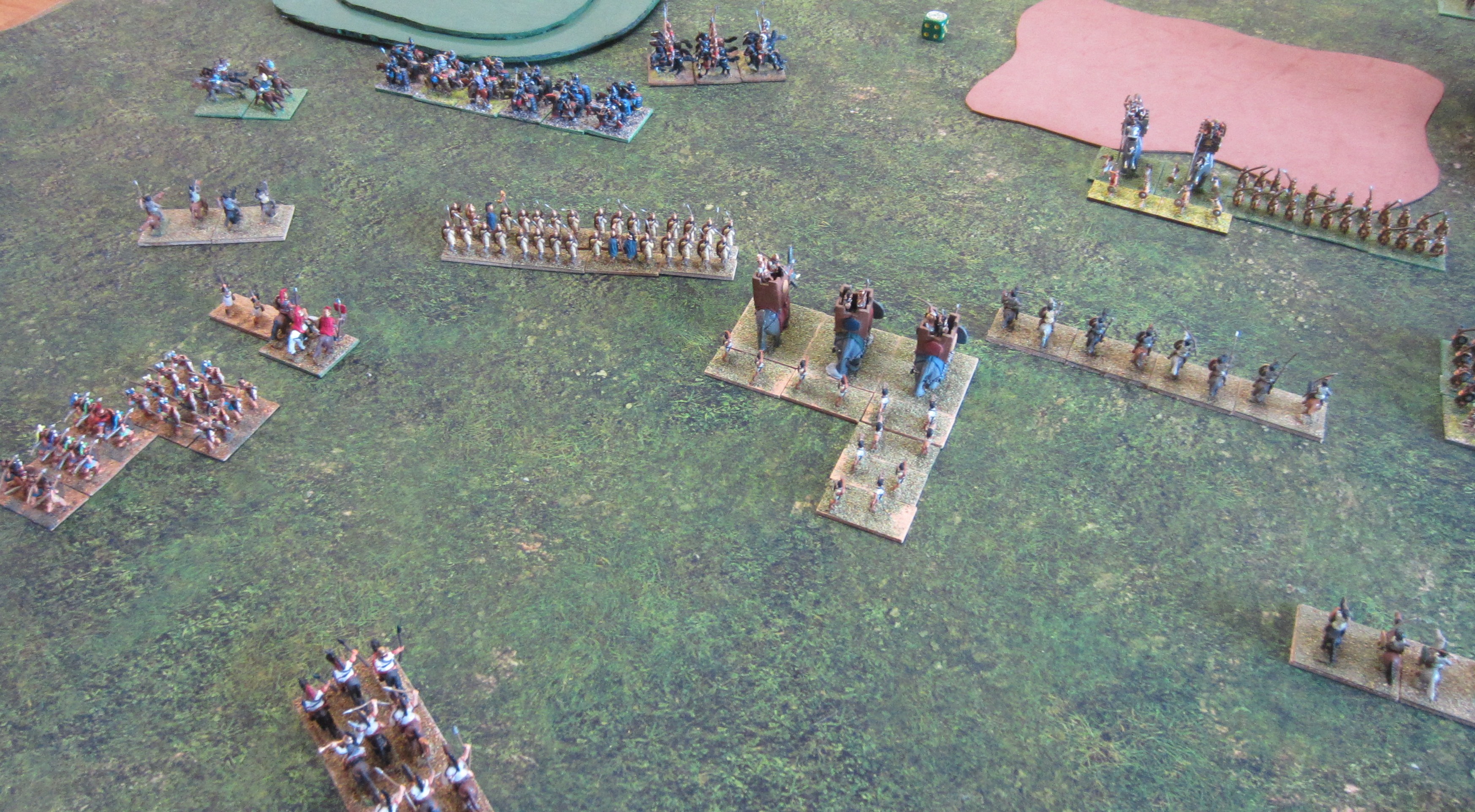
The lancers ride away from the spearmen and elephants – but they were eventually caught
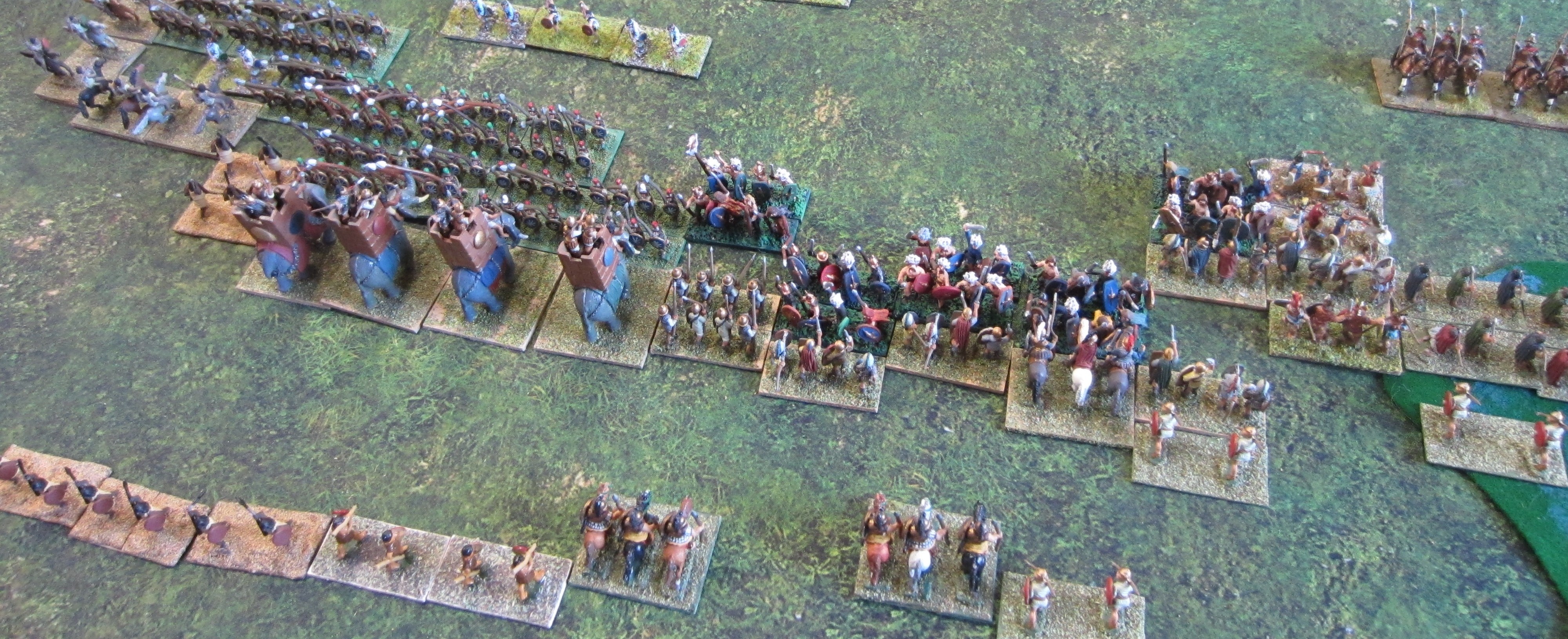
Galatian warband smashing our infantry line
The second game was against Drew Jarman who had French Ordonnance, including a substantial command of Swiss pikemen in the centre. We opposed these with elephants and concentrated on attacking the French left which had mainly bowmen, organ guns and a couple of war wagons with knights in reserve. The French shot effectively, destroying an elephant and some of our cavalry and auxilia, and though we managed to get to grips and destroy the artillery and a wagon a dribble of casualties broke one of our commands. Another 4-6 loss.
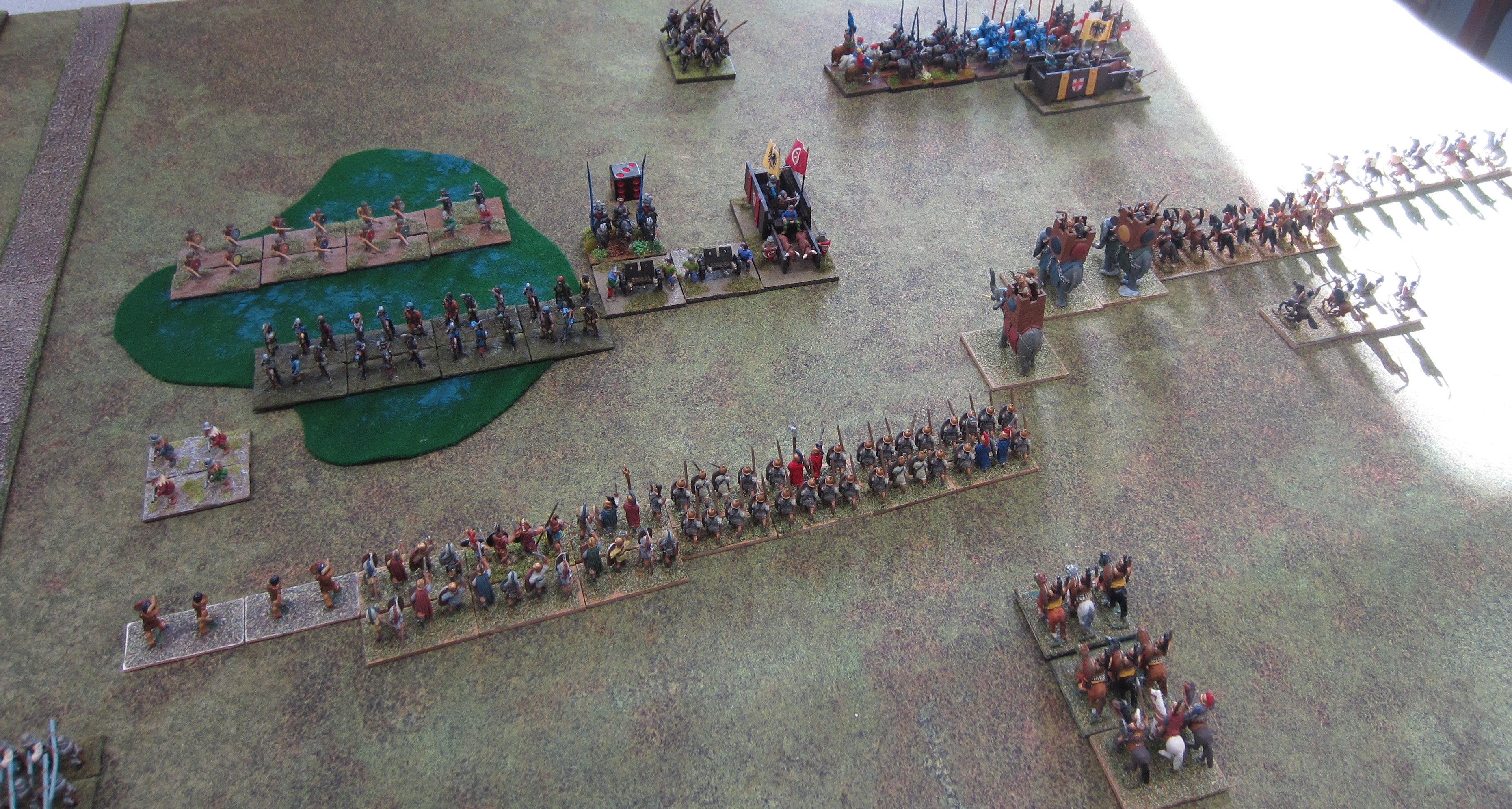
The French war wagons are shooting effectively
On Sunday morning we arrived to find that Jeremy Morgan had had to rush home because of sudden family illness, leaving his army behind. The organiser asked me to even the numbers by playing solo with Jeremy’s Middle Assyrian army.
Jeremy had been due to play John Mee, so I faced the Seleucids once again, this time with an army of Cv(S) chariots, Fast Blades, Inferior Bows, Auxilia and psiloi – four commands including an Aramaean ally with more of the same. The pike phalanx was neutralised by skirmishing chariots. This time the Galatians faced superior numbers of Blades with psiloi support, and they destroyed only a few elements before succumbing. I had sent chariots around that flank and they destroyed enough Fast Knight lancers to break the enemy C-in-C’s command. The game timed out before I could exploit that success so it ended in an 8-2 win.
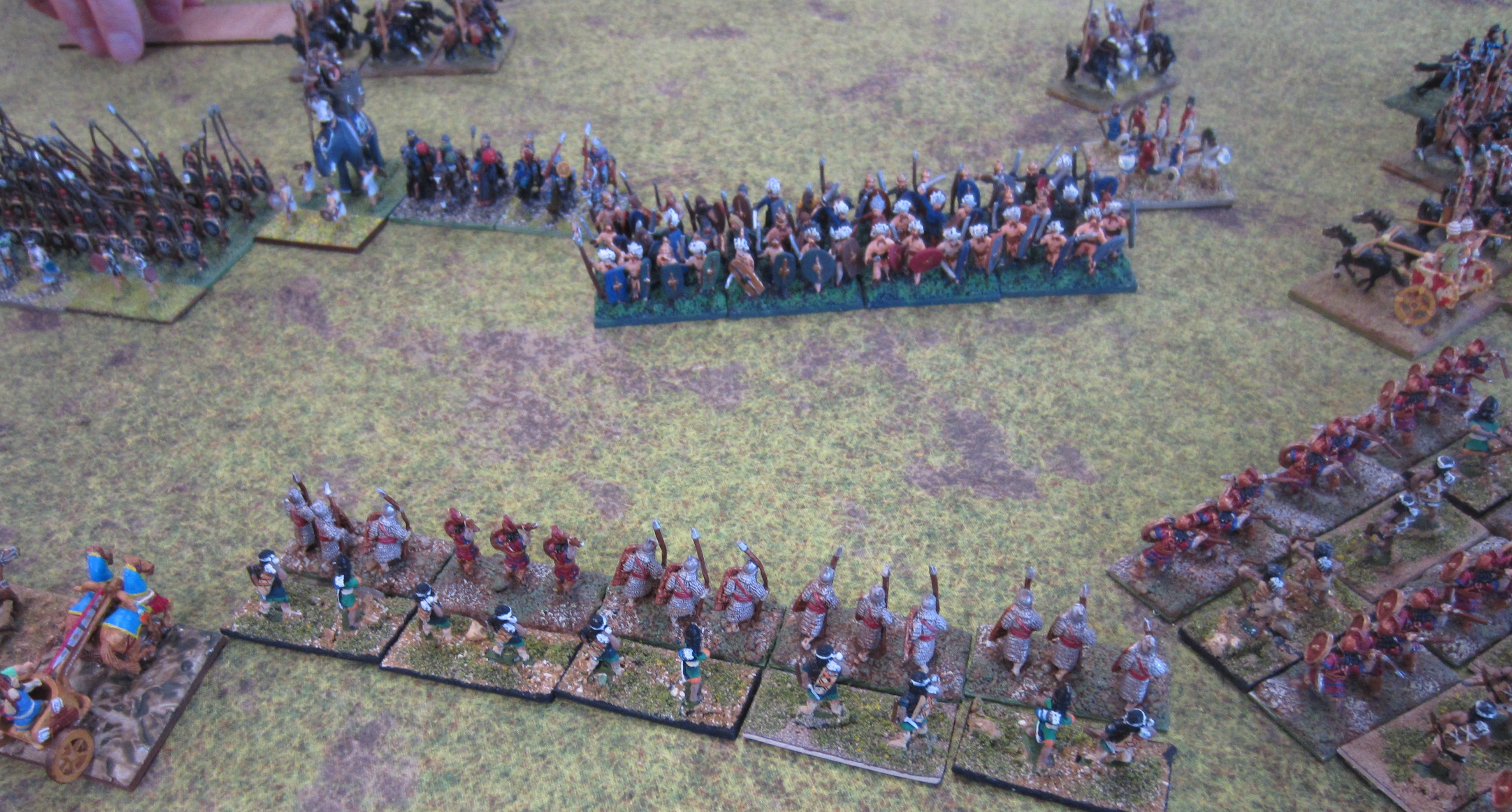
This time the Galatians were outmatched
Going into the last round Kevin Everard and Paul Holmes were top of the table with Late Romans, including an Arab ally with light horse and camels. I faced them with the Assyrians, and concentrated on the right flank where chariots faced the Arab light horse. In the centre my Fast Blades swordsmen and auxilia fought legionaries, with losses on both sides, while chariots charged a force of bowmen. Several chariots were lost but they managed to destroy most of the bowmen and then some auxilia. Late in the game the Roman C-in-C’s command broke, while mine was also close to breaking. Meanwhile the Arab light horse retreated onto a gentle hill on the Roman baseline, then had to stand and fight; the Assyrian chariots pushed them back over the hill crest then slew enough to break the Arab command (the Arab general recoiled off the table). That was enough to break the Roman army, but in the same combat round I lost another Blades element and my C-in-C’s command also broke. 8-2 win.
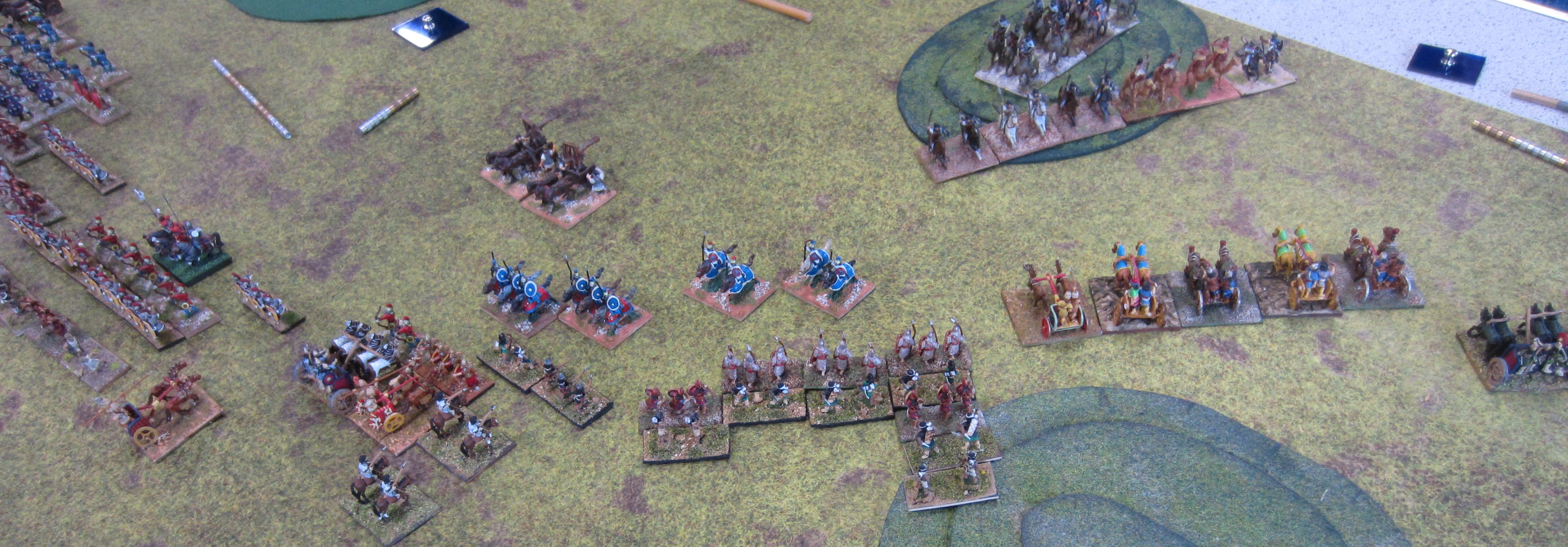
The Arab light horse retreat to their hill – where they stood and died
My score of 16 points added to Jeremy’s 10 from Saturday’s games was enough to win the competition. A pleasing end to the weekend.
Climb British Camp 2026
Eight players at Gavin Pearson’s 25mm competition, four of them with Macedonian pike armies. I fielded one of these – Pyrrhic, with two smallish pike blocks, assorted mounted (including one elephant) and numerous psiloi.
First I played Nick Coles who had Seleucids. Also pikes, of course – fewer than mine but with some Superior and supported by Galatian warbands. He had cataphracts, various auxilia and some light horse. This was a rip-roaring all-action game with fighting all along the line and massive casualties on both sides. The warband slew some of my pikemen but also took losses, including several ridden down by Pyrrhus in person; the Seleucid C-in-C’s command broke and the King himself was eventually slain by pikemen assisted by Pyrrhus’s bodyguard. However, the elite pikemen defeated my phalanx and broke my C-in-C’s command. Elsewhere the various mounted troops swapped casualties and the game was decided when a group of my psiloi destroyed a light horse element which was in front of the Seleucid elephant – this broke a second command and the Seleucid army. 7-3 win; my army was only one element from breaking too.
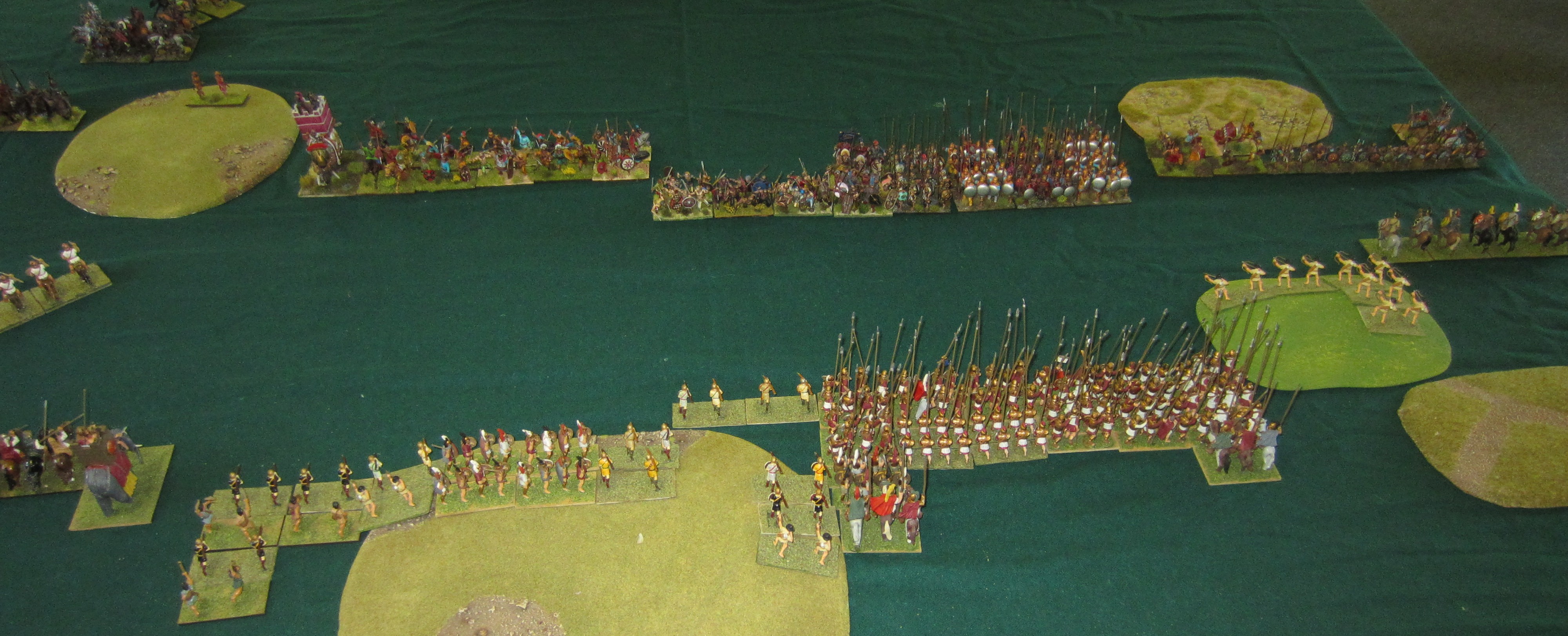
The Pyrrhic phalanx faces the Seleucid phalanx and Galatian warband
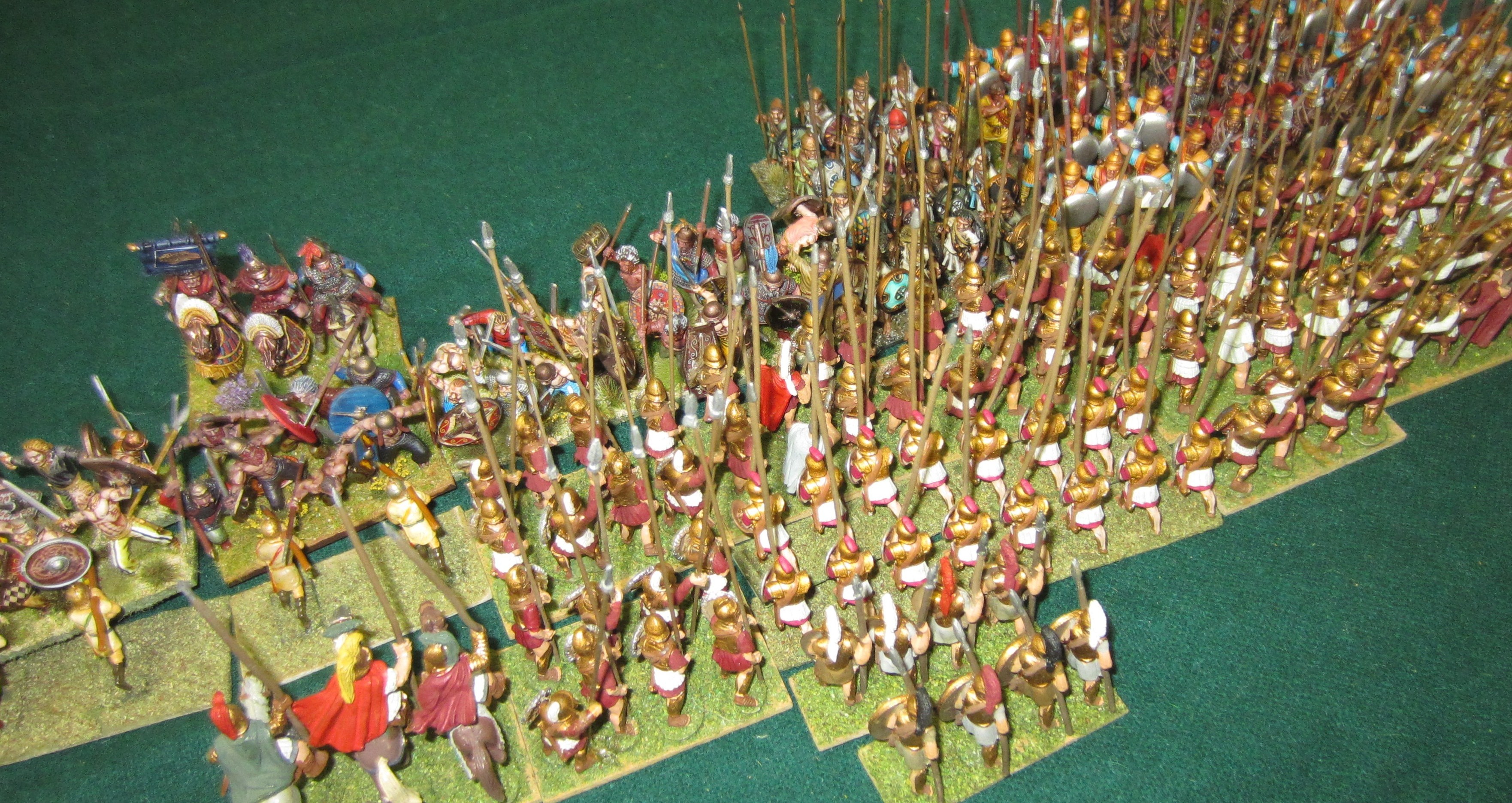
Pyrrhus is about to ride down Galatians then trap the enemy general
Next I faced John Vaughan with Romanian Franks. I invaded and placed steep hills which I could dominate with psiloi. The Frankish knights, nervous about facing pikes and an elephant, sheltered at the back behind large numbers of archers – mostly Bw(O) crossbowmen including a Venetian ally, but with some Bw(I) on the left flank facing steep hills. I sent a large force of psiloi to attack these and destroyed several elements, opening up that flank. The knights behind the archers started to come forward but one element was mugged by psiloi and that Frankish command broke.
In the centre the Frankish and Venetian crossbowmen shot with deadly accuracy, killing many of my light infantry and then my elephant. On the right flank the Frankish knights eventually charged against my mounted troops, hampered by a steep hill held by my psiloi; I got a couple of knights but my command, weakened by shooting casualties, broke. However, over on the left my psiloi got into the enemy baggage and destroyed just enough to make half the Seleucid army. My pikes did very little; in their only significant combat they lost two elements to a flank attack by auxilia. 9-1 win.
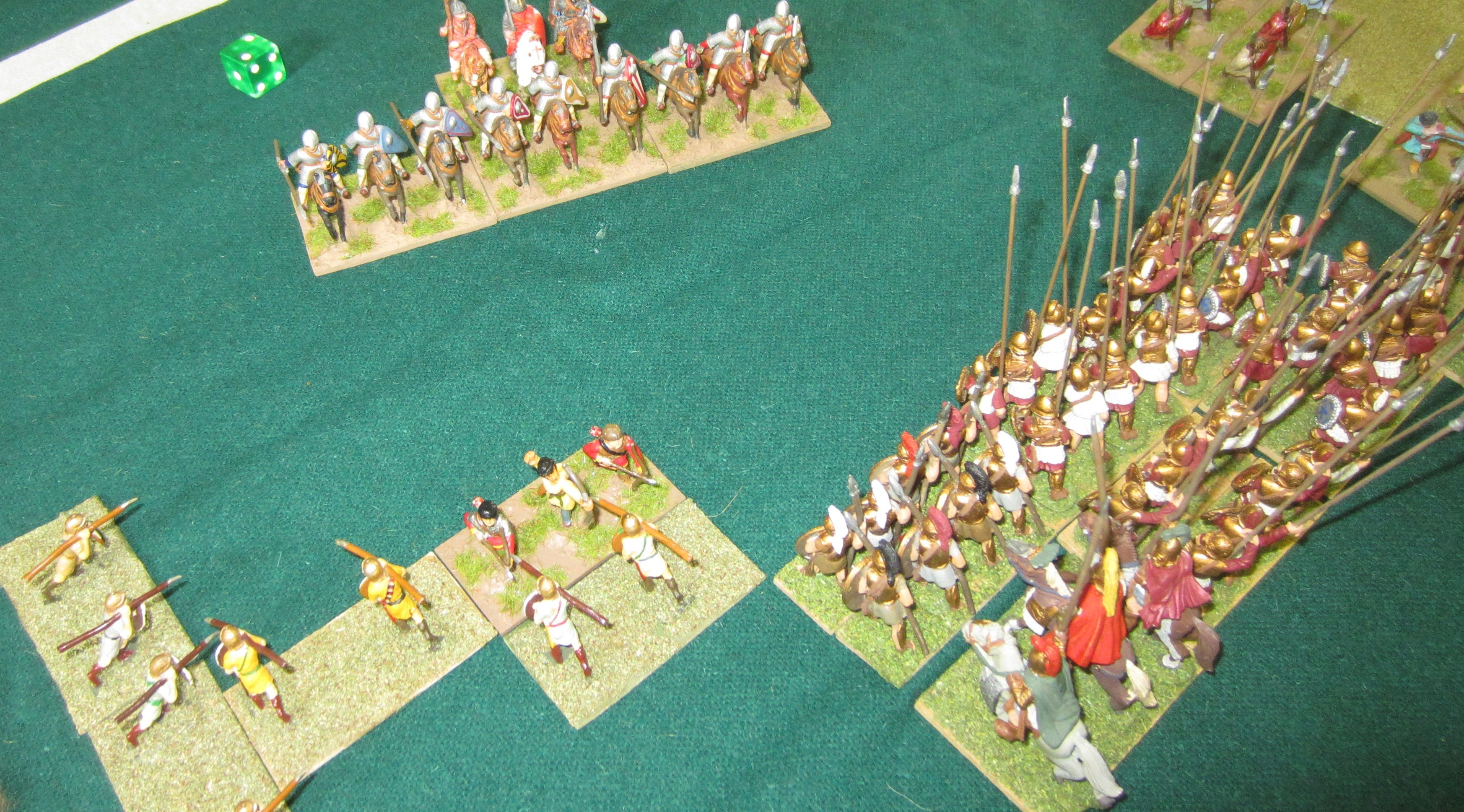
Pyrrhic psiloi finish massacring the enemy Inferior Bows
On Sunday morning Pyrrhus invaded Achaemenid Persia, defended by Gavin Pearson as Xerxes I. Gavin had four commands, which proved a crucial advantage as he was able to set up his final command on the right with sparabara Bw(X) facing my mounted troops and cavalry (invulnerable frontally against pikemen) against my phalanx. I attempted to redeploy behind a light horse screen, but the Persians rapidly closed down the space and opened up with their numerous bows. A hail of arrows was very effective, but during a brief rain shower a Macedonian general and a cavalry element broke through the sparabara line. A passing advantage, though as the double-overlapped general was then slain by Persian cavalry and his command was soon broken. In the centre Pyrrhus’s phalanx, after some delay, advanced to the attack and clashed with the Persians’ Greek hoplites. Outnumbered, the pikemen had little success and eventually my army broke on total losses for a sad but hard-fought 0-10 defeat.
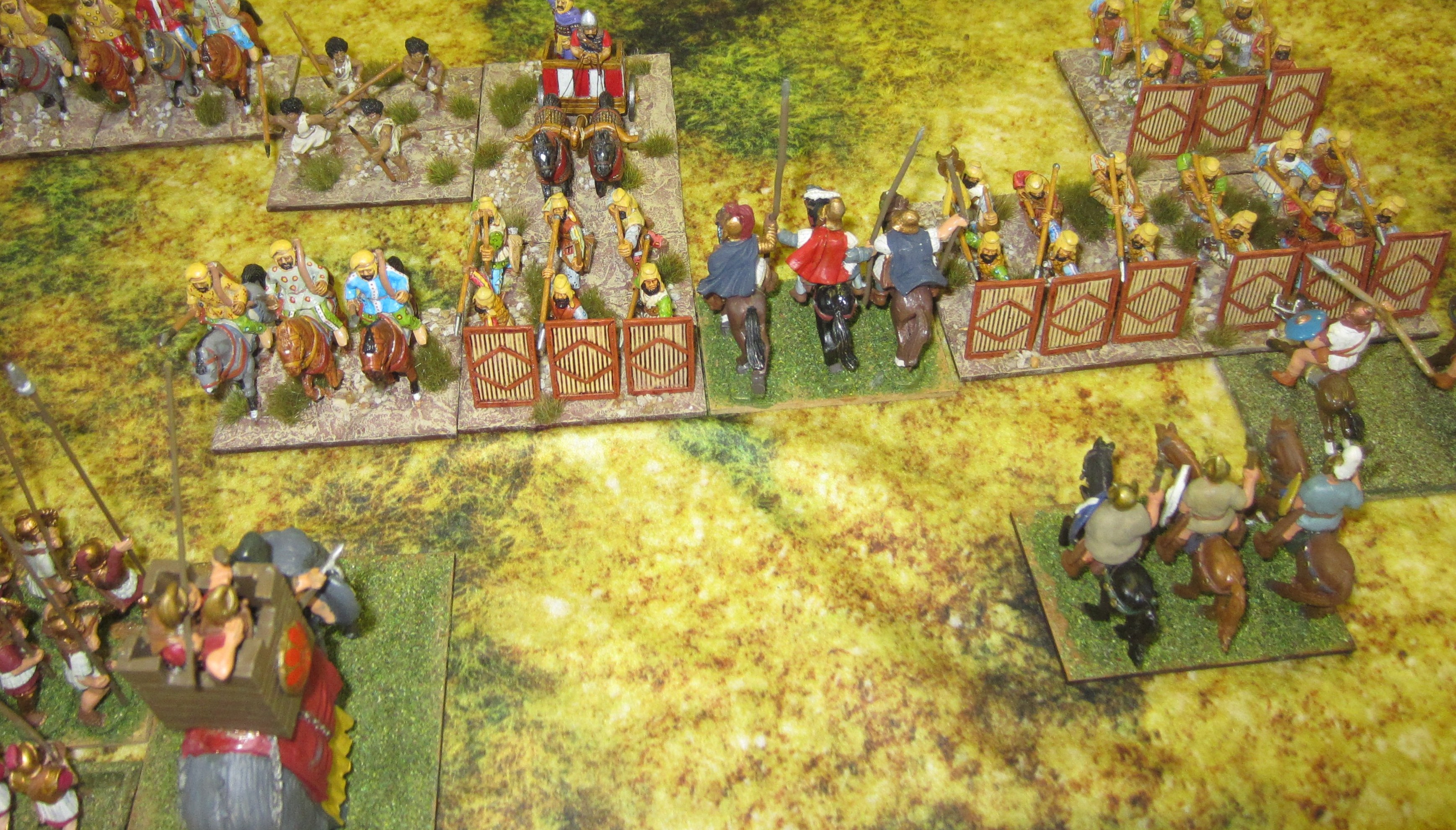
Breaking through the Sparabara wall. A temporary success
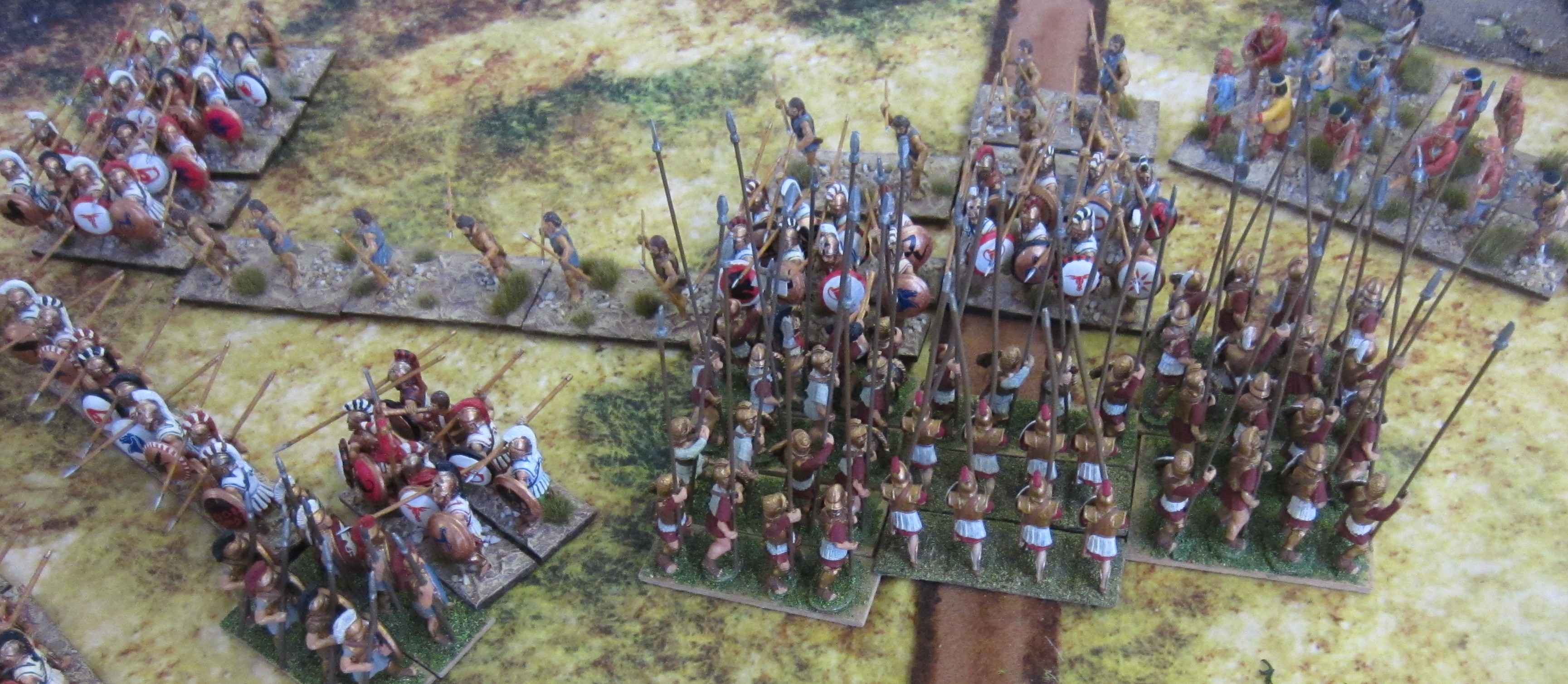
Pyrrhic phalanx versus Greek hoplites
The fourth game was against Duncan Thompson with Scots Isles and Highlands – mainly Blades with some bows and a substantial Galwegian command of Fast Warband with a Fast Blades general. The main action was very simple: my pike phalanx advanced and engaged a mass of Ordinary Blades. In an early combat a Highland general died to a 6-1 dice split; his command survived but was now pretty much immobile. One pike element was shot down but the rest slew numerous Blades and pushed relentlessly forward; one Macedonian general destroyed several Blades elements. On the left the Galwegians hid in an area of rough going, nervously eyeing the Pyrrhic lancers and single elephant. I sent light horse and psiloi to attack their general and, even in rough going, they killed him and a couple of warband elements. The Galwegian command broke. Then the Islesmen C-in-C was also slain by the dice – 5-1 this time – and his command broke to end the game in a 10-0 win.
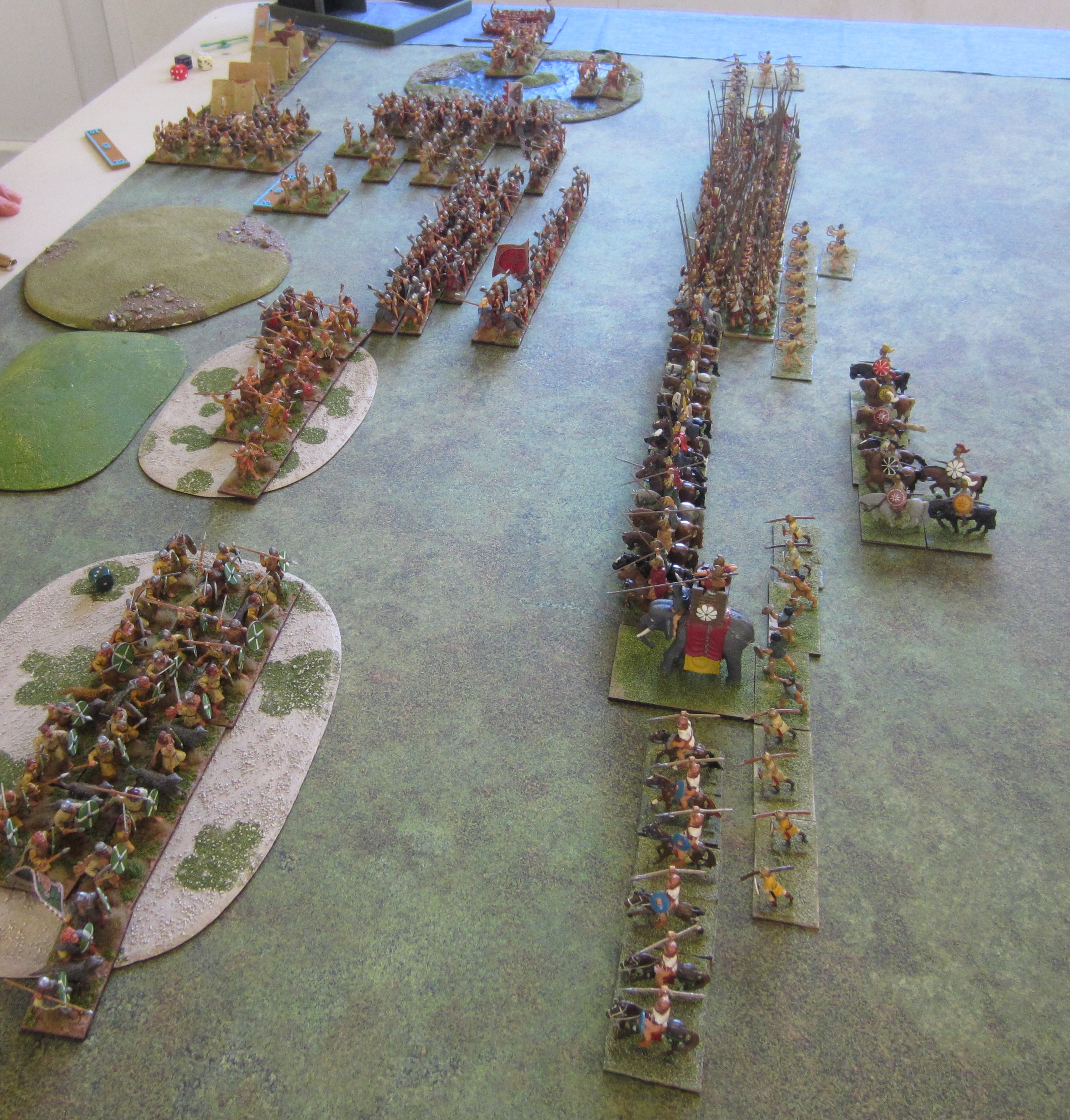
The Scots and Pyrrhic armies at deployment
I finished third, behind second-placed Jeremy Morgan on a tie-break, and Gavin won the competition one point ahead of us. An excellent weekend’s gaming as usual.
French v Germans, 13th century
The latest “Big Battle” DBM game, with three players a side, featured 13th century Feudal French and Medieval German armies, 25/28mm figures on an 8’x5’ table. 500 points, so large armies each with four commands. Given the date, Knights would be the dominant troops. The 23 elements of German knights were all Ordinary and Regular; the French, with slightly greater numbers, were all Irregular but more than half (16 including 4 generals out of 24 total elements) were Superior. These elite knights were grouped in two commands under the King and the single sub-general, while two ally-generals led the Ordinary knights. The French infantry were numerous but of generally poor quality, the best troops being mercenary crossbowmen. Each of the four German commands had some knights, a standard-wagon and assorted infantry.
The terrain featured a large wood on the German left, an area of rough going in the centre and some gentle hills which played no part in the game. The Germans refused their left flank and concentrated two commands against the French left. Crucially, one of these commands contained a block of Brabanter pikemen.
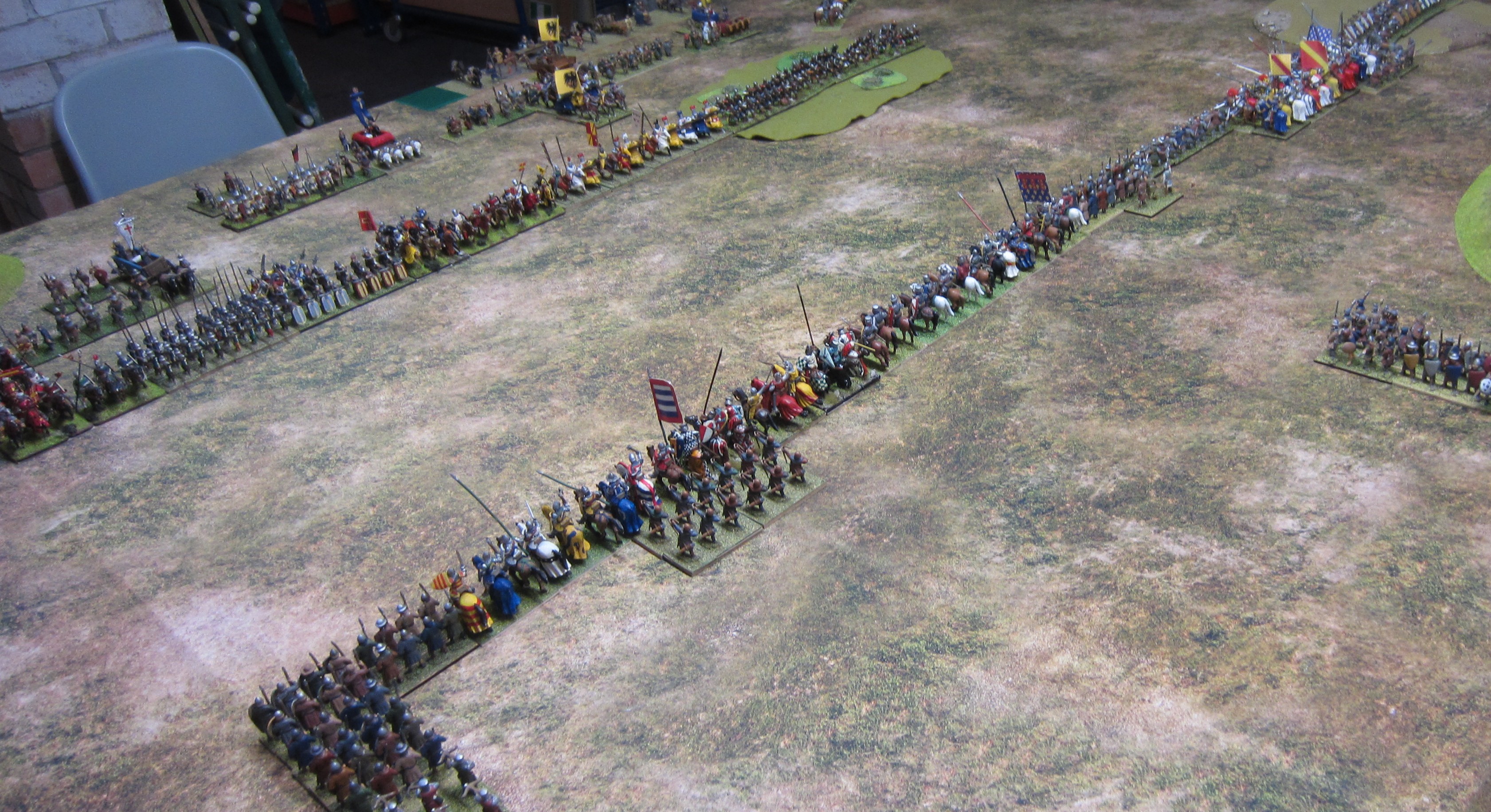
At deployment – French on the right. The Brabanters are at upper left
On that flank the German knights faced massed spearmen and crossbowmen so they all dismounted as Superior Blades. While this proceeded the French sub-general’s Superior knights rode forward and their formation was broken up by shooting from German crossbowmen. Two knight elements were forced by a low PIP throw to charge into the Brabanters, overlapped; 2-6 down and the knights died. However, the other knights then charged into the crossbowmen and destroyed four elements. The dismounted German knights attacked and made short work of French crossbowmen, and the French general, pursuing, was flanked and slain. The French command broke.
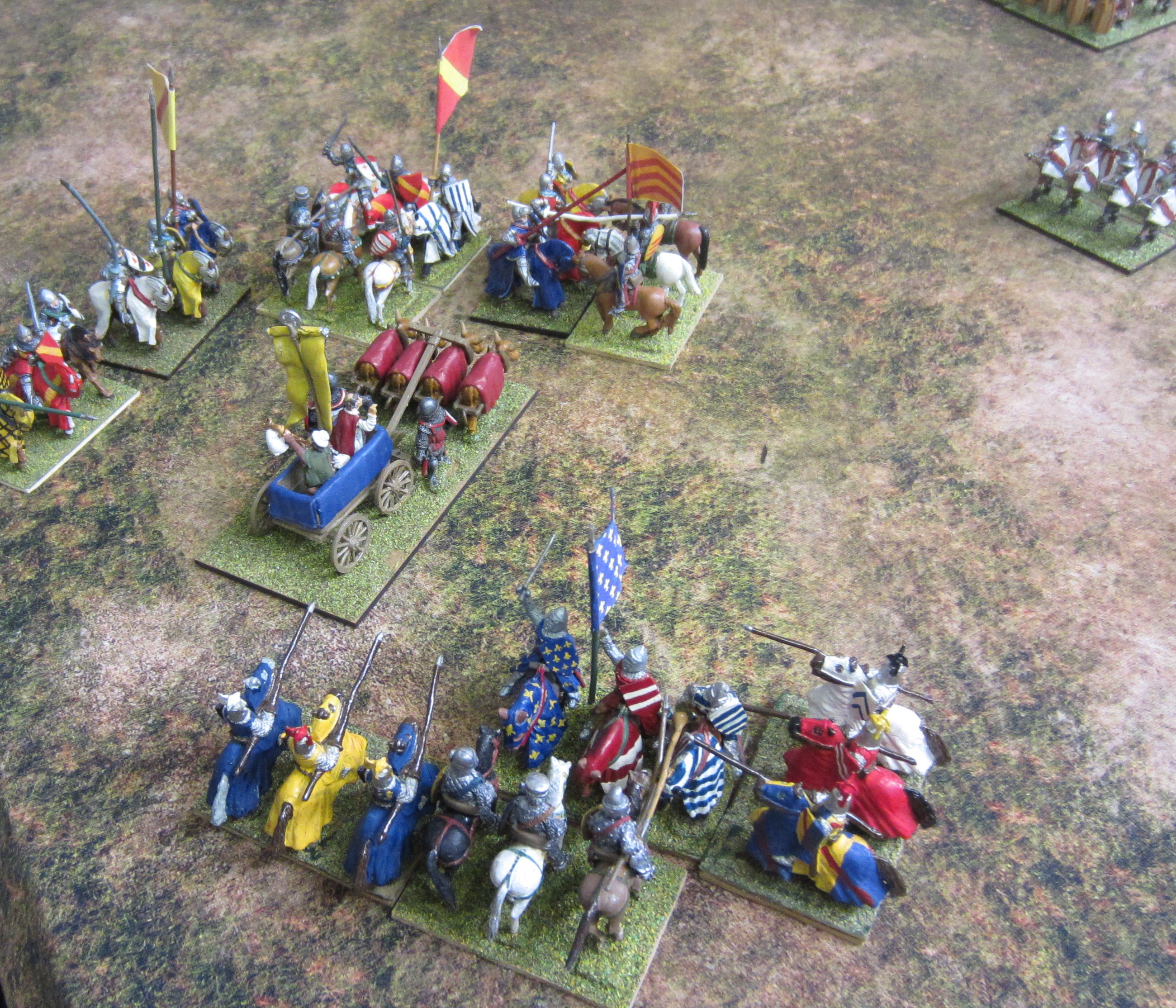
The French king is about to fall
On the other flank the French king manoeuvred his knights to go for German knights and a standard wagon (Inferior War Wagon) on the refused flank. One French element was unluckily shot down by crossbowmen shooting from the rough going, but the rest charged in and slew several German elements while also taking losses in a prolonged melee. The climax came when the French king was surrounded and cut down.
In the centre two French allied commands, with mostly Ordinary knights, attacked the German C-in-C. Mixed fortunes here with heavy losses on both sides, but eventually the German king (presumably Otto IV) was also flanked and killed. His command broke. However, after many shots the German crossbowmen destroyed an Inferior Blades element and that was enough to break one of the allied commands. The French army collapsed.
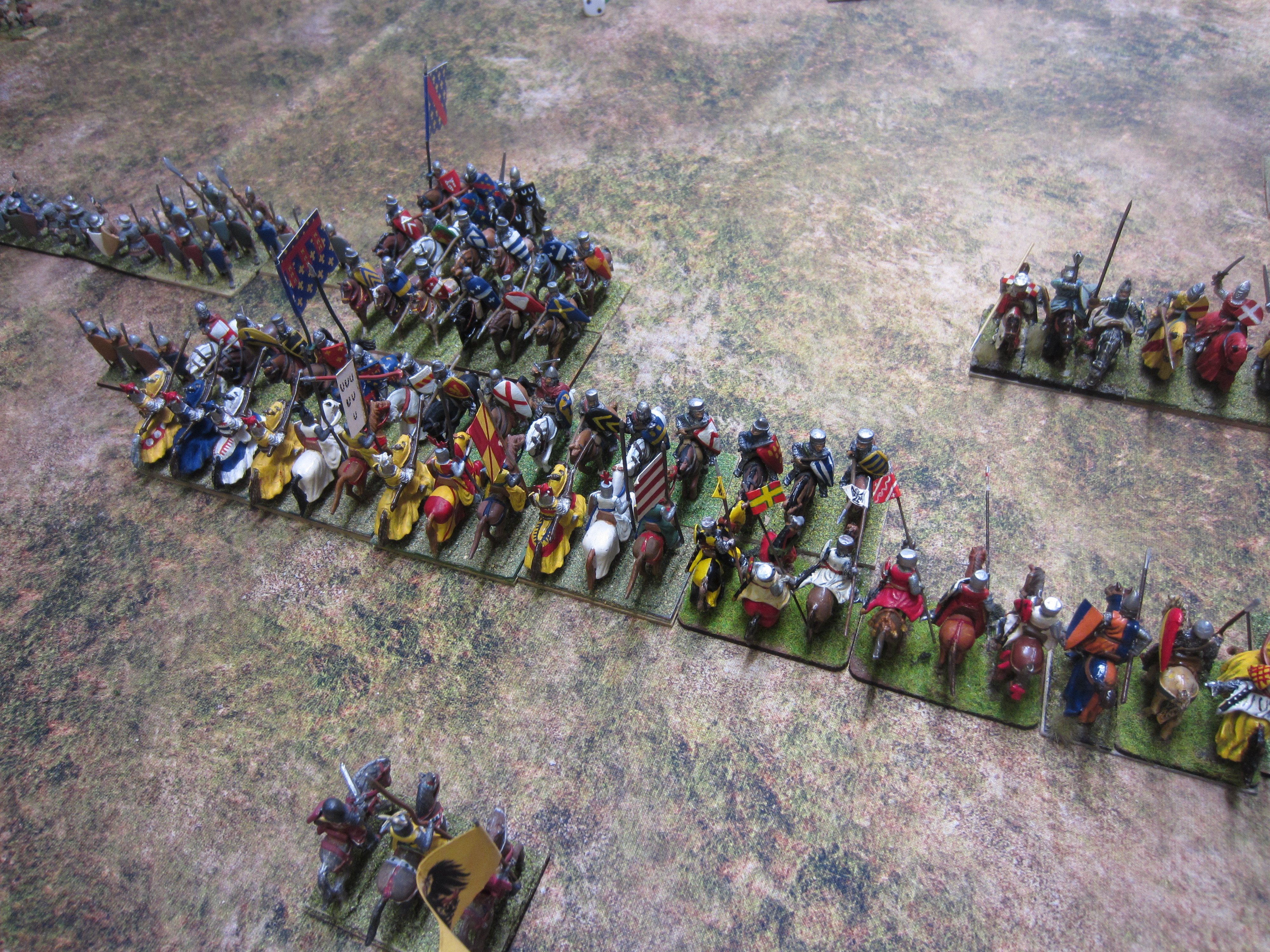
Knightly combat in the centre
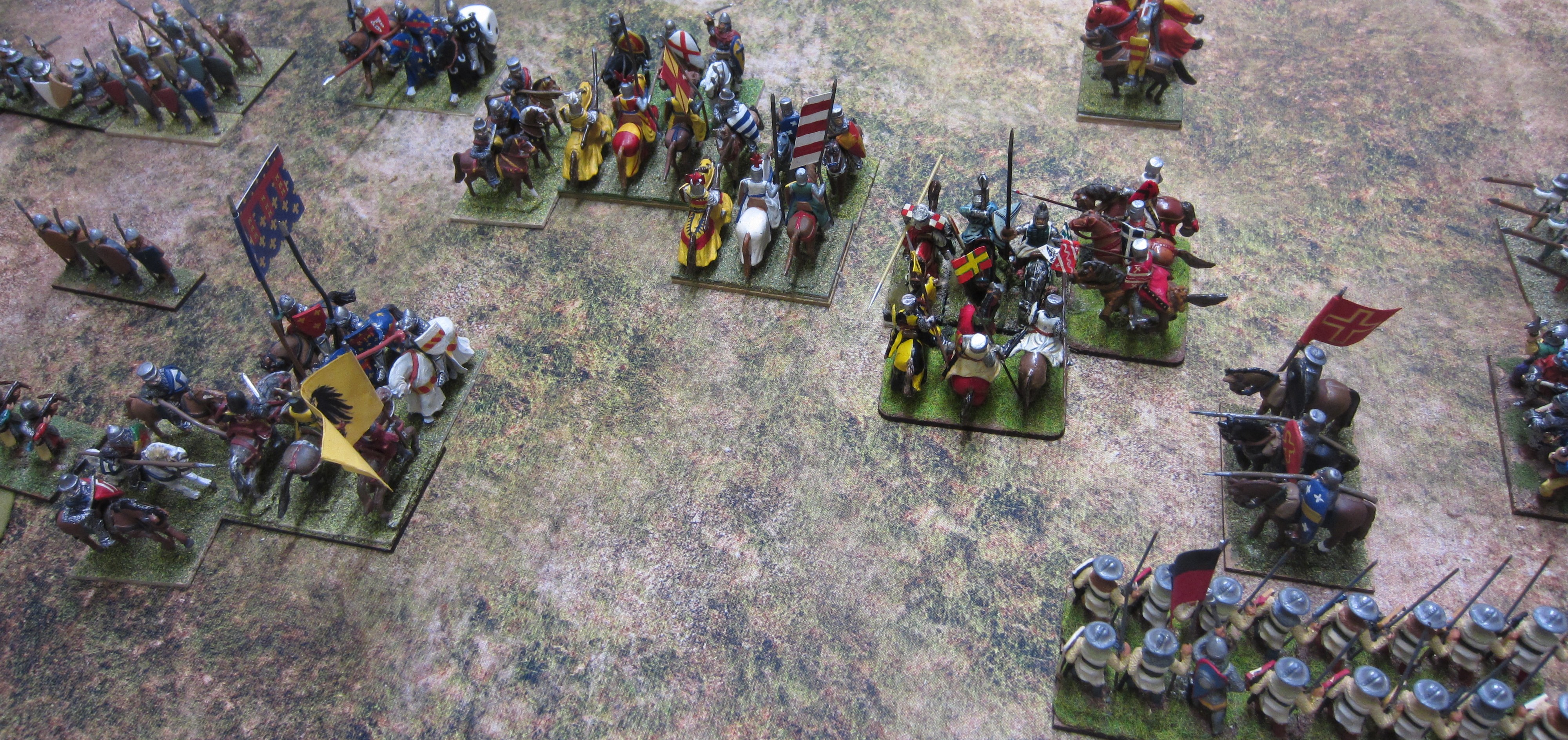
The French break through to slay the German king
A great spectacle with all those colourful knights on the table (in armour ranging from the late 12th to early 14th centuries), and a very hard-fought battle. 8-2 in DBM scoring, but two German commands were each a single loss from breaking. Most of the French infantry weren’t engaged, most PIPs being needed to control the knights.
Corinium 2026
The theme for this doubles competition was “Elite Armies” – must have four commands and no more than 70 element equivalents, so needing expensive troops. Unsurprisingly, there were lots of elephants, superior knights, artillery etc, and expendables as these don’t count as element equivalents. We took Middle Imperial Romans; three commands with Blades (the C-in-C’s Blades were Bd(S) Praetorians) plus the usual supporting troops including three Fast Artillery. Our fourth command was an Arab mini-command of four Light Horse.
In the first round we faced Pete Connew and Richard Newland with Later Carthaginians, Hannibal at Zama, featuring eight expendables (untrained elephants) and a Numidian ally. The elephants were a nuisance; all were soon destroyed, but they inflicted significant casualties and disordered our ranks, weakening our centre. They were followed up by spearmen and cavalry who infl;icted a trickle of casualties while taking losses themselves. The Numidian ally on the left soon lost a couple of LH elements and the rest fell back; one more loss would have broken that command. On the right a strong force of Gallic warband attacked the Praetorians and some auxilia who were in rough going; numerous warband died but so did several Praetorians, eventually breaking our C-in-C’s command. With losses elsewhere that made half our army gone so we lost 0-10. A very hard-fought game; Hannibal’s command, like the Numidians, was itself only one loss short of breaking.
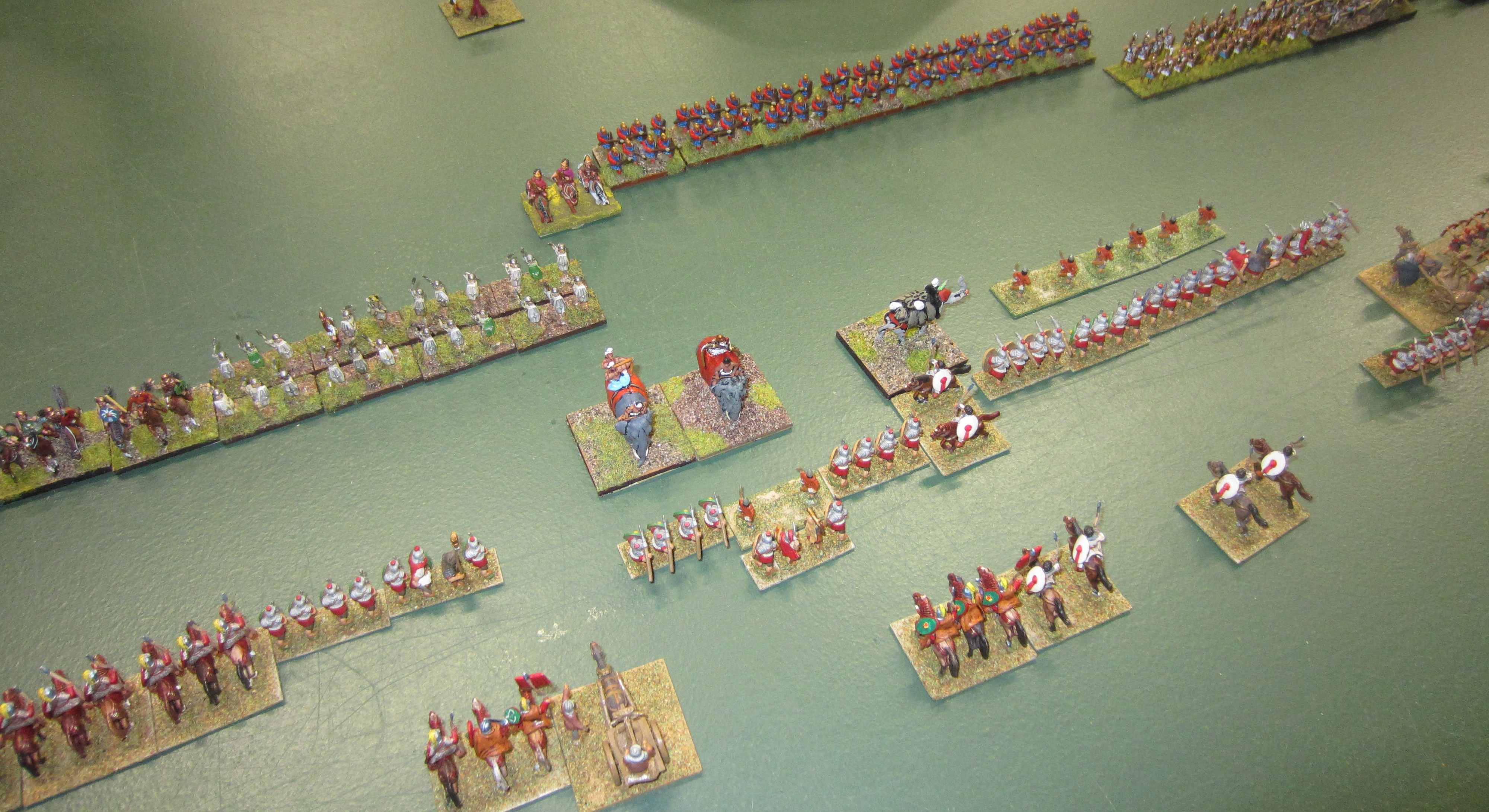
The expendable elephants have caused chaos
Our next opponents were Martin Golay and Tony Green with Ming Chinese. More expendables (thunderbomb oxen) but these did no damage other than some delay to our planned attack. We refused our right flank while attacking in the centre; losses on both sides, but our right-flank command was overmatched and eventually broke. The game timed out at 4-6.
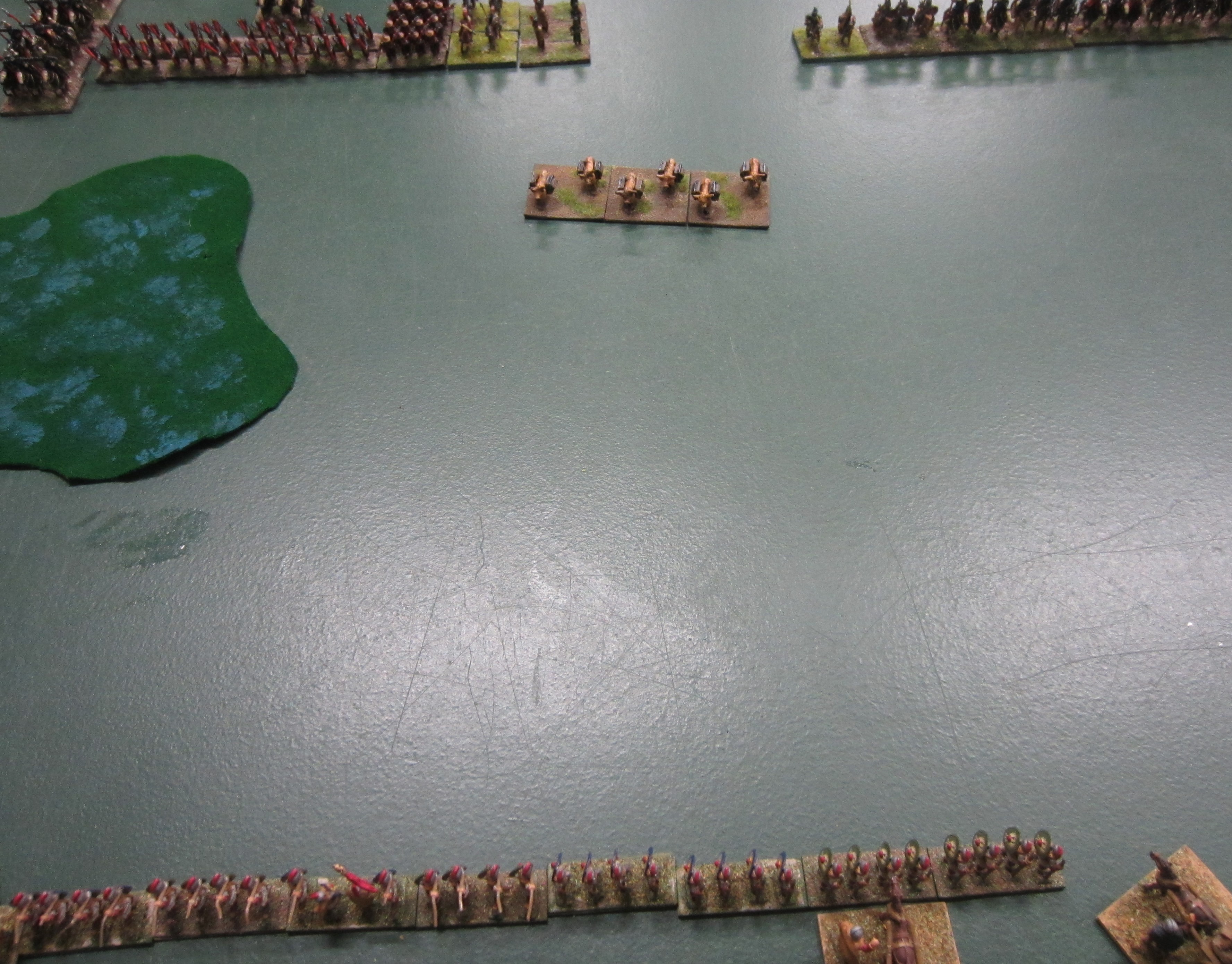
Thunderbomb oxen head for the Roman line
The third game was against John Calvert, who had taken over a Neo-Babylonian army at short notice. The key units in this game were our artillery, which shot down Kn(S) chariots and Bw(X) bowmen to break one small command. Meanwhile the Babylonian chariots rode down supported legionaries and cavalry – three 6-1 dice splits in one combat round – to break our smallest Roman command. Then our legionaries destroyed some camels and a second Babylonian command broke to give us a 9-1 win.
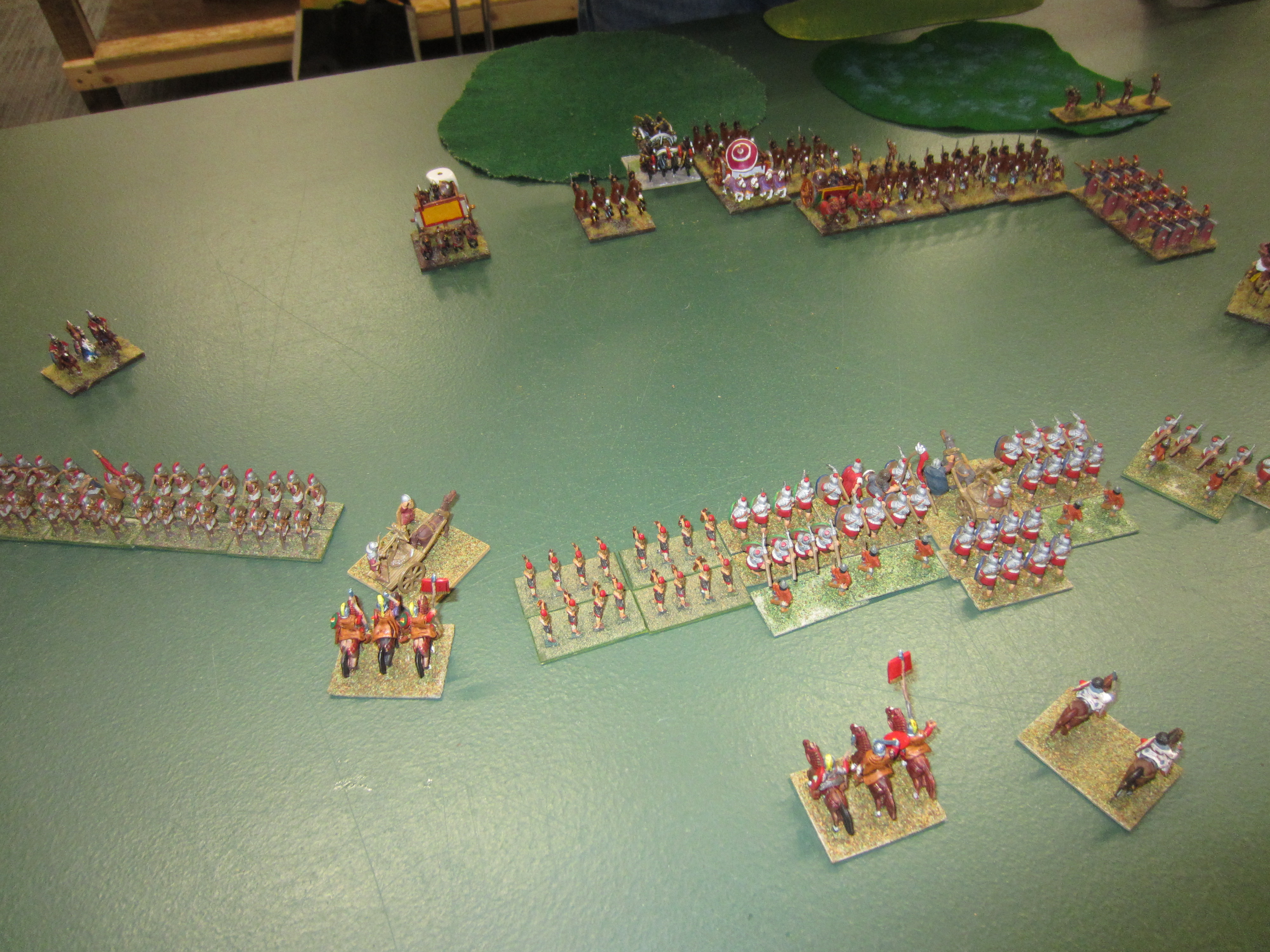
Roman artillery picking off Babylonian chariots and bowmen
Finally we met DBM maestro Jeremy Morgan with Timurids – more expendables (stampeding camels) and Inferior Hordes (terrified civilians), plus bombards and a couple of elephants. The Hordes formed a screen across the centre while the Timurid cavalry swept around our right flank – helped by excellent PIP scores while our first scores were three ones for the Roman commands. The bombards, eventually helped by bowmen, inflicted significant losses on our Auxilia holding rough going on the right, while our centre was seriously delayed by the need to get rid of the Hd(I) and our main mounted forces strove unsuccessfully to get to grips on the left. Jeremy spent many PIPs on manoeuvring to get the perfect matchups, but by the time he was ready and charged the game was nearly over. His attack was held (with loss, including an elephant) and the game ended at 5-5.
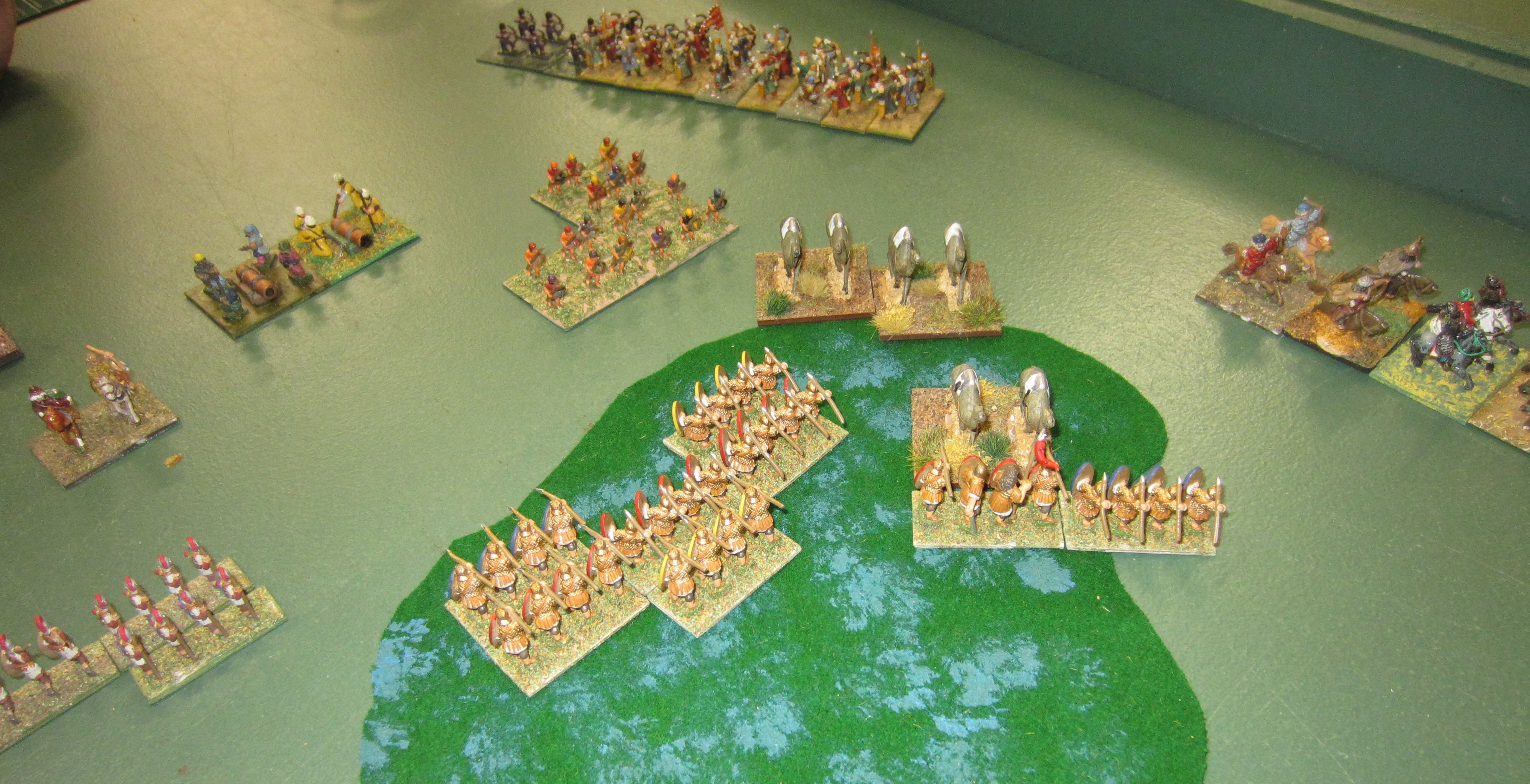
Stampeding camels attack Roman auxilia in rough going
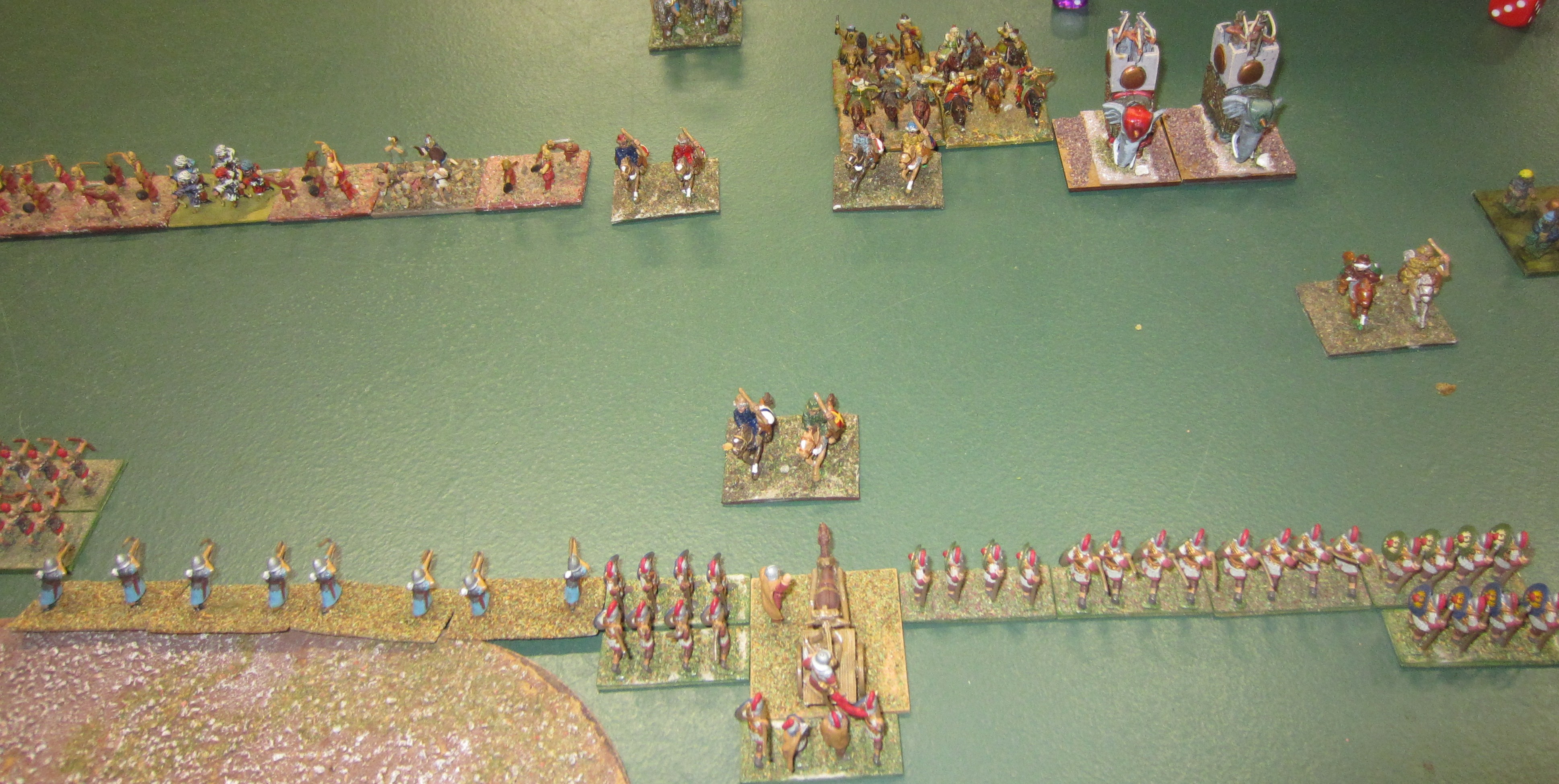
Timurid light horse shield the elephants from the threat of artillery
Not one of our better performances, but several of the games could have gone either way and we had a good time.
Westbury Wars 2026
For the 25mm competition held in my house I fielded a Hittite Empire army, newly painted. Two Hittite generals commanded large forces of spearmen (Exception Auxilia) backing up Ordinary Knight and Ordinary Cavalry chariots, with a Syrian ally-general leading Superior and Ordinary Cavalry chariots plus Fast Blades, Auxilia, psiloi and Hordes. A fairly large but lightweight army. As other players’ lists were revealed I had qualms as there didn’t look to be much I could beat!
The first game was against Paul Holmes with a Successor army. Lots of pikes and a large cavalry wing featuring Knights and Light Horse as well as Cavalry. I avoided the pikes and went for the cavalry, with mixed success – losses on both sides but no commands broken. The pikes never got into action, apart from chasing chariots, (Cv(O)) and the game timed out as a 5-5 draw.
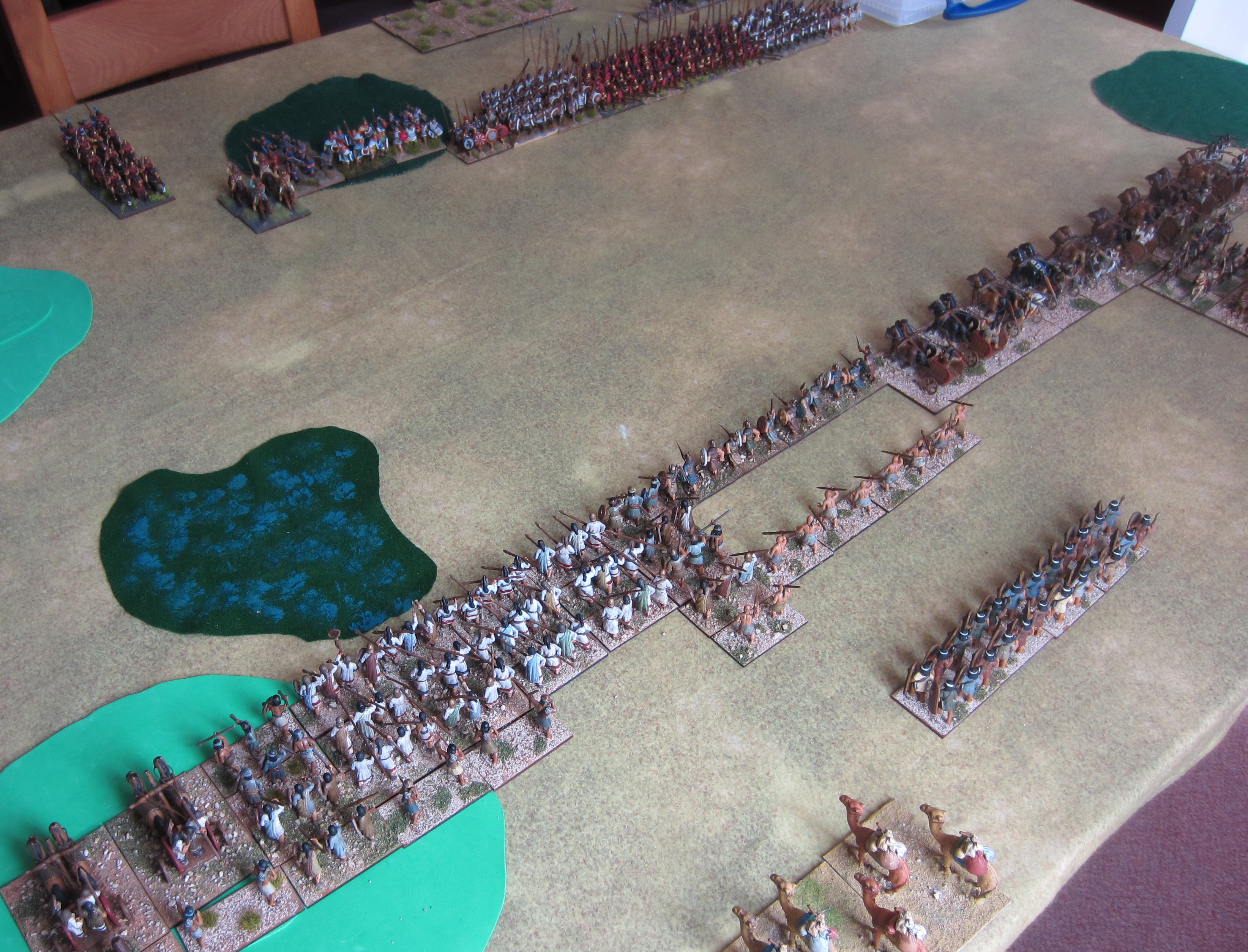
Next I faced a regular opponent with a familiar army – Derek Bruce with Marian Romans. The Romans fielded an elephant on one flank and a substantial Arab allied command, with camels, on the other. My allied command was initially unreliable and this allowed Derek to send cavalry around my flank while the Arabs went for my chariots. My ally was soon in trouble and his command broke; then my C-in-C’s command went too, mainly due to the camels, and my army collapsed for a quick 0-10 defeat.
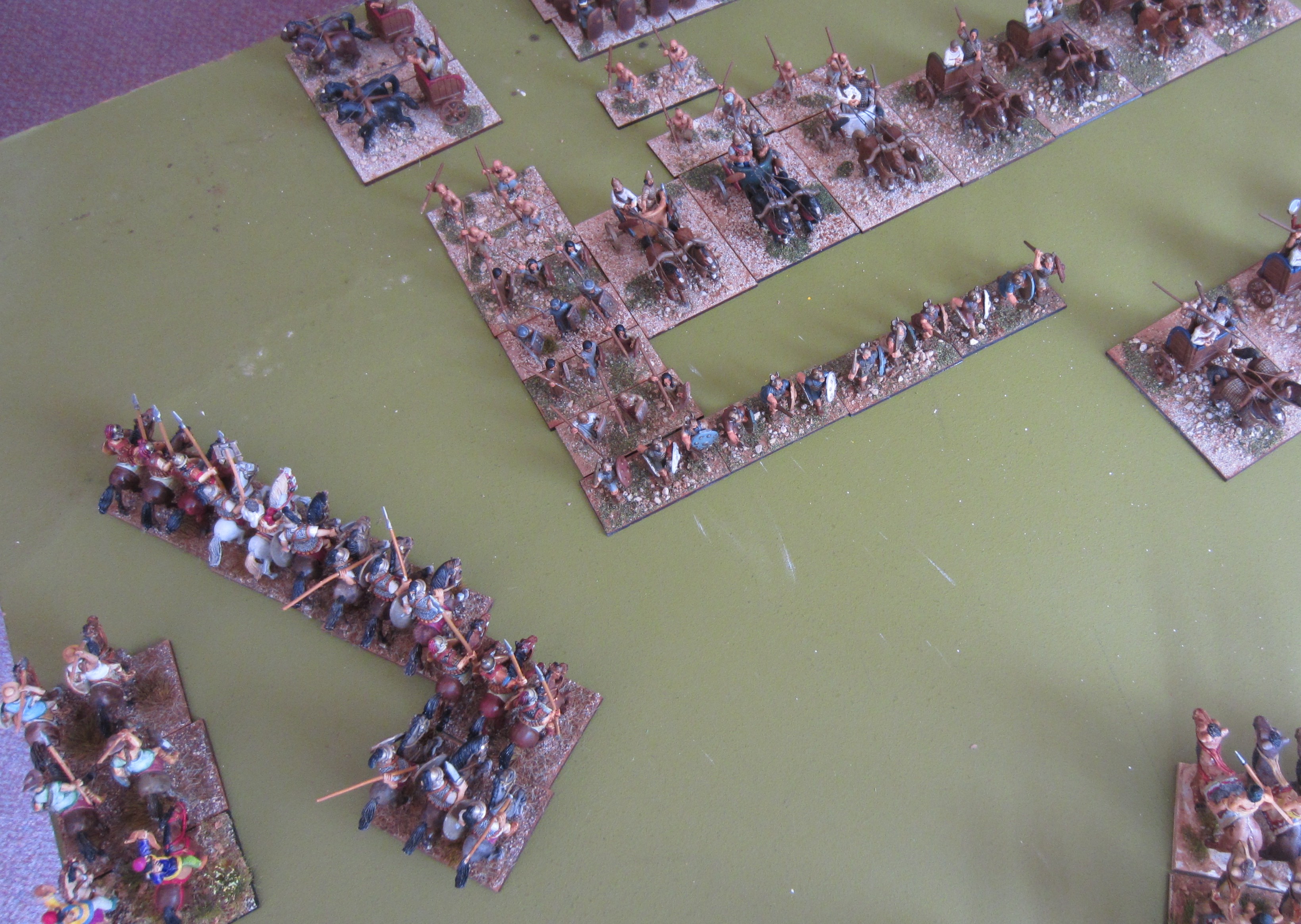
The Roman flanking move threatens the paralysed (unreliable) ally
The third game was against Duncan Thompson with Late Imperial Romans. At deployment I had an excellent defensive position with plenty of rough going for my 32 Auxilia elements and secure flanks… but rather than settle for a draw I attacked the enemy centre which was held mainly by cavalry. My right-flank command’s Kn(O) chariots were unfortunate, leaving their general isolated: he was only 2-3 down but the dice went against him. Only three elements lost from that command but it broke. Then my Cv(S) allied general had a similar experience, again, 2-3 down but the dice were 1–6. I fought on as best I could but casualties broke my army. I did break the Roman cavalry command just as my army went, for a 1-9 defeat.
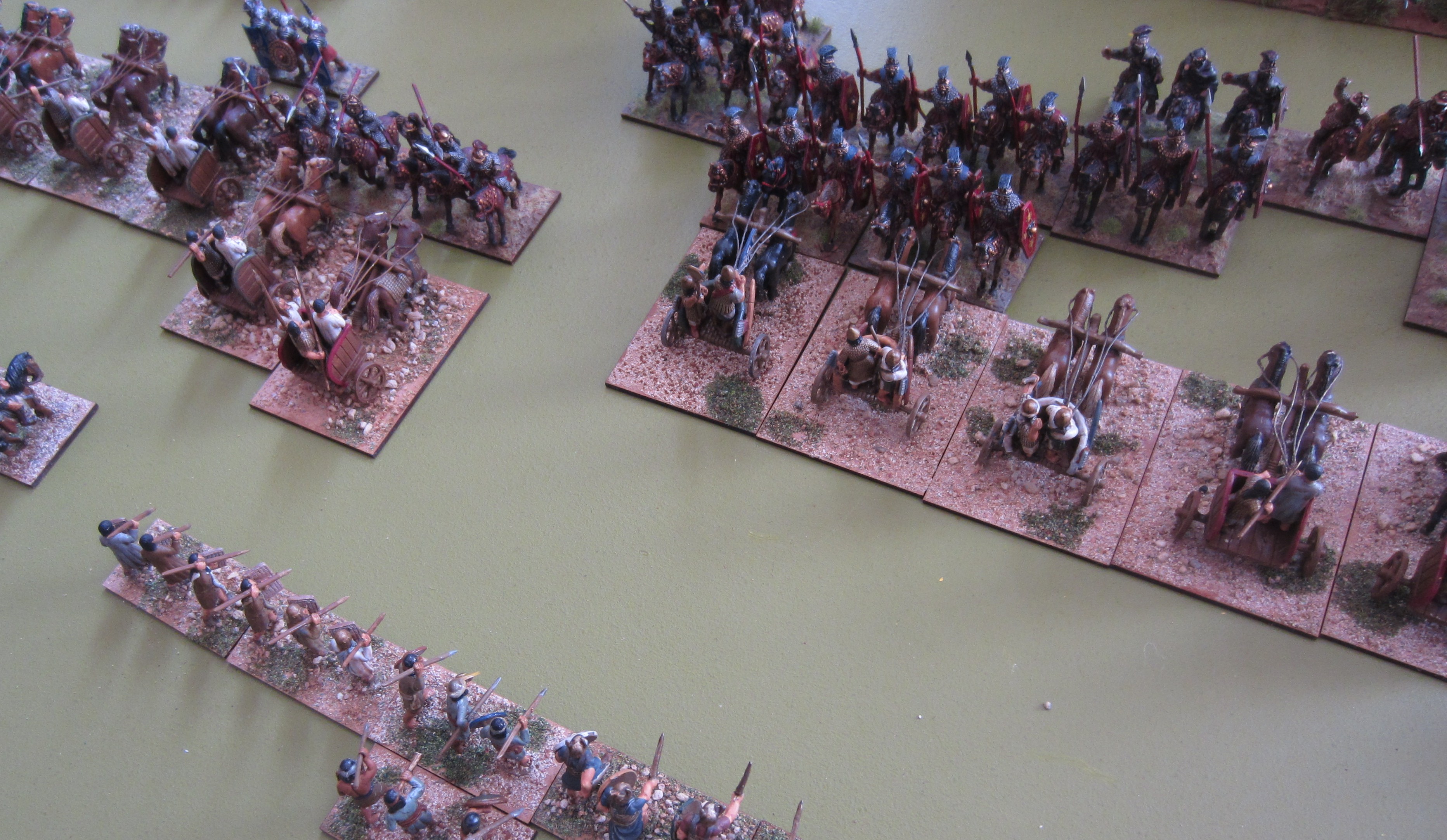
The central cavalry battle
Finally another difficult opponent in Pete Howland’s Wars of the Roses English. I feared the arrow-storm. But there was plenty of rough going and my Ax(X) spearmen, formed up four deep to allow for missile casualties, closed with only a few losses. The English C-in-C’s command lost six Bw(S) elements and broke, then the allied general, with a breakpoint of only four, also went. A 10-0 win to finish.
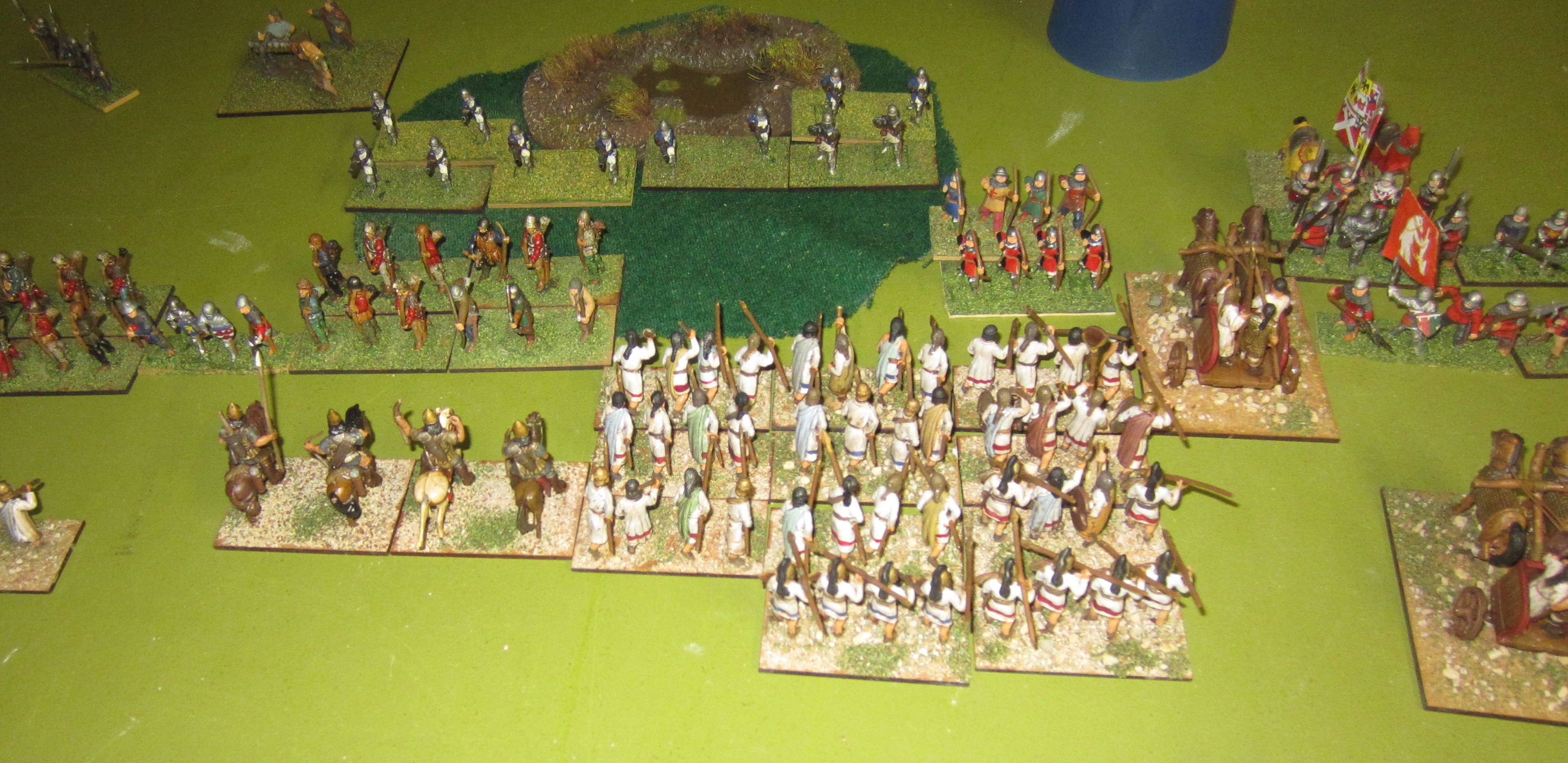
Hittite spearmen slaughtering longbowmen
The Hittite army, though large, is fragile against the sorts of armies usually found in 25mm competitions so I might not use it again.
Venta Silurum 2026
Blazing sunshine in the Vale of Glamorgan for the first doubles competition of the year. The theme was “Armies and enemies of Ancient Egypt, 2000-335 BC”. Russ and I took Middle Assyrians – Cv(S) chariots, Blades and Auxilia with psiloi support, a few light horse, a few not very good archers and a small Later Aramaean allied command.
In the first game we faced the formidable Dave Madigan and Chris Smith who commanded Later Sargonid Assyrians – a relatively small army but with excellent troops, notably Superior Knight heavy chariots and large numbers of Superior Cavalry. Four Regular commands, one of them consisting of just a Cv(S) general. We invaded and placed a road and steep hills – which all landed on the enemy side of the table. A strong wind blew up the table, handicapping the enemy bowmen.
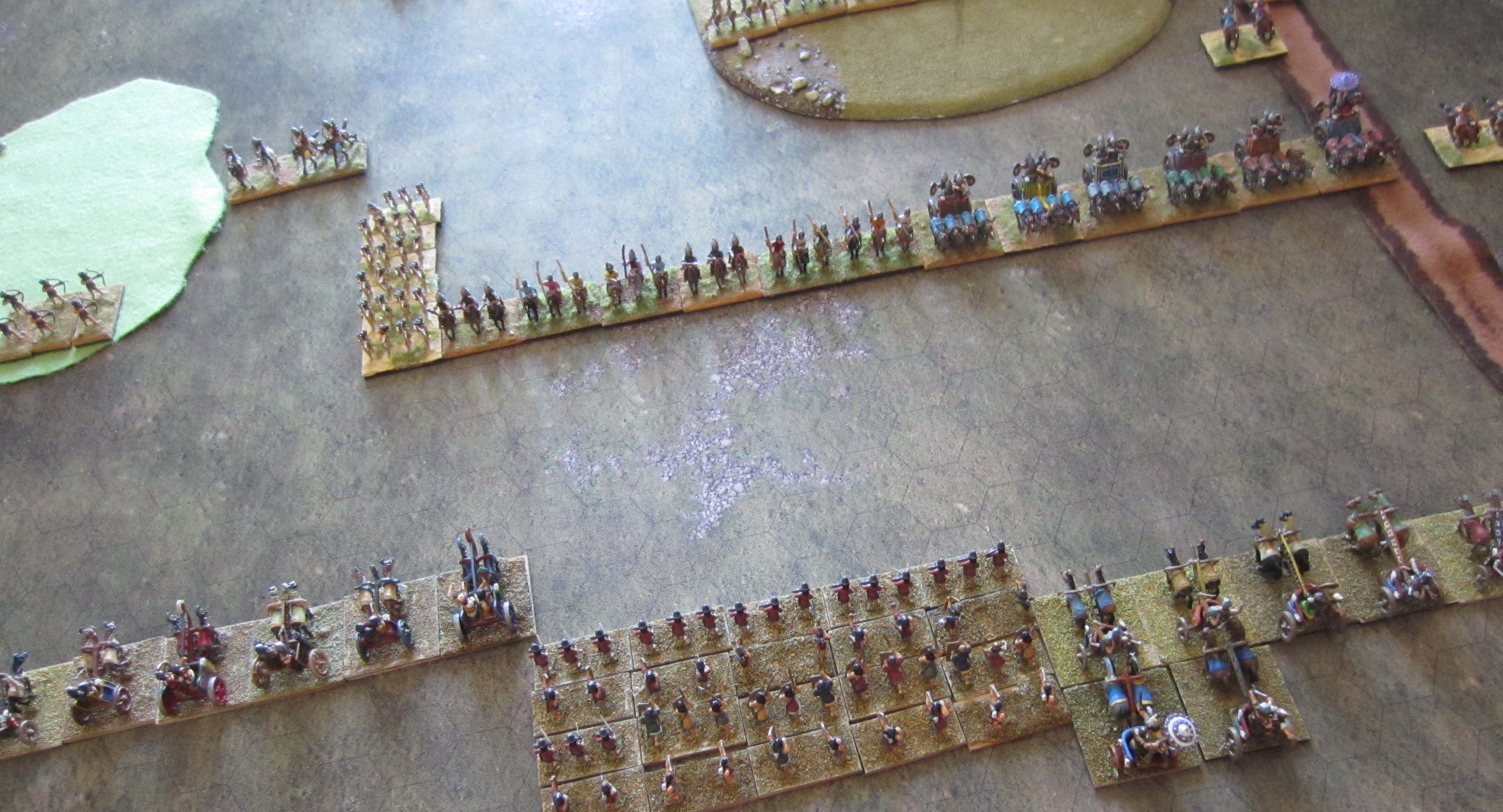
The formidable Sargonid heavy chariots are at top right
Being caught in the open but deploying second (and thus able to pick the matchups), we attacked all out. On our far right a strong force of Cv(S) went for our small allied command (break point 3) which amazingly beat off the attackers with loss. In the centre our supported Blades and chariots faced the weight of the enemy – more Cv(S) and the Kn(S) chariots. Heavy losses on both sides, but our chariots managed to ride down Sargonid Bw(O) archers and our Auxilia caught enemy Auxilia who were trying to outflank the chariots. The enemy C-in-C’s command broke. Then our C-in-C’s battered command broke too – but accumulated losses reached half the Sargonid army so we won 8-2. An excellent tense game with plenty of fighting.
Next we played Pete Connew and Richard Newland, who’d won their first game 10-0, with New Kingdom Egyptians. This time we lost the setup dice and had to defend, placing rough going which deterred the enemy on our far left. The enemy’s strike force was opposite our left and consisted of their barbarian mercenaries, Fast Warband and Fast Blades. They went for our chariots and supported Blades but were destroyed for only small loss to our lads. On the right it was a different story as the Egyptian chariots and Regular infantry massacred our allied command and damaged our C-in-C’s command too. With what turned out to be the last shot of the game Egyptian archers destroyed another chariot to break the C-in-C, then in the close combat two more Egyptian Bw(O) died and that broke their army. 7-3 to us, and another thrilling close game.
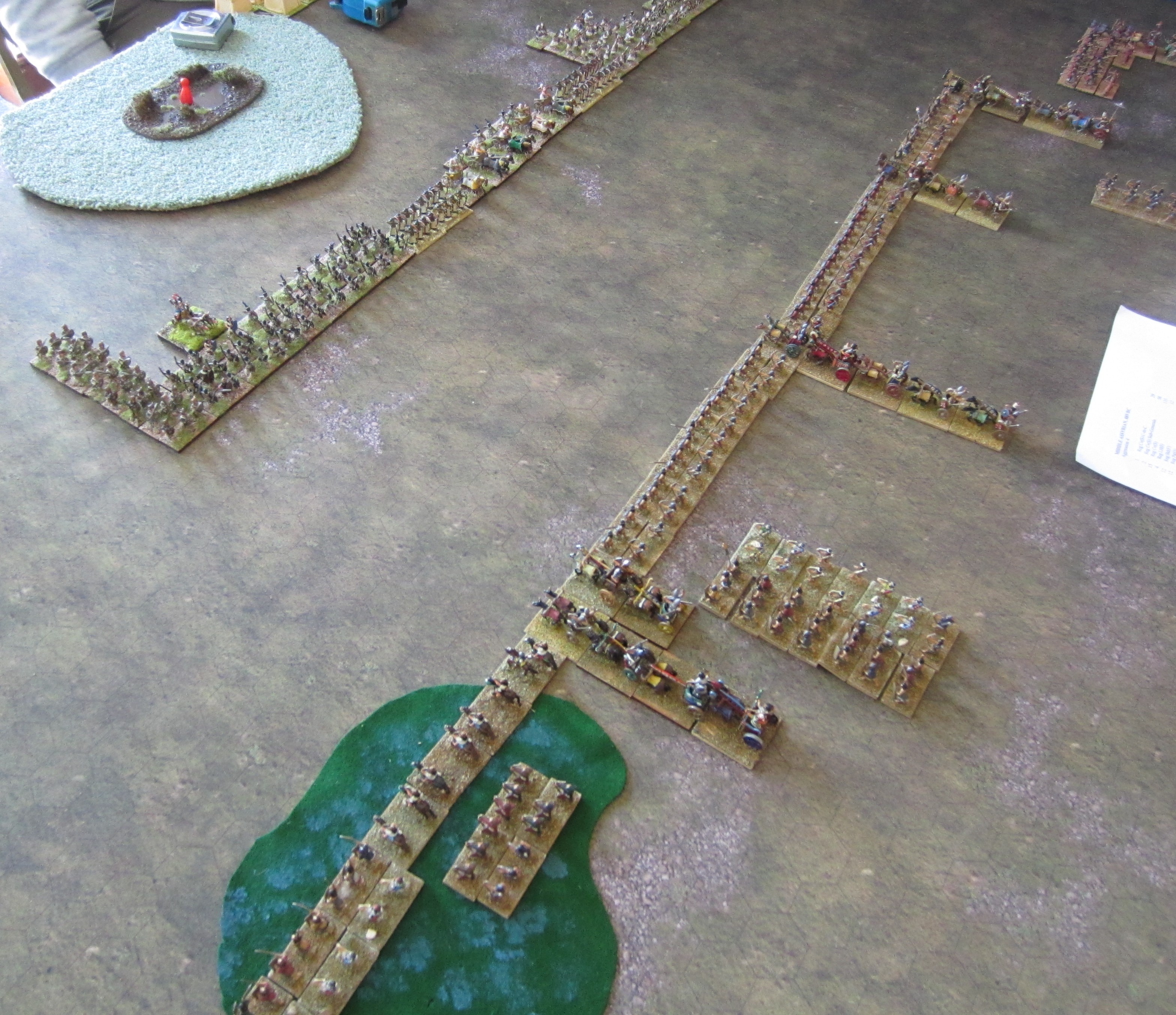
Our swordsmen face the wild warband
Our third game was against Later Achaemenid Persians led by Nick Coles and Jimmy Walton. We invaded and placed some areas of rough going, some of which were helpful. In the centre our Bd(F) swordsmen were faced with a large force of Greek hoplites, plus four scythed chariots. The chariots were initially deterred by the few bowmen deployed facing them, but eventually charged; two were shot down, one contacted bowmen and died, the other destroyed a Bd(F) element and was then destroyed by the second line. However, the hoplites advanced to attack our swordsmen and slew several; some hoplites went down but they and their accompanying auxilia broke one of our large commands. Our allied command on the left had auxilia sheltering in rough going with the mounted troops behind it, and looked reasonably safe.
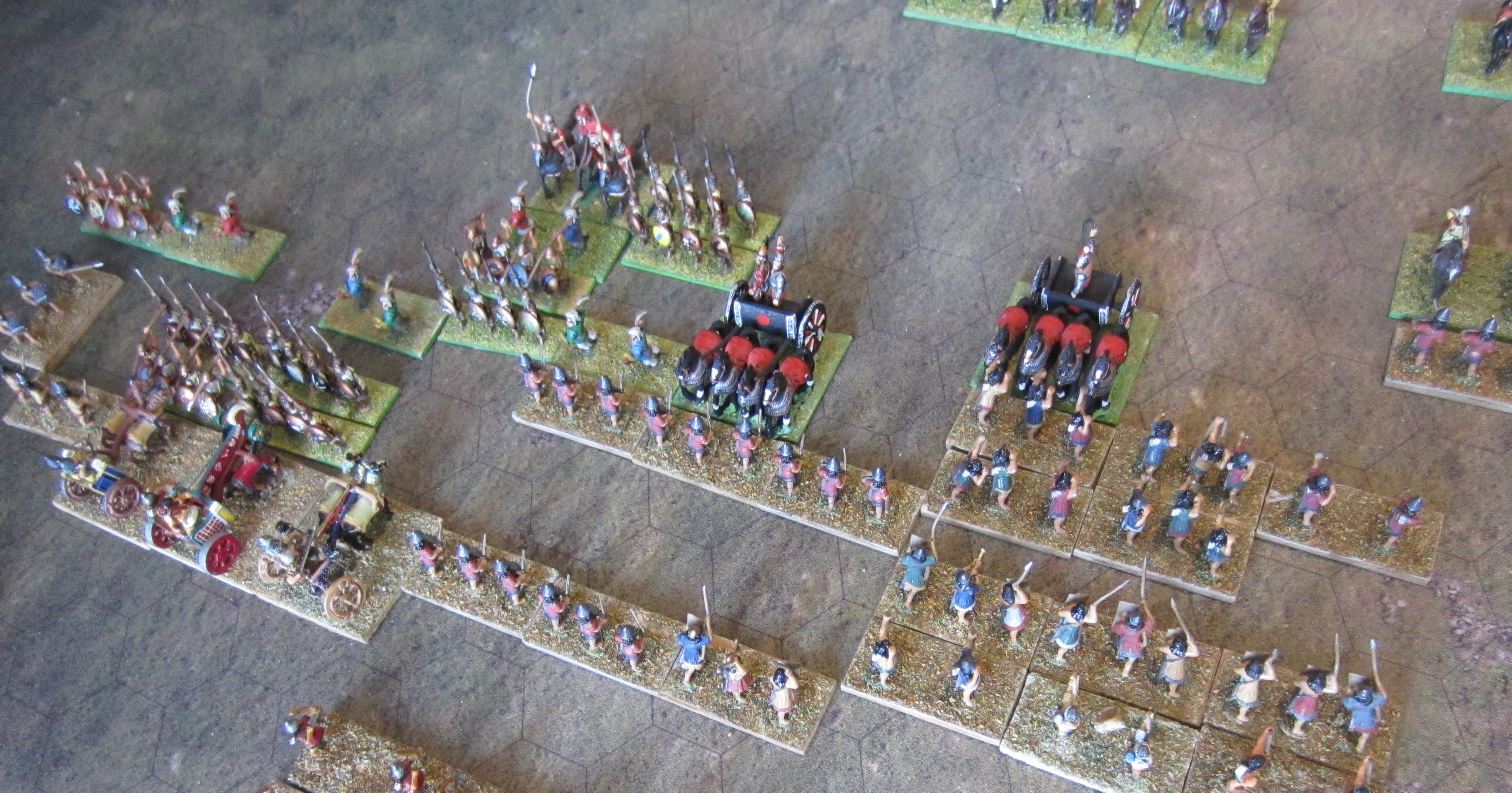
The last hurrah of the scythed chariots
On the right a mixed force of Persian cavalry, auxilia and Inferior Knights attacked our chariots, auxilia and bowmen. A tough struggle ensued with heavy losses on both sides, but we had superior numbers, the Kn(I) proved ineffective and the enemy C-in-C’s command broke. The game ended at 6-4 to us – the third excellent hard-fought game of the weekend.
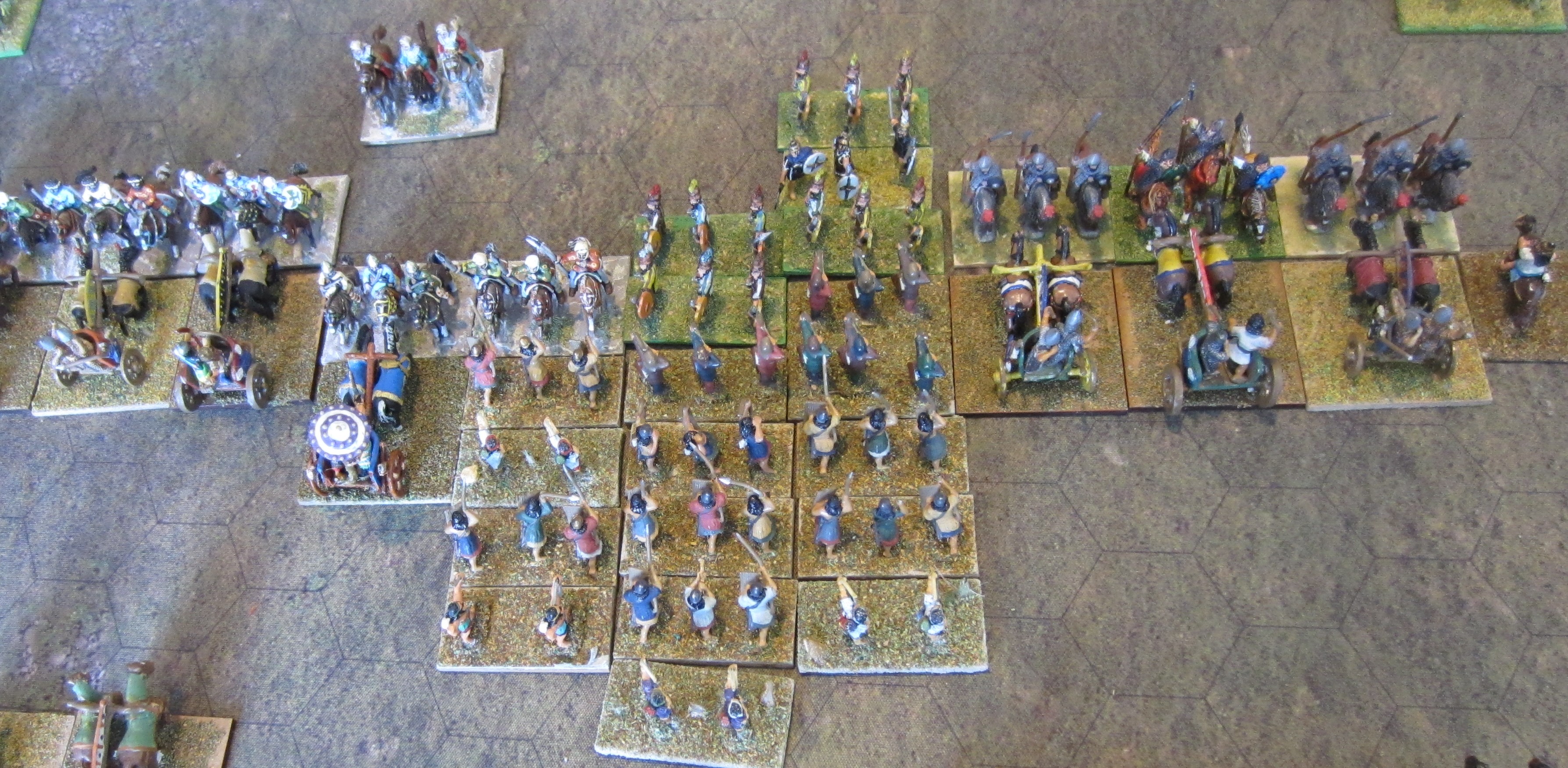
Bitter struggle on our right
Finally we played the redoubtable Jeremy Morgan who had Early Achaemenid Persians. We refused our left, anchoring it on a patch of rough going filled with auxilia and psiloi; on the right the Persians held a larger area of rough going with many bowmen and a few auxilia. A Skythian allied command held the centre; it was unreliable but soon came on line. Our main infantry force faced the Skythians but manoeuvred towards the left where a large number of Sparabara archers threatened. The Sparabara, with accompanying cavalry, moved round our left flank and proceeded to shoot our light infantry with considerable success – we were reduced to moving our troops back as much as possible to get out of range.
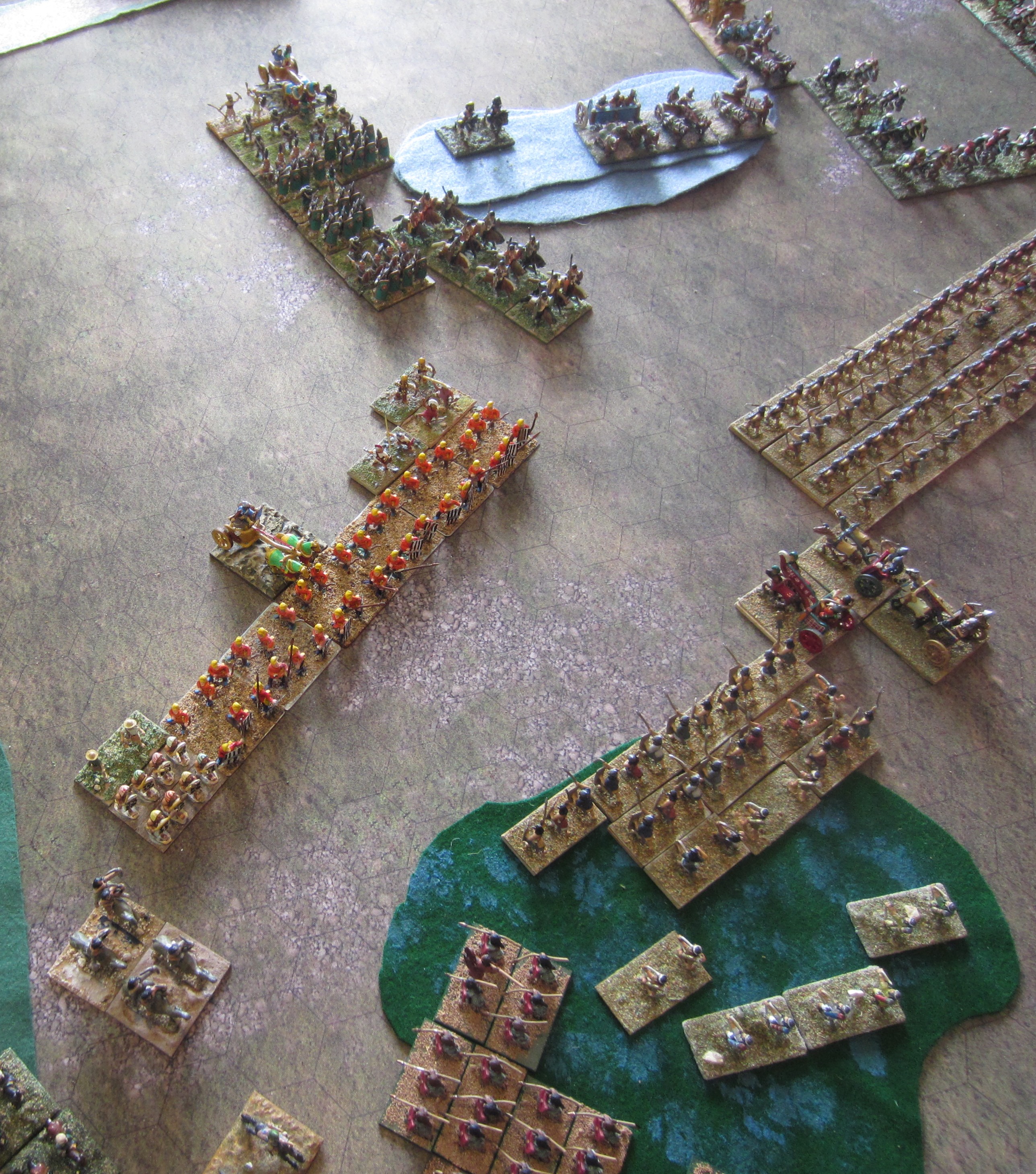
The Sparabara commence shooting down our auxilia
The Skythians in the centre did nothing except retreat when pursued by our chariots. Jeremy assembled a force of Babylonian Kn(O) chariots and Persian cavalry to attack our swordsmen and supporting psiloi, but ran out of time to get their charge in. On the right our auxilia and bowmen attacked into the rough going. Losses on both sides, but no command was seriously in danger. Despite heavy casualties the game timed out as a 5-5 draw.
26 points got us second place and a trophy each – figures splendidly painted by Jimmy Walton.
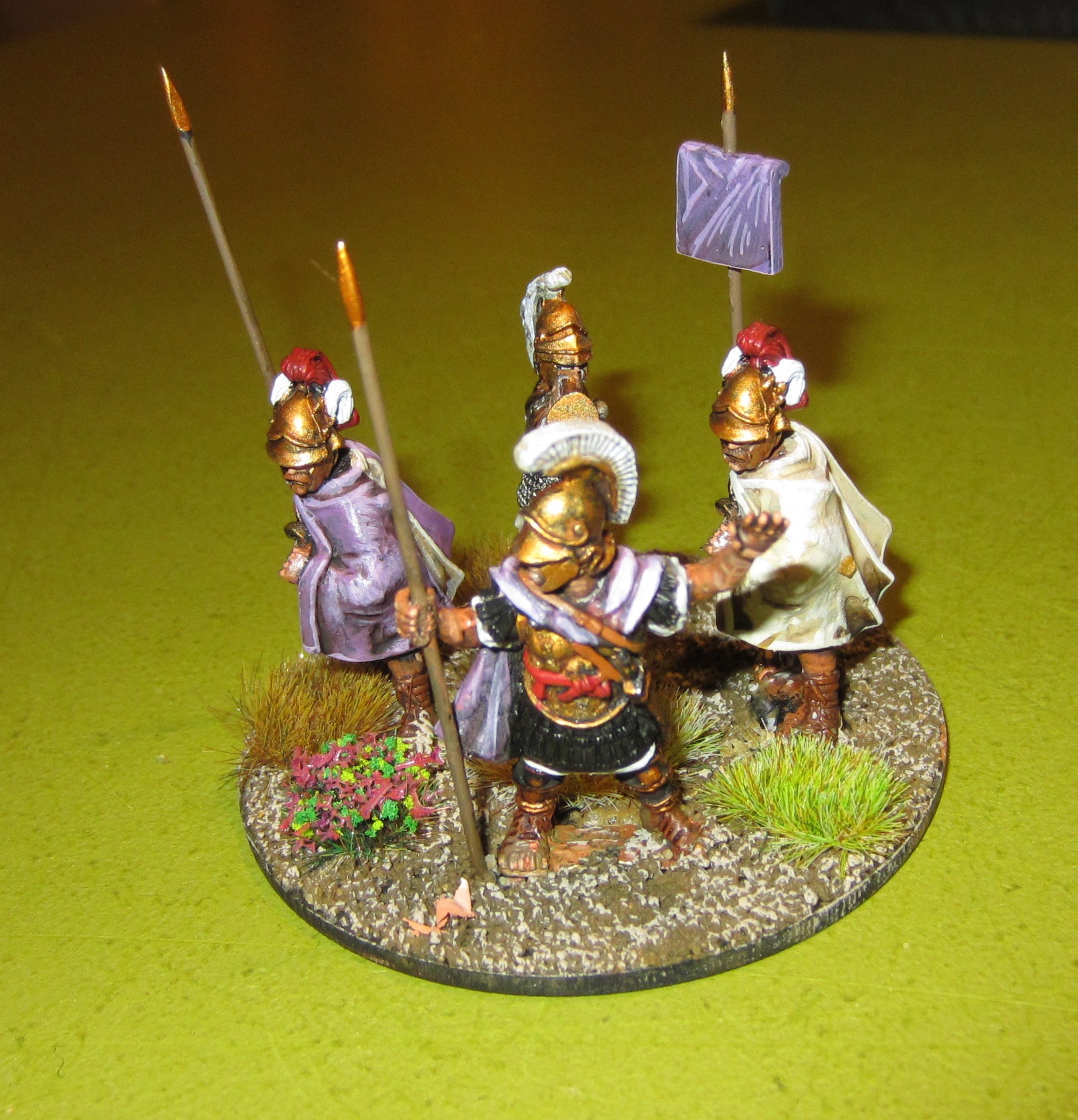
Classical Indians v Seleucids
Another big 25mm game: the dice decided that Russ King and I commanded the Indians against John Calvert and Duncan Thompson with Seleucids. We defended, and placed steep hills despite having no light troops; one hill on our right was useful as it obstructed an enemy flanking move by cavalry, and another on our left was a nuisance as it constricted our Superior Cavalry chariots. We had four commands, including an internal ally, while the Seleucids had only three – two with massed pikes and the other with mounted troops and elephants. The Indians had three commands with Superior Elephants – eleven altogether – and one on the left flank with Cv(S) chariots. Each command had bows, blades and hordes.
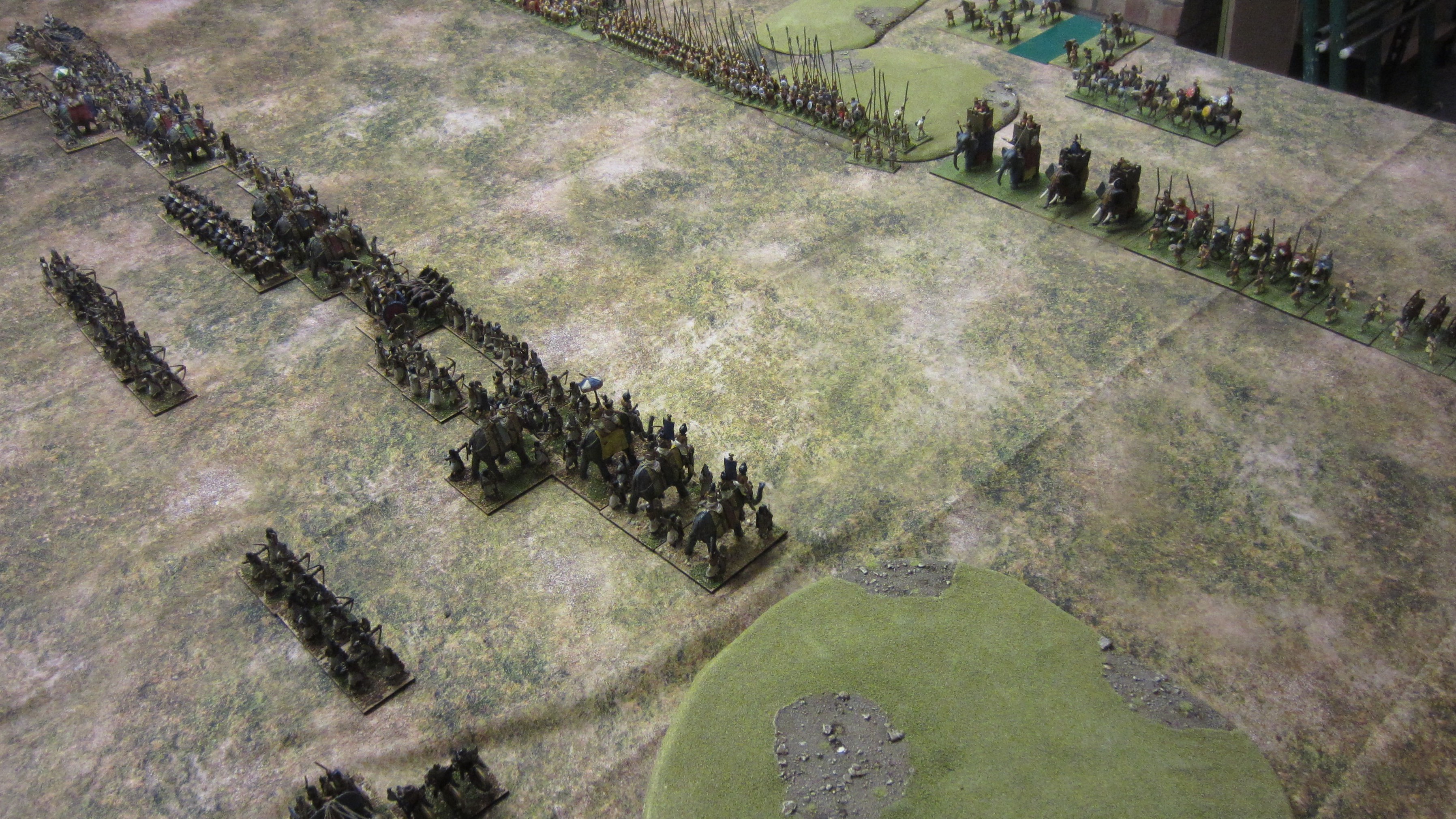
The battle lines are drawn
On the right our allied command faced the enemy mounted force. A thrilling elephant v elephant clash went the Seleucids’ way, with assistance from their numerous psiloi, and after a tough struggle our small allied command broke. In the centre the Seleucid bolt-shooters potted two elephants but their pike phalanx, thinned out in places to cover the field, failed to defeat Indian blades and elephants.
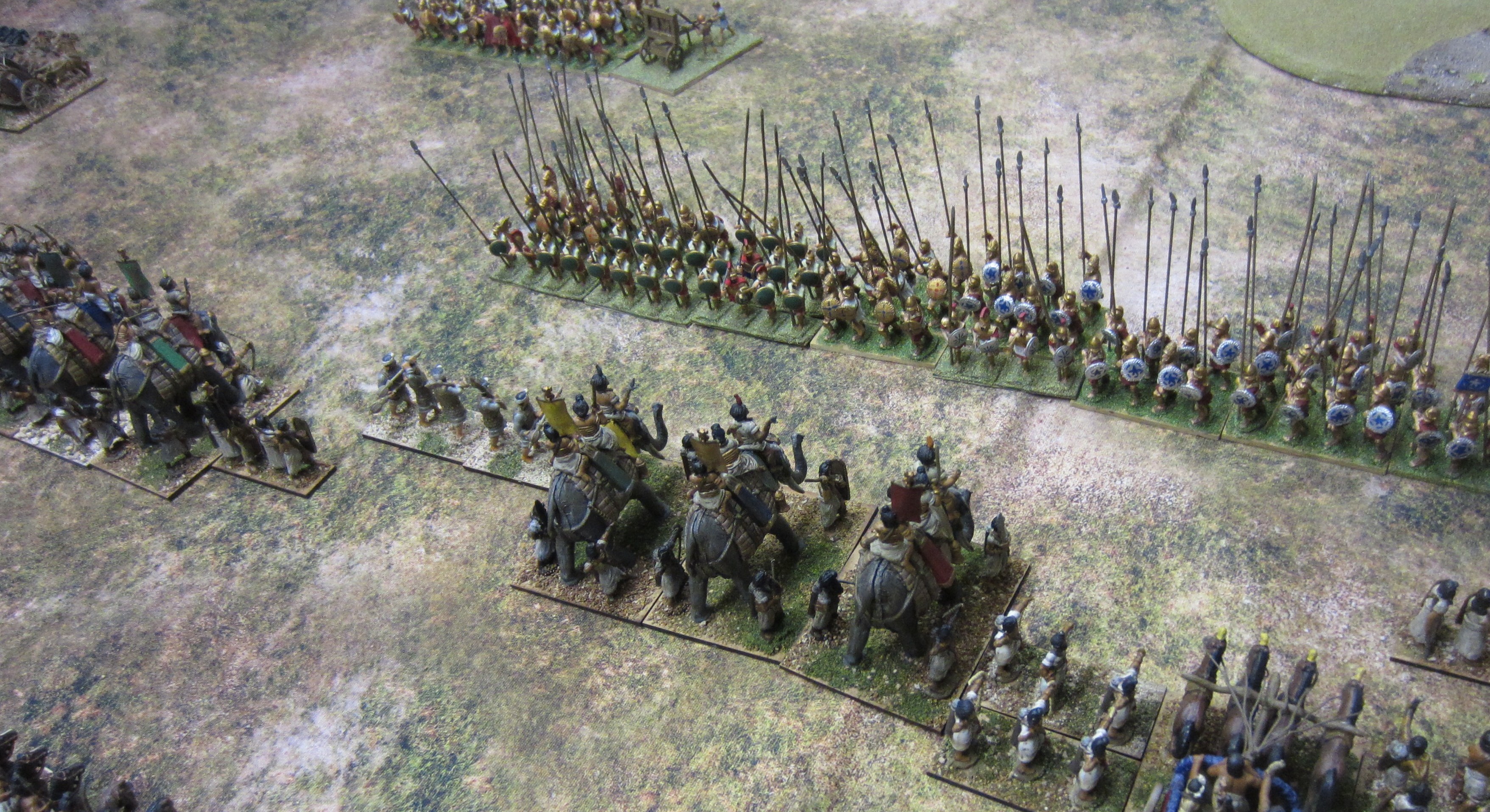
The central clash
The decisive clash came on the left. Indian chariots killed some auxilia then managed to flank and destroy the Seleucid C-in-C, whose command broke. This allowed elephants to attack the flank of the central pike block, assisting the blades to break that command and win the game 9-1.
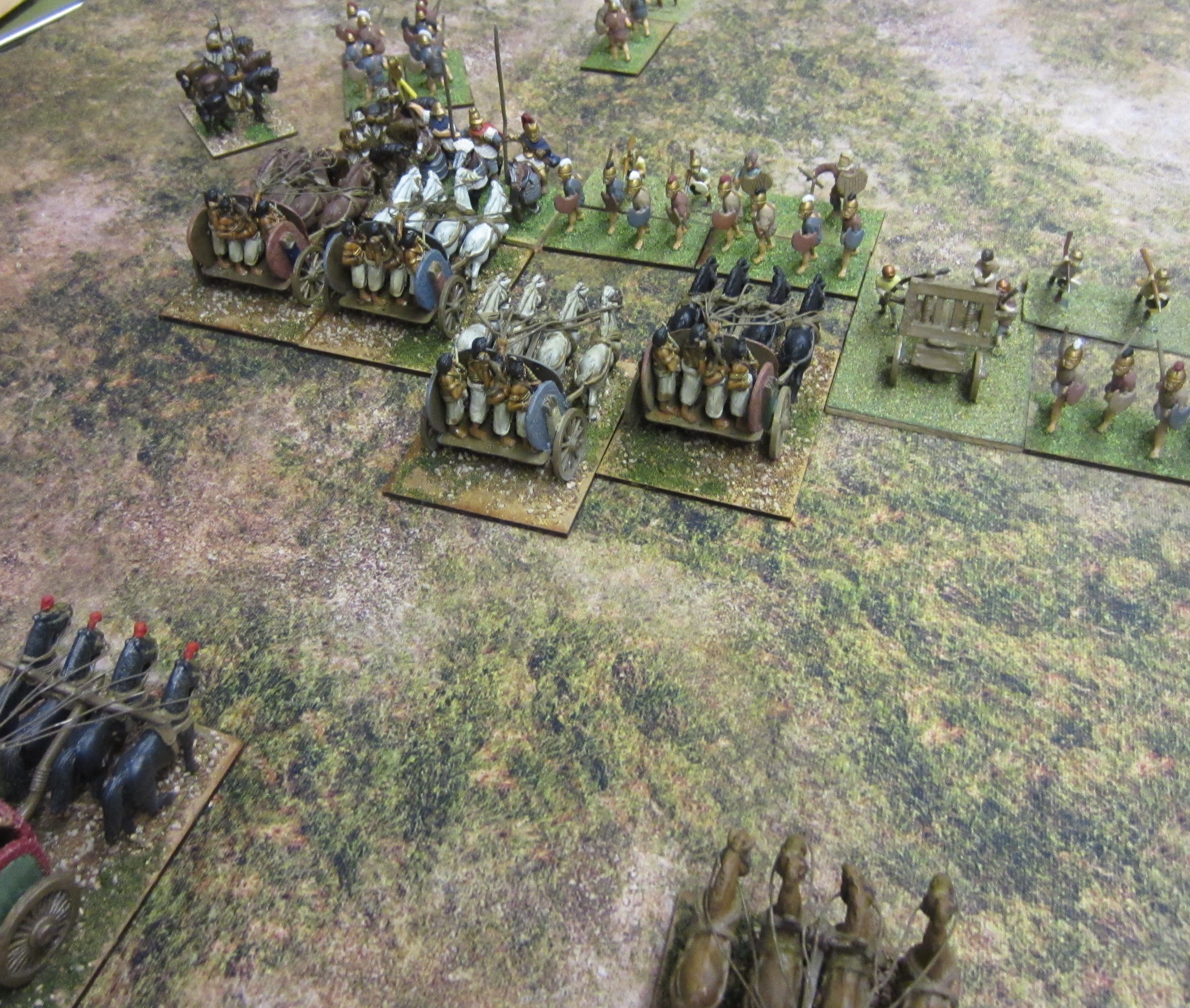
The Seleucid C-in-C is in trouble…
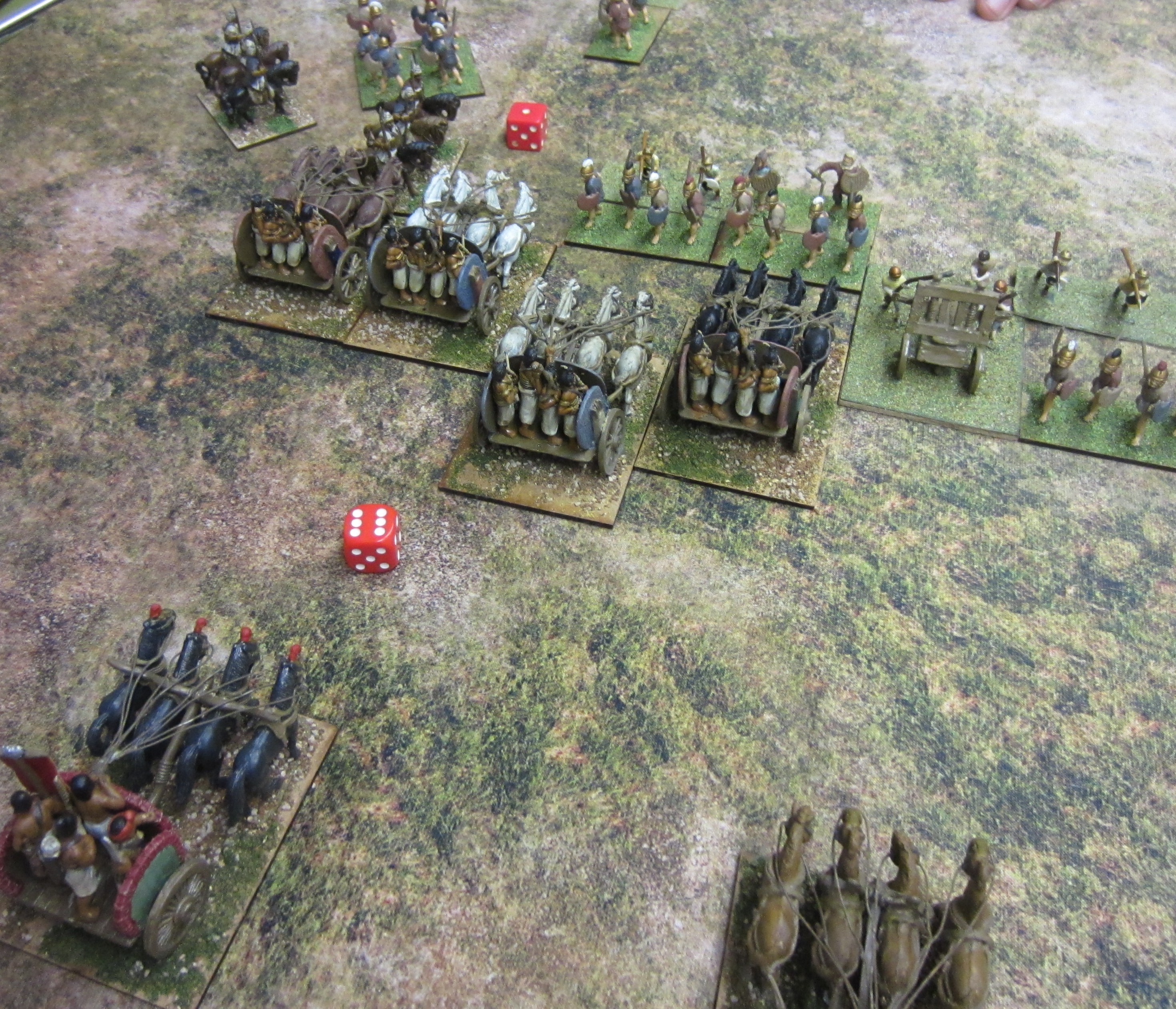
…and the dice went against him
Another terrific game.
Teutonic Orders versus Estonians
Two more big DBM battles (500 Army Points on an 8’ x 5’ table), two players each side, saw the Teutonic Orders attempting to conquer Estonia. The Teutons had three commands each with knights, mostly Superior, and crossbowmen, some with small numbers of spearmen, skirmishers and Hordes, plus a German City ally with more knights and mediocre infantry. The Estonians had large numbers of warband, some Superior but mostly Fast, plus bowmen, a few skirmishers and one heavy stone-thrower (Superior Artillery). The fourth Estonian command was a Russian ally, featuring Alexander Nevsky of Novgorod with a force of Fast Knights backed by spearmen and psiloi.
On paper the Teutonics should win easily, Fast Warband being very vulnerable to knights. But it didn’t turn out like that.
In the first game the defending Estonians were favoured by the terrain, which included large areas of rough going where their warband could get at it. Their left flank was held by log barricades lined with archers, with the Russians on the far left. The right flank was a stand-off as a large warband command occupied rough going where the German ally couldn’t get at it.
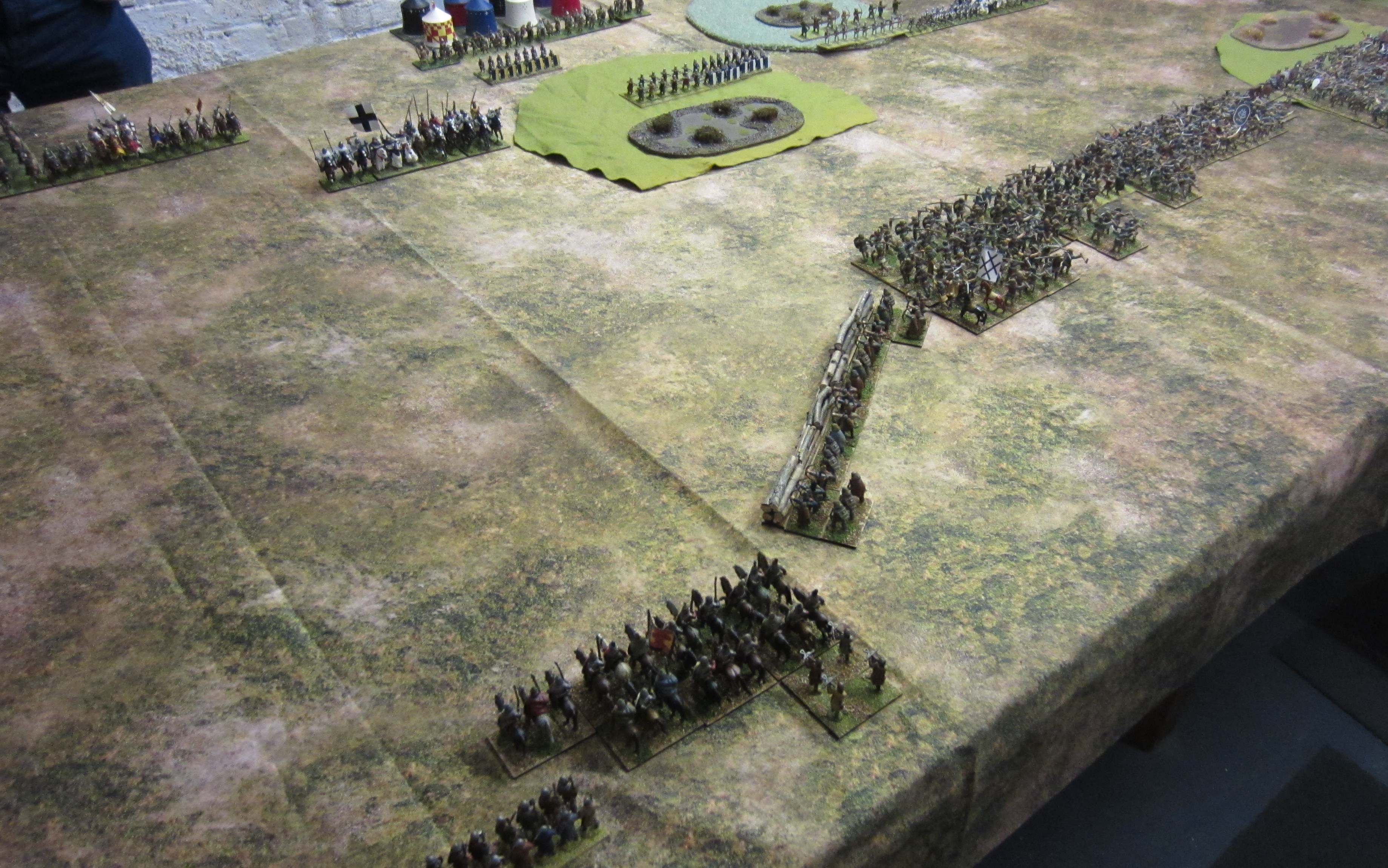
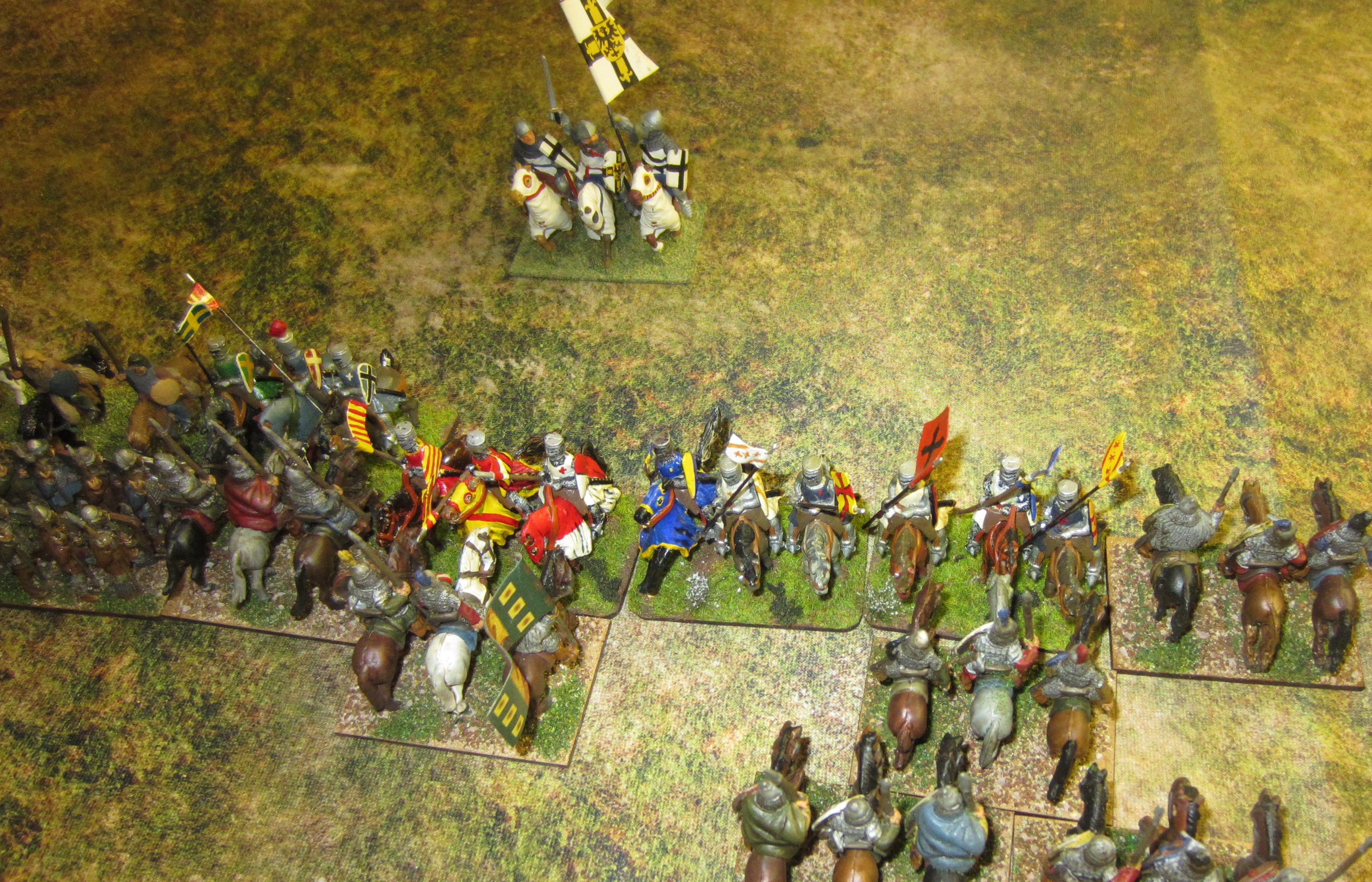
In the centre a vast horde of warband charged into rough going to attack numerous crossbowmen; several warband elements were shot down but the rest eventually massacred the crossbowmen. On the far left the Russians clashed with better-quality knights and managed to defeat them; with the destruction of the crossbowmen this broke two commands and the Teutonic army. 10-0 to the Estonians.
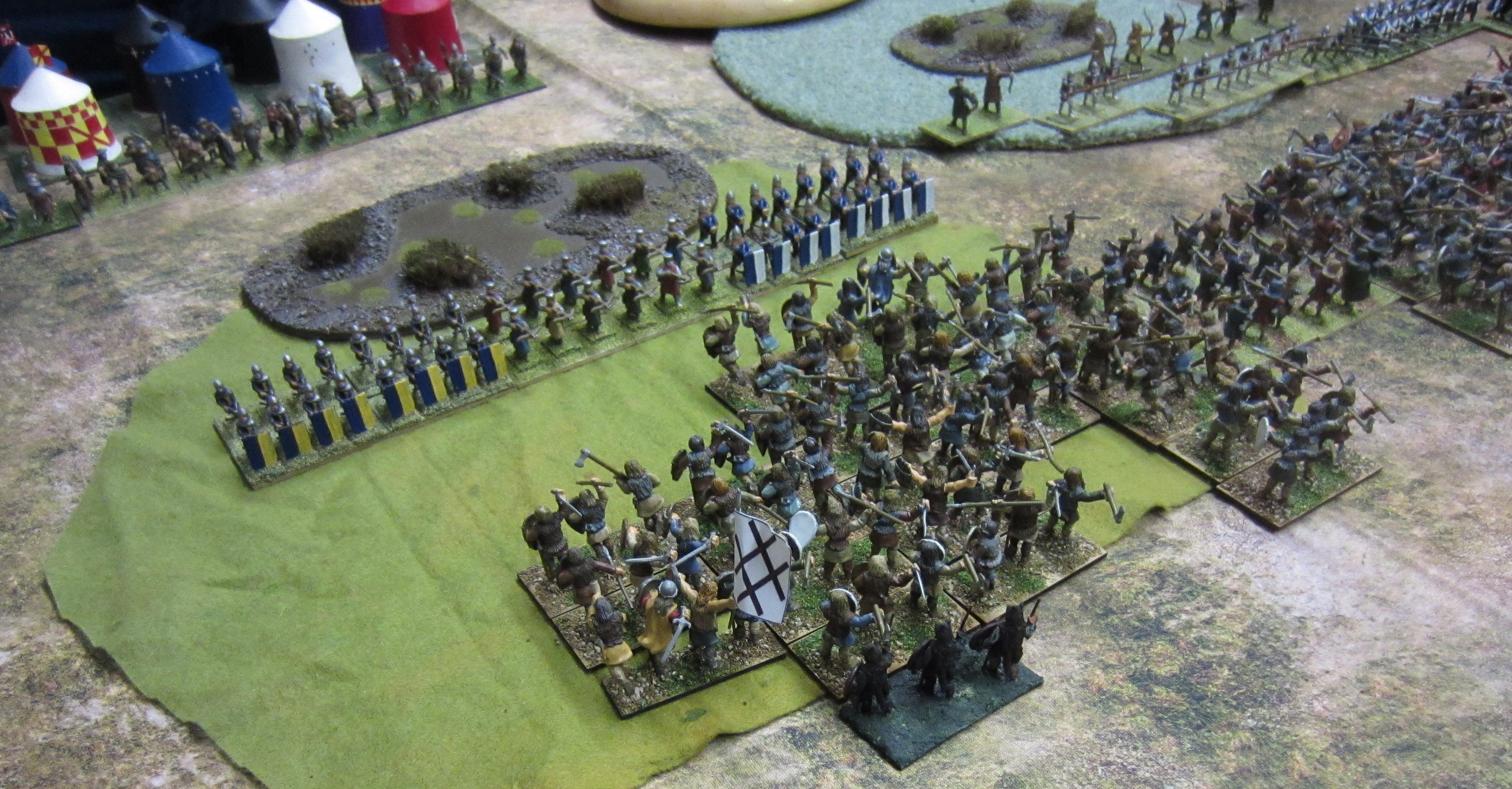
Then the players changed sides and played again. This time the Estonians invaded and the terrain was much less helpful for them; the warband would have to face knights in the open. The Russians were on the far right and defeated the German ally but then broke themselves, while in the centre the elite warband bravely took on Superior Knights – and mostly survived.
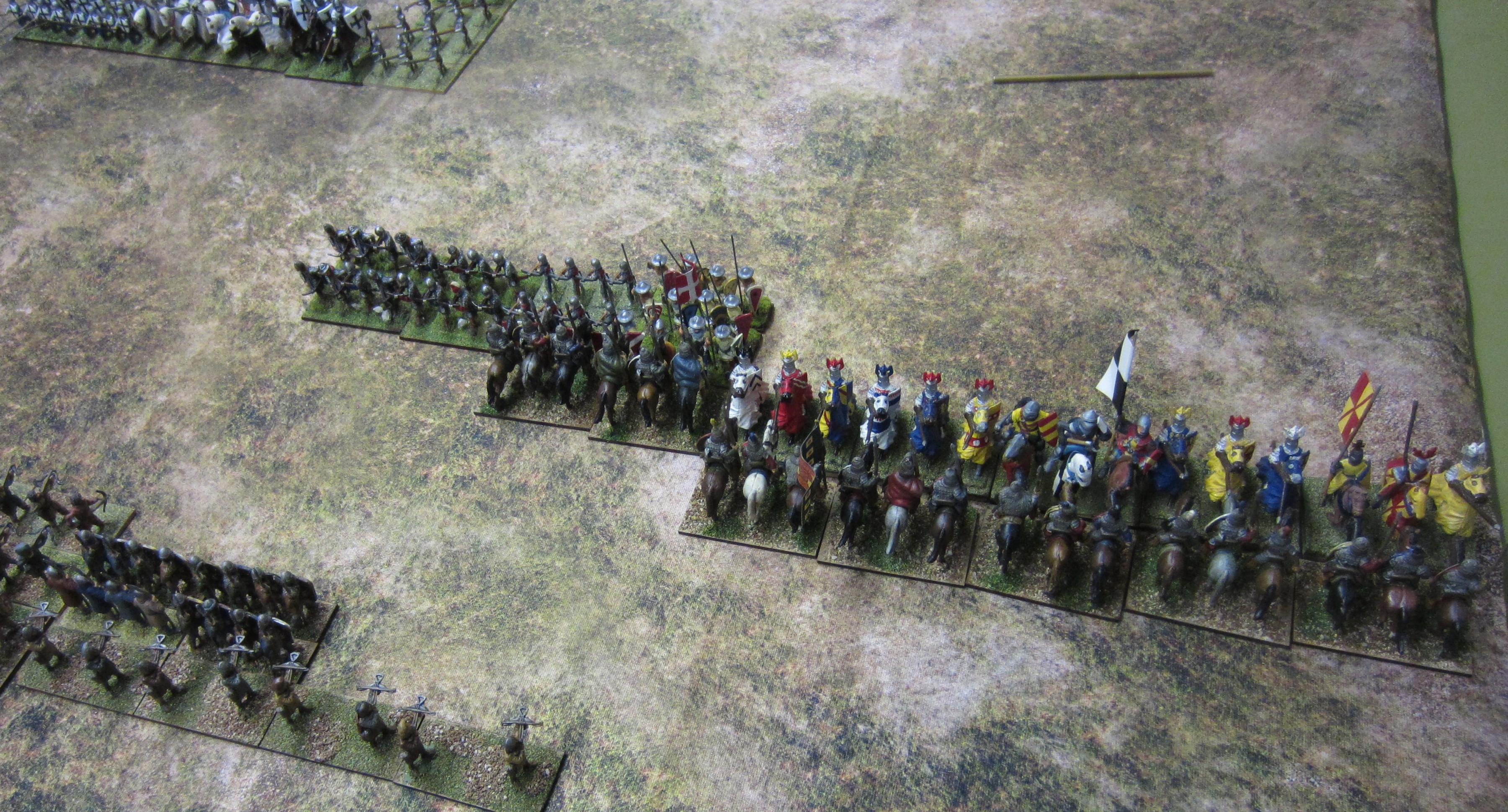
They also slew the Teutonic spearmen. One Estonian command broke, following the death of its general, but then so did a small Teutonic command. Accumulated casualties made exactly half the Teutonic army; the Estonian army was just half an element from breaking too. 8-2 to the Estonians.
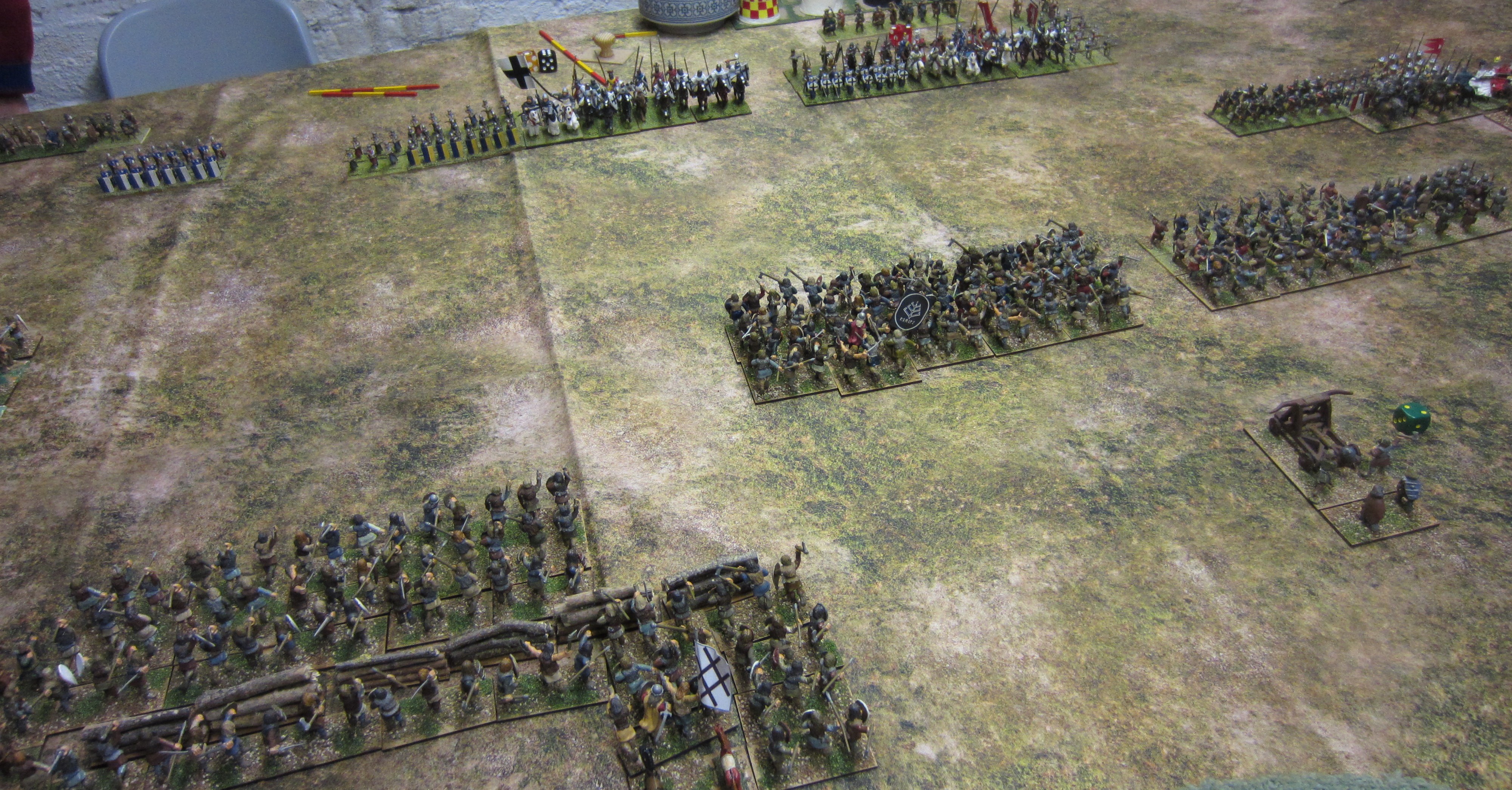
A great day’s gaming, enjoyed by all.
A Thousand Years Ago
The 24th in my series of themed DBM competitions was played at Frome on 7/8 February. The theme was ”A Thousand Years Ago”, with 18 armies from Europe and the Near East all dated 1026 AD.

The winner was John Brooker, whose West Frankish army won all four of its games, beating Italian Lombards, Bretons, Bohemians and Early Serbians. The tight theme meant that there was a marked absence of exotica such as pike phalanxes, elephants, longbowmen and disciplined troops (except for the Byzantine and Fatimid Egyptian armies which did have some regulars). Fast Knights dominated, but there were plenty of heavy infantry (a clash in which Scottish “Thegns”, as Superior Warband, crashed through a mass of Russian spearmen was particularly memorable) and there were some armies with lots of light horse. Early Hungarians met Dynastic Bedouin in the last round, with around a hundred light horse on the table.


Next year’s competition will be entitled “Bajazet Yilderim”, featuring armies of the Ottomans and their enemies, 1360-1403 AD.